
Want to visit both Kenya and Tanzania but only have 7 days to allocate and wonder whether you have enough time to enjoy both?
You’ll be pleased to know that being right beside one another, a combined 7-day Tanzania and Kenya safari is doable with a bit of planning and allows you to see the best that both nations have to offer.
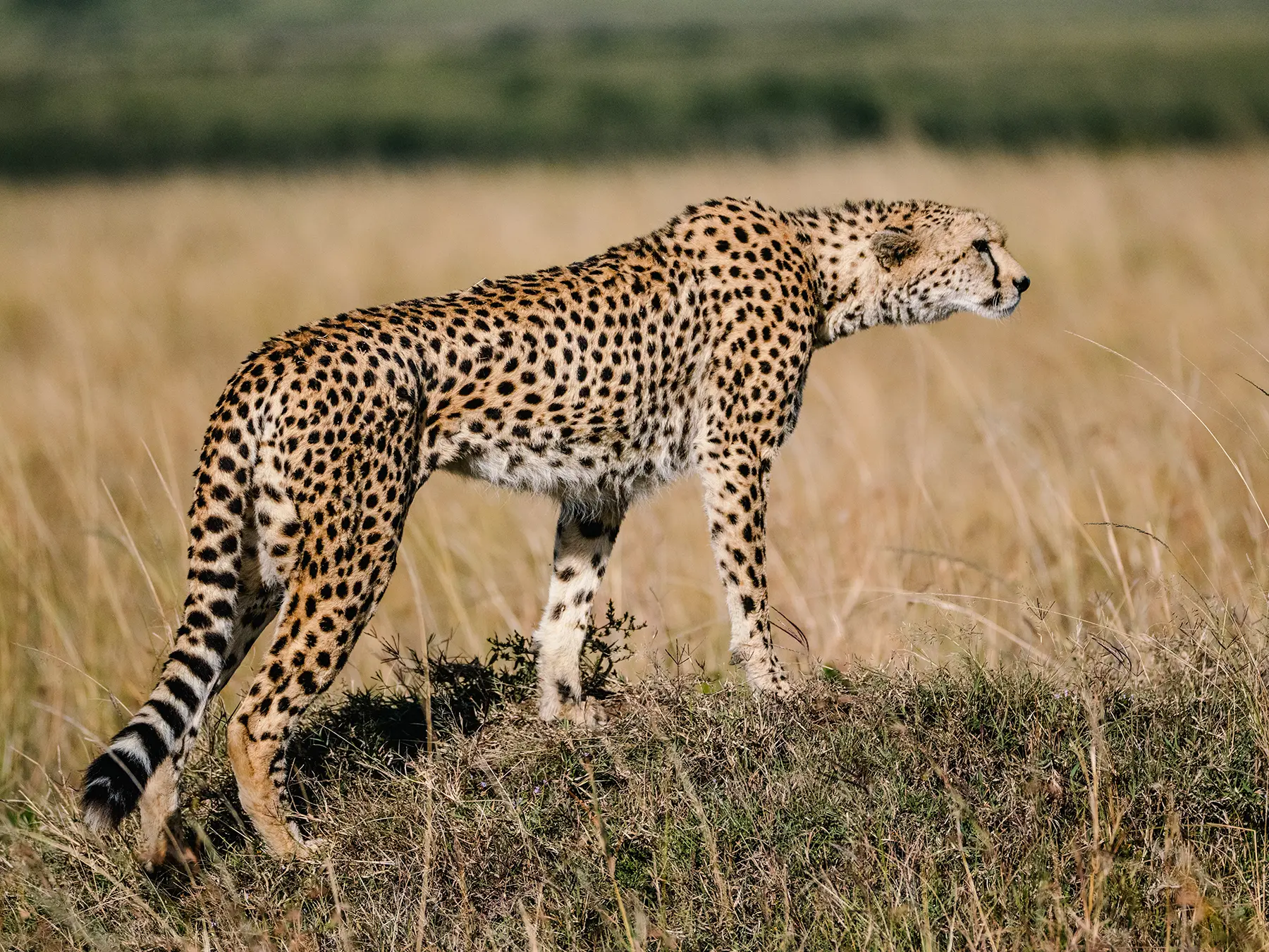
This 7-day itinerary focuses on the world-class Maasai Mara National Reserve in Kenya which is famous for its fantastic predator sightings, and the legendary Serengeti National Park, a sprawling Eden that houses the second largest terrestrial mammal migration, the Great Wildebeest Migration.
Both the Serengeti and Maasai Mara form part of the same extensive ecosystem but fall into different countries, the Maasai Mara in Kenya to the north and the Serengeti sitting just below in Tanzania. Despite being part of the same wilderness area, there are some striking differences in the landscapes and so a visit to both is really worthwhile.
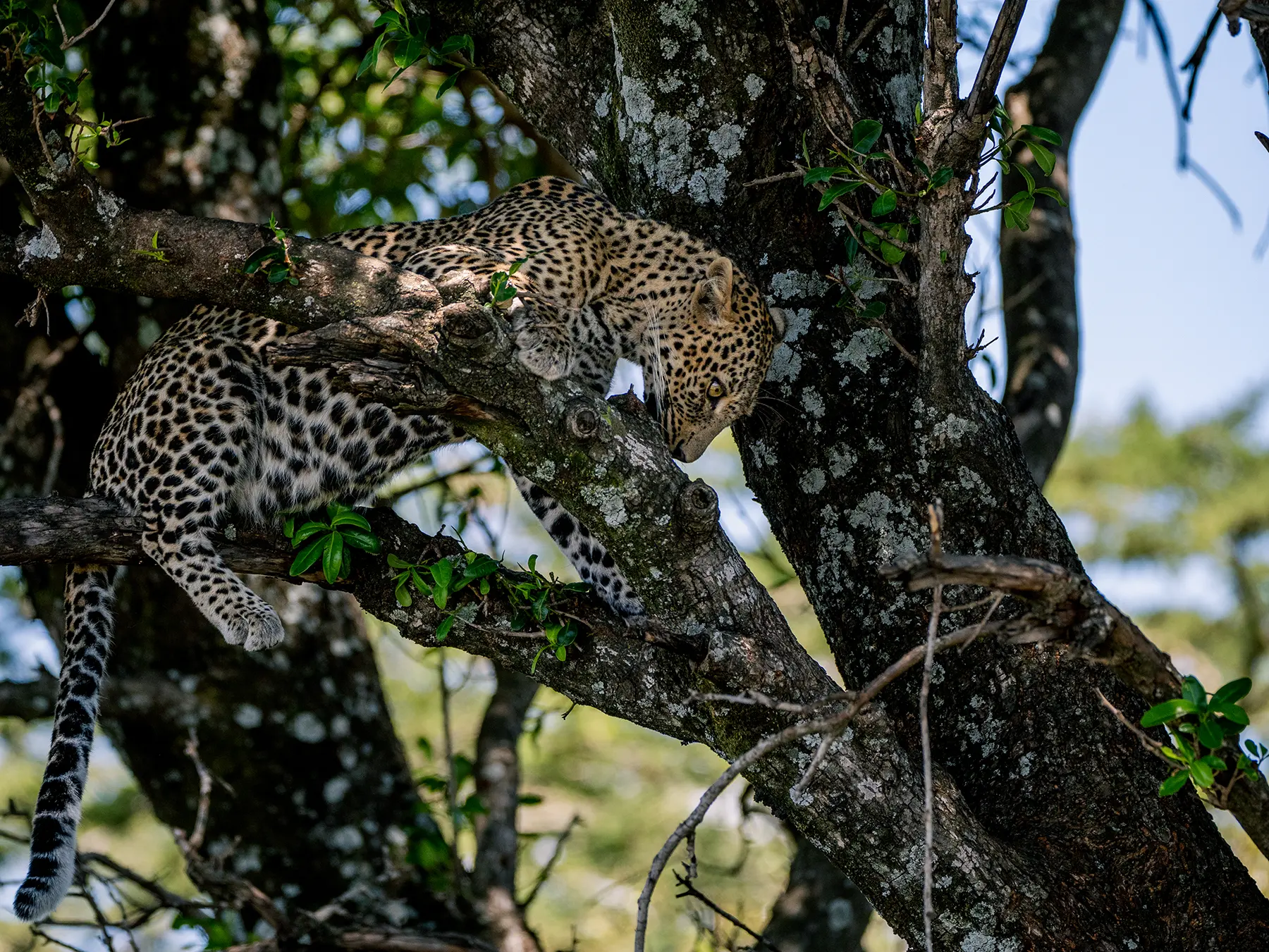
The Maasai Mara and Serengeti are two of my favourite safari destinations in the world and have each provided me with some incredible sightings, including a female leopard pouncing upon an unsuspecting warthog in the Maasai Mara, before taking it up a tree.
Seven days also lets you visit Tanzania’s mystical Ngorongoro Crater with its super-high concentration of lions and black rhinos on the crater floor. There’s truly nowhere else like this on the planet. Trust me, your first views of the crater floor will stay with you forever!
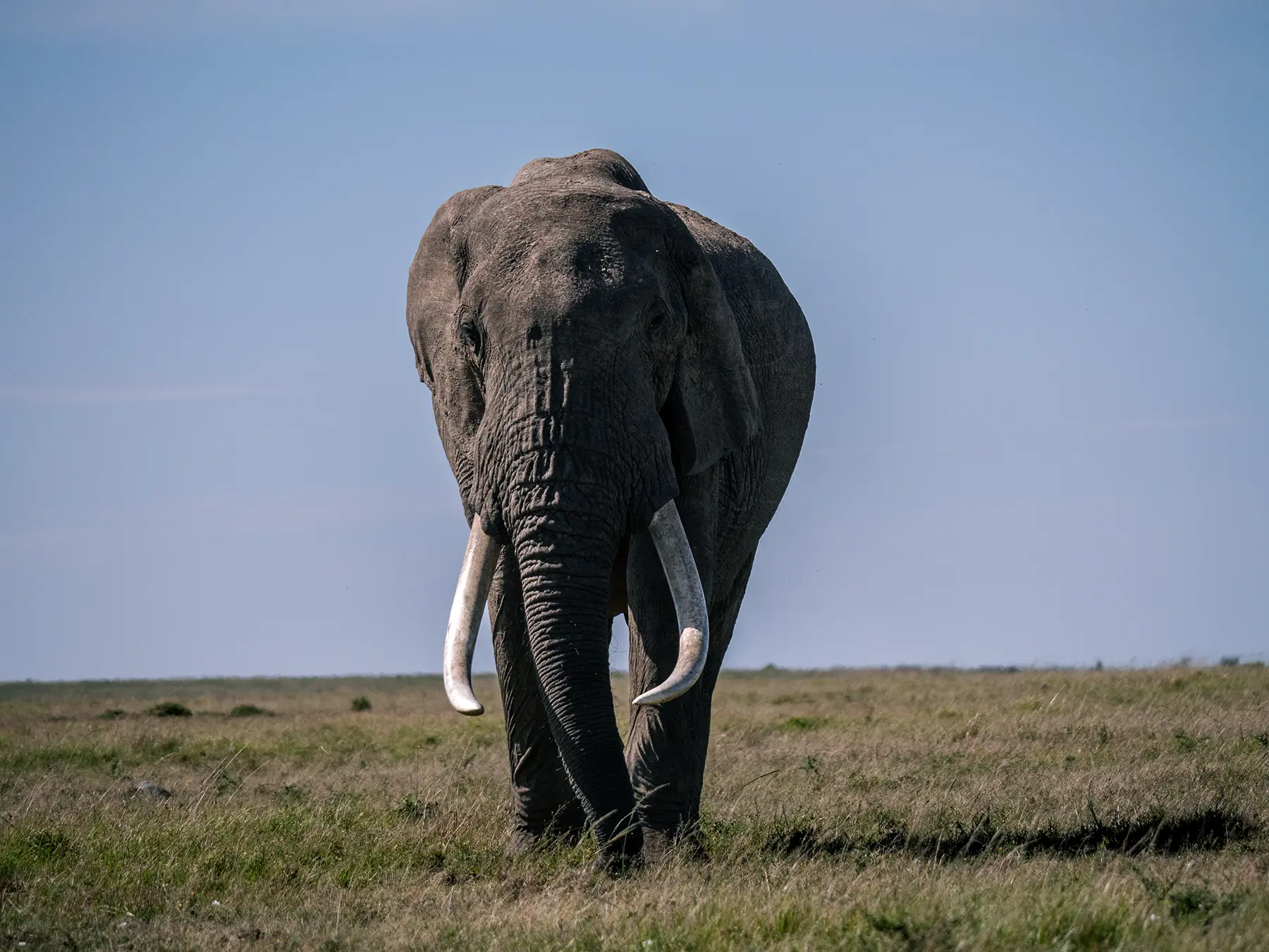
If you have more time, consider a 10-day Kenya and Tanzania safari or a 2-week Kenya and Tanzania itinerary to add extra destinations such as Kenya’s Amboseli with its iconic Big Tuskers or Tanzania’s Tarangire with its huge elephant herds.
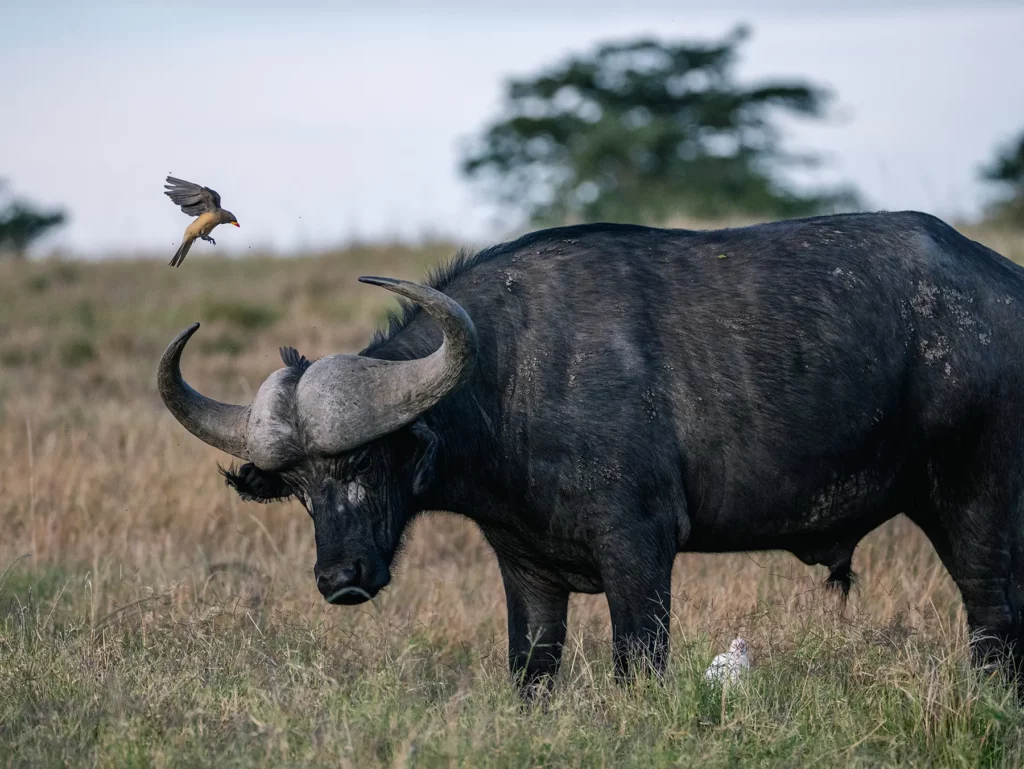
After visiting Kenya and Tanzania countless times, I’ve perfected this 7-Day Kenya and Tanzania itinerary to show you everything Kenya and Tanzania have to offer as well as giving you the most ‘bang for your buck’.
I’m going to give you an idea of how much it will cost, the best time to visit and how to find the best safari tour company.
As I walk you through the itinerary, I’ll share tips, tricks and how to avoid some of the mistakes I’ve made.
I’ve also spoken at length with my favourite Kenya and Tanzania guides as well as conducting copious amounts of additional research to ensure you receive everything you need to know to have the ultimate 7-Day Kenya and Tanzania safari.
It’s easy to focus only on the fun stuff when planning the trip of a lifetime, but I’ll make sure your itinerary includes the practicalities too, like allowing time to navigate rough roads or building in moments to relax. These details often make all the difference.
Key Takeaways
- Trip Duration: 7 days covering two countries
- Countries: Kenya and Tanzania
- Budget Range: $2,100-$10,500 per person
- Best Time to Visit: July-October (dry season, migration river crossing)
- Key Destinations: Nairobi, Maasai Mara, Serengeti, Ngorongoro Crater, Arusha
- Wildlife Highlights: Big Five, Great Migration, black rhinos, big cats
- Border Crossing: Isibania crossing between Kenya and Tanzania on Day 4
- Average Drive Time: 4-6 hours between parks
- Accommodation Style: Tented camps and safari lodges throughout
- Unique Features: Great wildebeest migration, Ngorongoro Crater is the world’s largest intact caldera
- Difficulty Level: Moderate (includes international border crossing)
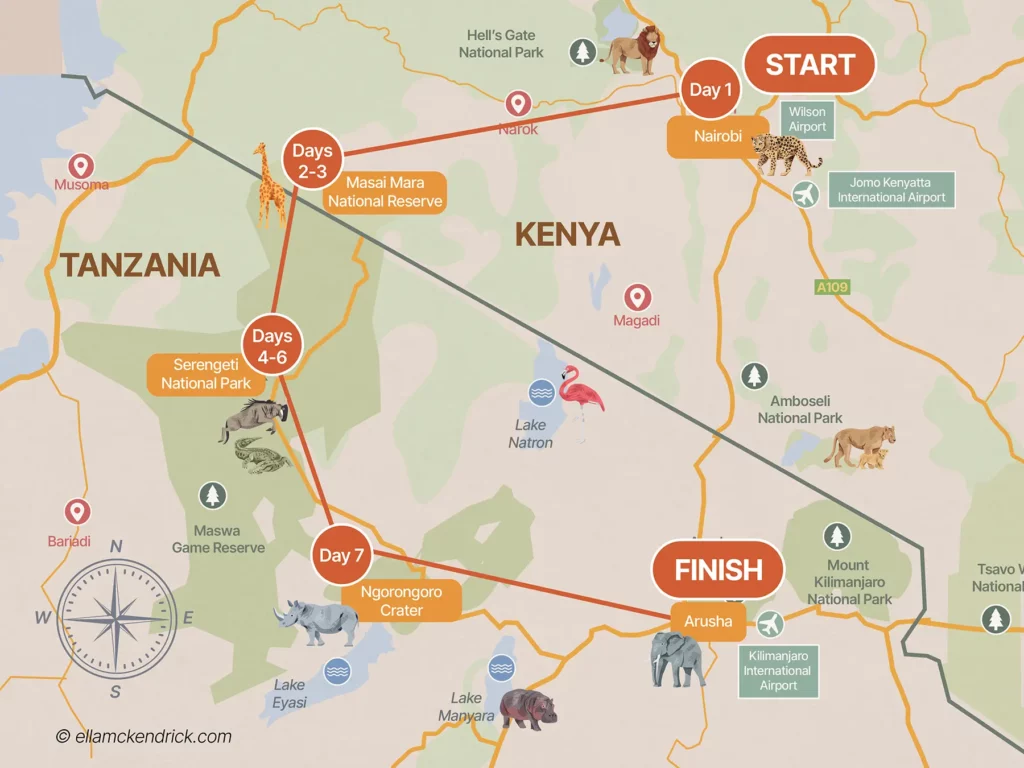
7-Day Kenya and Tanzania Safari Itinerary Map
Embark on the Safari of Your Dreams
Save time and ensure an incredible safari experience by getting quotes from my recommended local safari companies
I’m here to make booking your perfect safari quick, easy and risk-free.
Join the rapidly growing tribe of over 1,000 travellers who’ve booked their dream safari using my insider tips and recommendations.

It takes under 60 seconds to fill out the form and in under 48 hours you will receive multiple, no-obligation proposals from my favourite local tour operators with glowing online reviews.
Get your free no-obligation safari quotes and my top safari tips and recommendations
In This Guide
- Why Go on Safari in Kenya and Tanzania?
- How to Book Your 7-Day Kenya and Tanzania Safari
- How Much Does a 7-Day Kenya and Tanzania Safari Cost?
- Best Time to Visit Kenya and Tanzania
- How Long to Spend in Kenya and Tanzania
- 7-Day Kenya and Tanzania Safari Itinerary Overview
- Day by Day Breakdown
- Final Thoughts
Why Go on Safari In Kenya and Tanzania?
With frequent Big Five sightings, the Great Wildebeest Migration and an incredible volume of wildlife across 60+ reserves, Kenya and Tanzania are Africa’s leading safari destinations and two of my absolute favourites. A 7-day cross-border is a great way to see the best of both.
Let’s take a look at why a Kenya and Tanzania safari makes perfect sense!
Easy Access via Nairobi
Jomo Kenyatta International Airport in Nairobi is one of Africa’s best-connected airports, with direct flights from London, Amsterdam, Dubai, Doha and other major cities.
It also serves Kilimanjaro International Airport in Arusha and through it Tanzania’s northern safari circuit, making Nairobi the ideal place to start and end your cross-border safari.
The Great Wildebeest Migration & River Crossings
The Great Migration is the world’s second largest land mammal migration (long thought to be the largest until an even bigger migration was discovered in South Sudan).
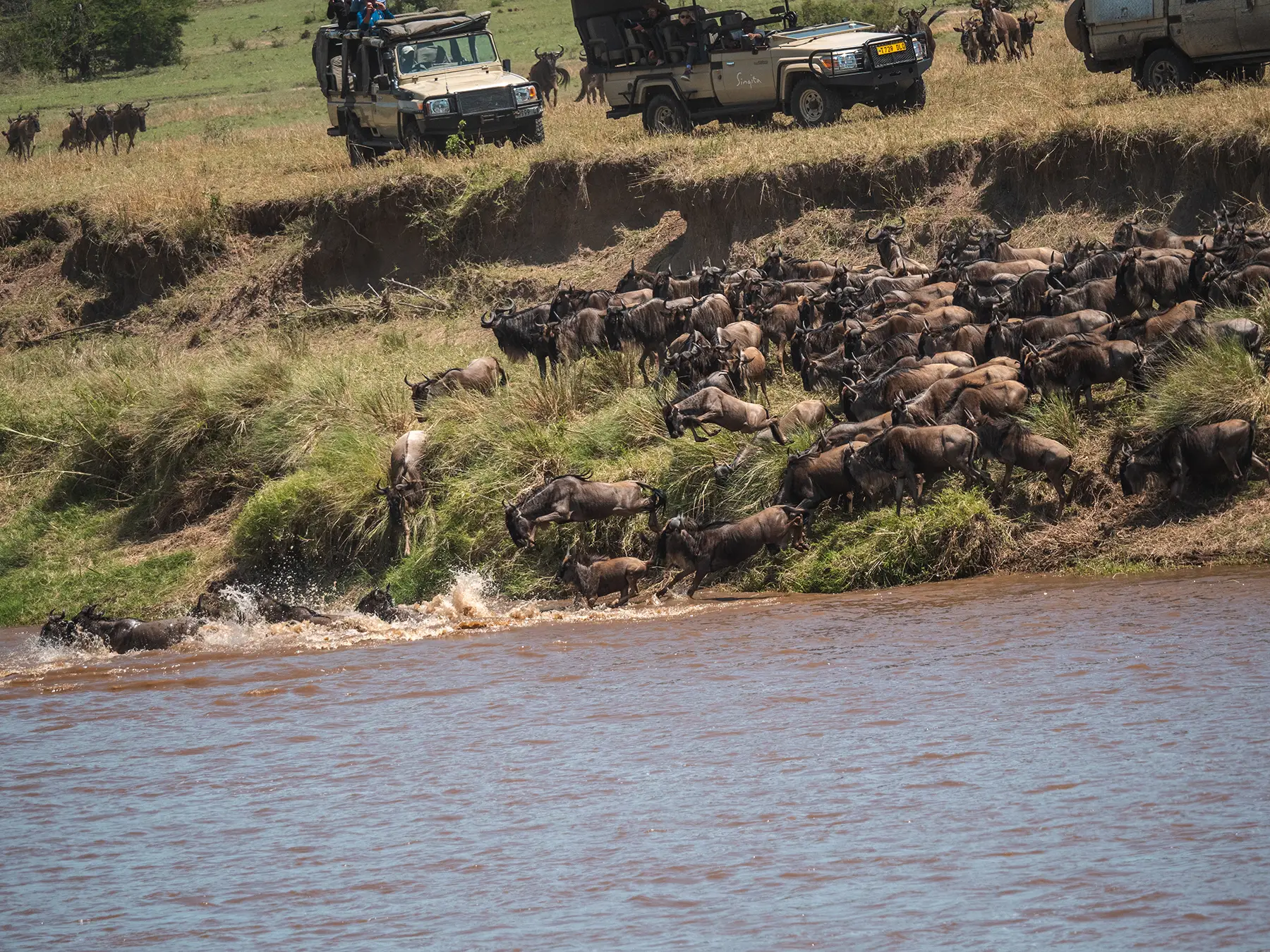
The phenomenon sees huge herds of wildebeest cross the crocodile-infested Mara River between mid-July and mid-October each year as they journey north from the Serengeti in Tanzania to Kenya’s Maasai Mara and back again.
You can see both sides of the Great Migration ecosystem by starting in the Maasai Mara and then crossing into the Serengeti.
Big Five Sightings
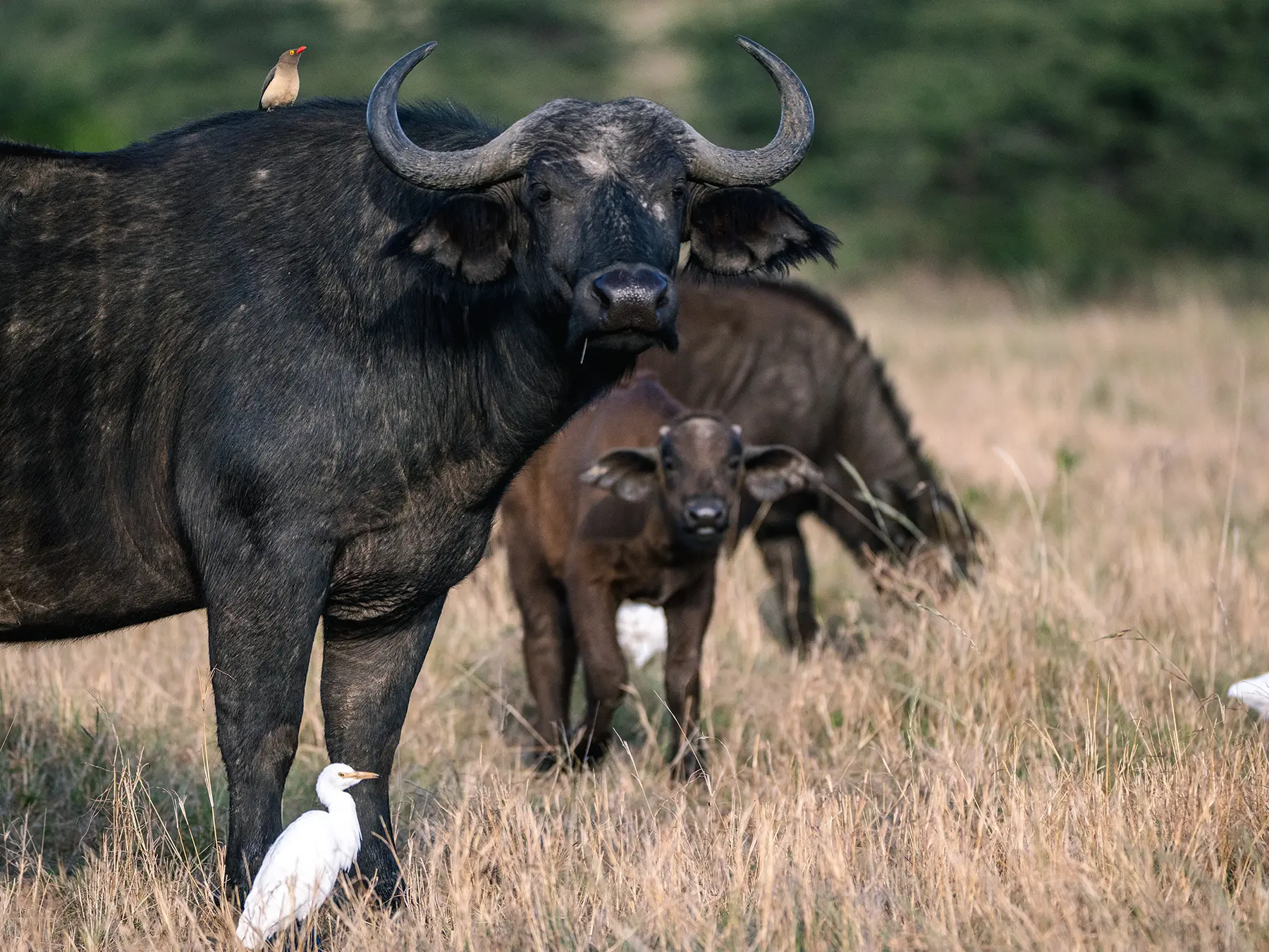
You can see all of the Big Five in both the Maasai Mara National Reserve and Serengeti National Park.
Boasting a lion density of 16.5 per 100km2 driven, the Maasai Mara is renowned for exceptional predator sightings. Lions, leopards and cheetahs can all be found here in healthy numbers.
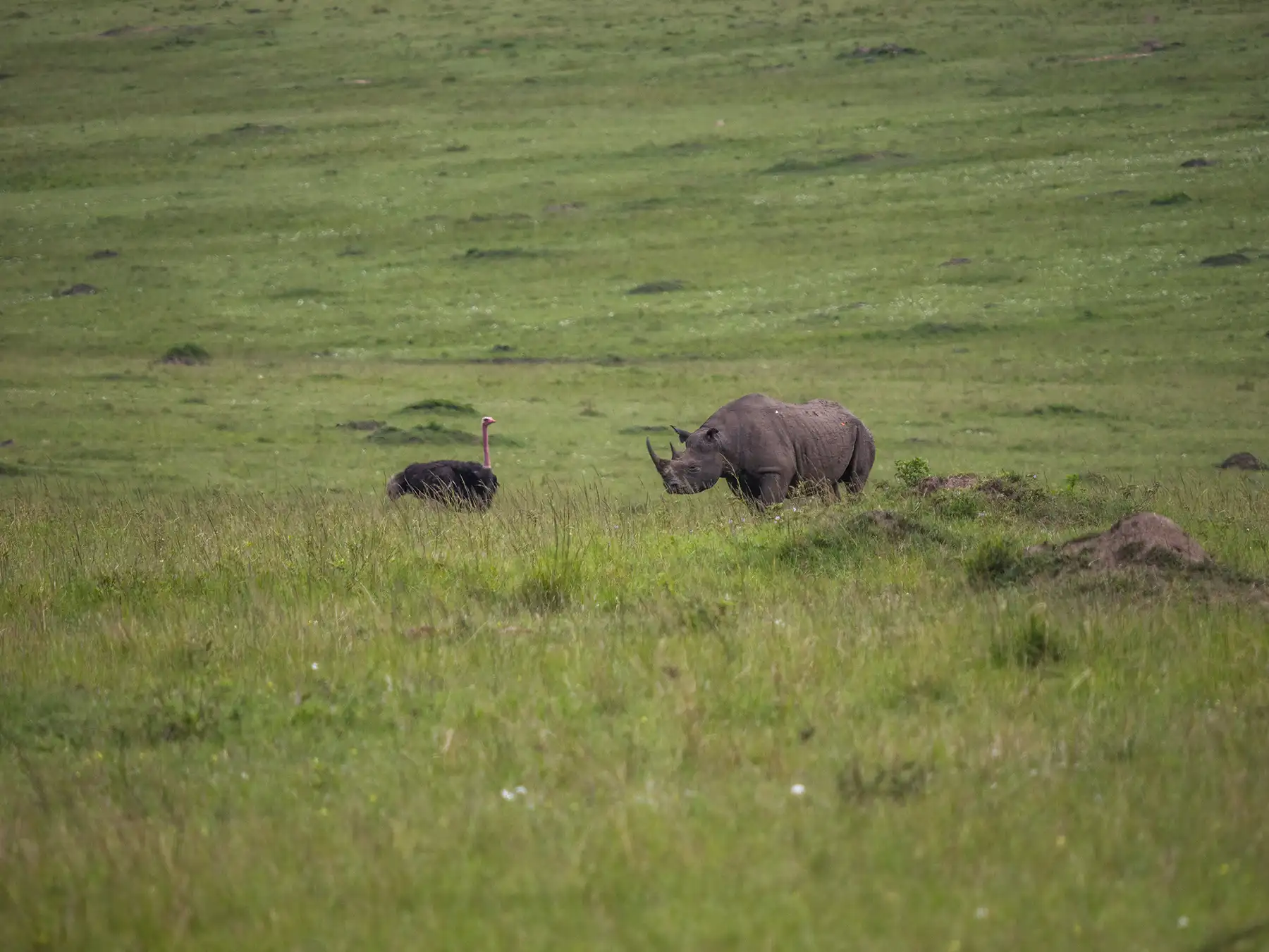
While all of the Big Five can be seen here, black rhinos can be elusive. I have, however, been extremely fortunate to see black rhinos on not just one visit, but two visits to the Maasai Mara! The first time I saw a black rhino from afar in the Mara Triangle. Then on a more recent visit, just ten minutes from my lodge, I encountered a male black rhino who was patrolling and scent marking his territory, marching parallel to the road. It was a long and clear sighting. To top things off, I then had two additional sightings of this rhino later in my Maasai Mara visit!
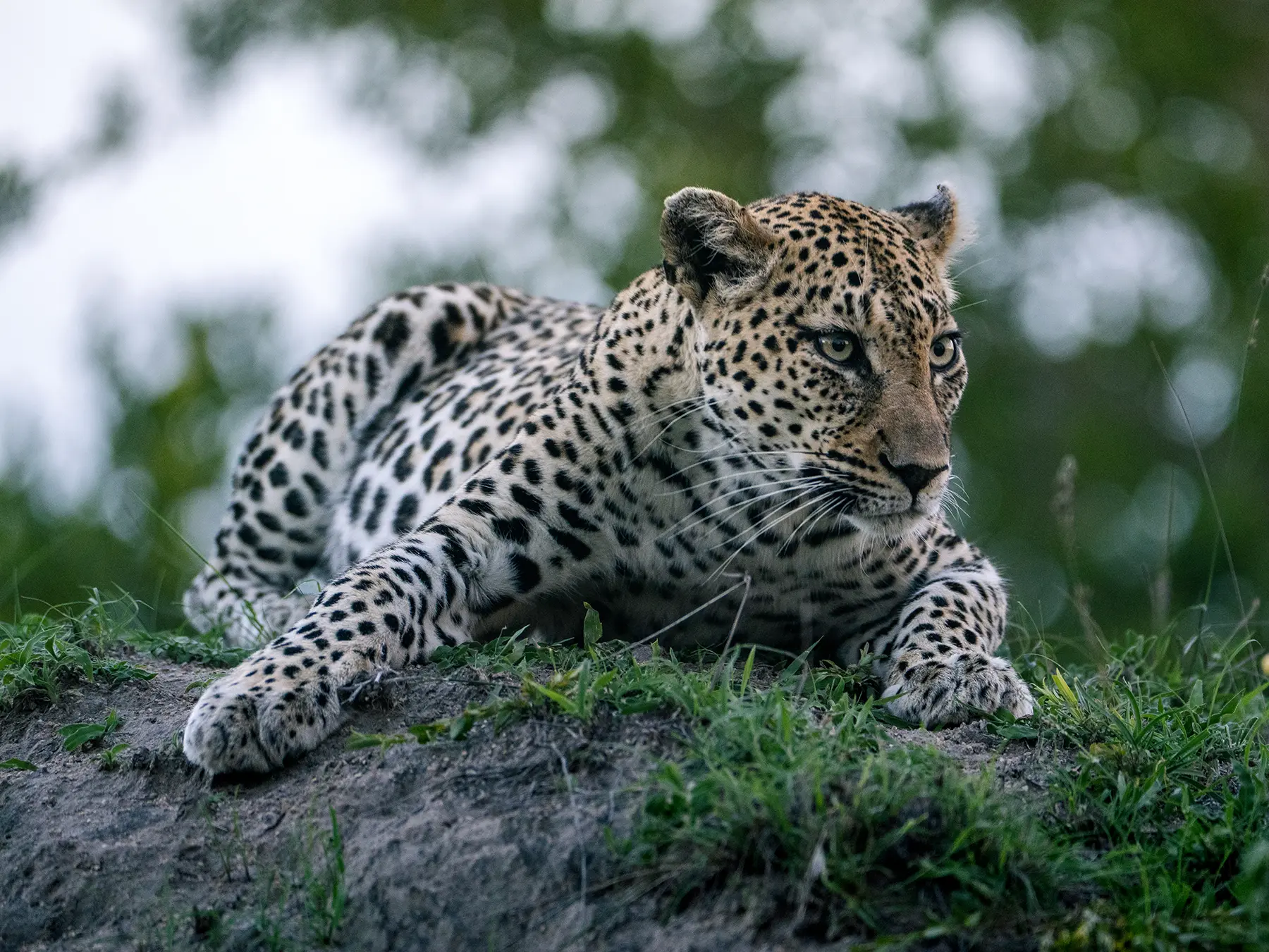
Even leopards can prove challenging to spot. After spotting at least one leopard on every visit to the Maasai Mara, including some really spectacular sightings, like of a leopard dragging a gazelle to the shade of our vehicle and then feasting there, I perhaps started to take my sightings of them a little for granted.
Then on a visit to Maasai Mara one March, we didn’t spot any leopards over our 4 night stay. This unpredictability is why I recommend increasing your chances by visiting Serengeti too.
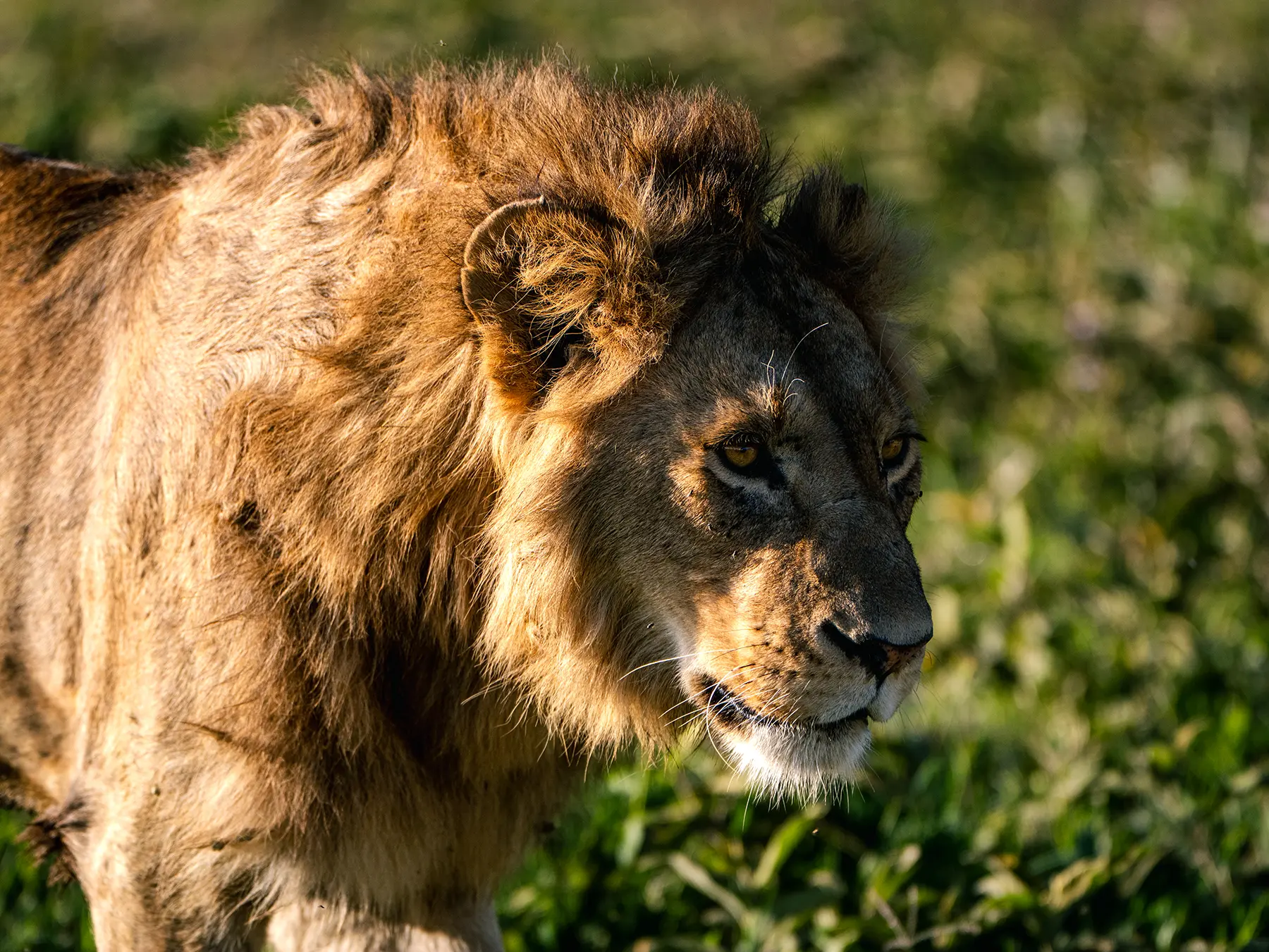
The Serengeti offers amazing lion, leopard, elephant and buffalo sightings on its 14,763 square kilometres of plains. Again, as in the Maasai Mara, rhinos are rare and in fact I’ve not been lucky enough to encounter a rhino in the Serengeti (yet!).
Housing 30,000 mammals year-round, the vast 264 km2 Ngorongoro Crater is surrounded by walls reaching 610 metres in places and Tanzania’s best location for black rhino sightings. This is where you have the best chance of seeing them over this 7-day itinerary. The crater also has Africa’s highest density of lions.
Pros of Safaris in Kenya and Tanzania
- Both countries host the Big Five, with particularly high predator concentrations.
- The Great Migration can be seen from both countries at different times.
- Visiting Tanzania will enable you see the iconic Ngorongoro Crater, boasting Tanzania’s highest lion density.
- Experience two distinct safari ecosystems: the open Mara grasslands and the vast Serengeti plains.
- Both countries have an excellent tourism infrastructure, including expert local guides and great accommodation.
- Multi-city flight tickets are available for Kenya and Tanzania without significant price increases, allowing you to fly into one country and out of the other.
Cons of Safaris in Kenya and Tanzania
- Seven days isn’t much time to see the highlights; you’ll have longer drives and less safari time than with a 10-day itinerary.
- Crossing the border at Isibania can take up to two hours with paperwork and visa processing.
- The 10-hour drive between Maasai Mara and Serengeti will take up an entire day of your trip.
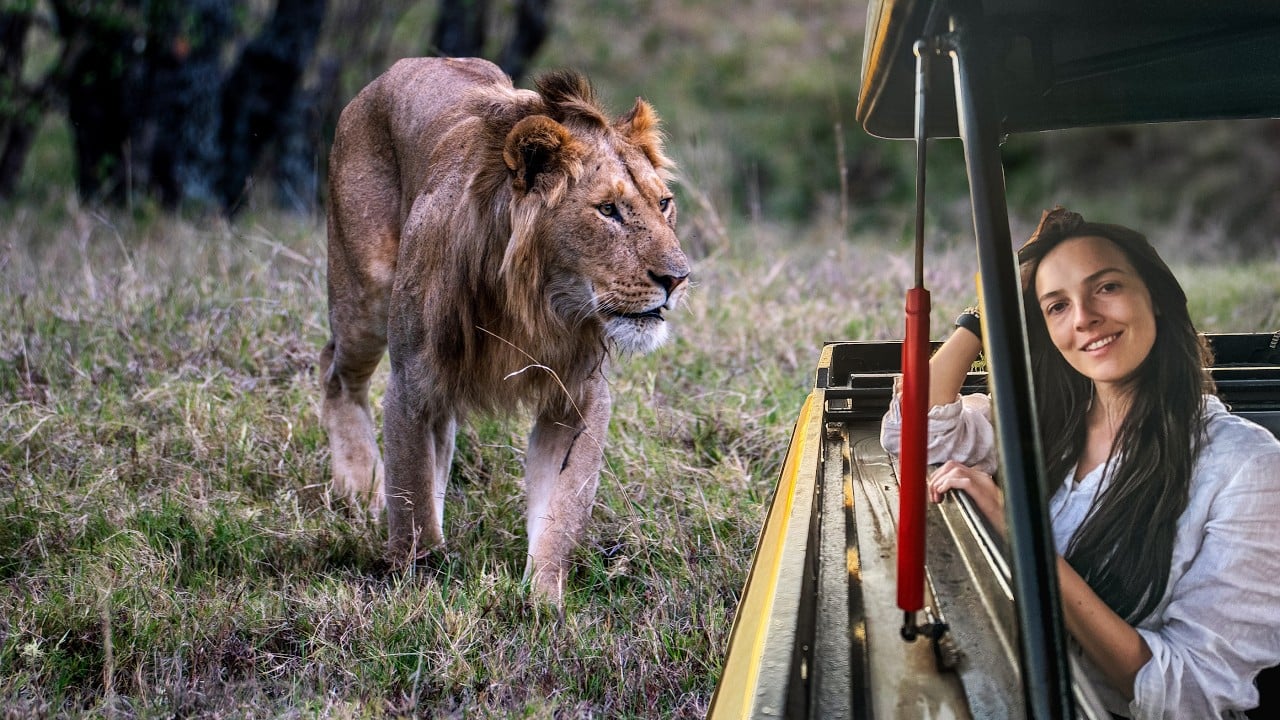
Check out my Kenya and Tanzania safari experience videos below or simply skip ahead to my 7-day Kenya and Tanzania itinerary if you prefer!
How Do You Book a 7-Day Kenya and Tanzania Safari?
I’ve personally tested out all of the different booking methods across many safaris over the years. I have found that booking through a reputable local tour operator is hands down the easiest and most cost-efficient way to organise your 7-day Kenya and Tanzania safari.
This is how I book my combined Kenya and Tanzania safaris and it’s always a fantstic experience.
Local operators can arrange accommodation, reserve permits, game drives and domestic air transfers, often at a lower cost than international agents.
Some of my recommended local operators have even set up their own lodges and tented camps which they have exclusive use of and preferential pricing.
You can get quotes from the same local tour companies I use to organise my own trips here: Safaris By Ella
As well as local tour operators, other booking options include international travel agents and self-drive safaris.
Booking Options at a Glance
| Option | Cost | Flexibility | Best for |
|---|---|---|---|
| Local tour operator | $$ | High | Most travellers, best value |
| Self-drive | $ | Extremely high | Experienced drivers who can handle driving on rough gravel roads and who don’t mind fewer wildlife sightings vs what you’d see with a guide |
| International agent | $$$ | Medium | Travellers wanting to book international flights and safari in one package who are prepared to pay up to 40% more than a local tour operator |
Why I Recommend a Local Tour Operator for Kenya and Tanzania
A local tour operator handles everything from the moment you land: accommodation across all your parks and reserves, transfers between each location, park entry permits, game drives with expert guides, and knowledge of where the wildlife is right now.
Having tested all booking methods, this is how I book all my safaris these days.
Take it from me, I’ve tried all three of the different methods before!
On my first visit to Tanzania, I booked a regular taxi from the airport rather than arranging a transfer through my tour operator. This turned out to be a mistake that I will not repeat. The driver was pushing 100 kilometres per hour on poorly lit roads, making reckless overtakes on blind bends while watching a television show on a small screen mounted to his dashboard. I arrived at my accommodation shaken and grateful to be in one piece.
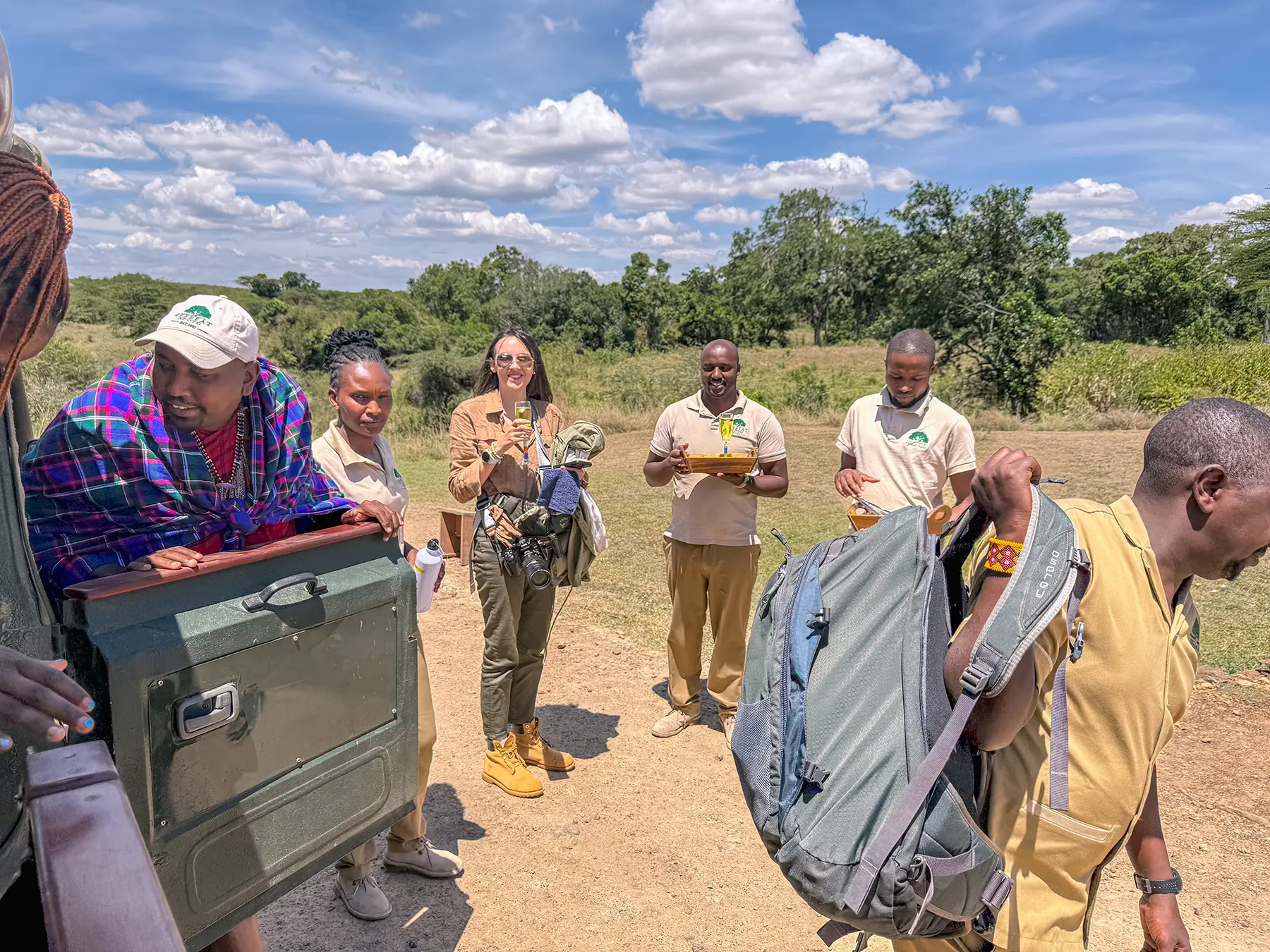
In contrast, the professional safari drivers I used for the rest of my trip were calm, cautious and excellent behind the wheel.
The cost of booking through a local safari company is fairly comparable to booking everything yourself, because local operators get preferential accommodation rates which largely balance out their mark-up.
The benefits you get from spending that bit extra are immense. You don’t need to stress about researching where to stay and booking everything individually. Everything is taken care of and you only have one point of contact when you have any questions.
What a Local Operator Gives You
- The best local tour operators offer a full end-to-end service that includes parking permits, accommodation, vehicles, dedicated guides, fuel and even meals. Every detail is taken care of: all you have to do is enjoy!
- I have been on both self-managed safaris and safaris organised by an agent, and believe me, it’s so much more relaxing to have a professional manage the logistics.
- There’s often little difference in cost between booking through a local operator and organising your trip yourself. Local agents can access better rates with lodges and hotels, plus booking with an agent will save you time and effort.
- Local operators know the parks and reserves intimately and have good relationships with service providers – the kind of expertise that’s simply priceless. This local knowledge, combined with their superior wildlife tracking abilities, means you’re much more likely to enjoy unforgettable encounters when accompanied by an experienced guide.
- Booking a local guide boosts your chances of good wildlife encounters substantially, as local guides help each other out with useful tips as part of a connected radio network.
- A local tour operator will have the experience and know-how to put together a far superior itinerary to what you would end up with if self-driving or booking through a hotel.
- Thanks to their close relationships with the nearby lodges and camps, local operators can sometimes even manage to secure rooms when hotels look fully booked online, as facilities often reserve a small number of places for local partners.
What to Watch Out For
- Standards can vary widely across tour operators, so the lowest price isn’t always best. Cheaper prices could reflect poorer-quality accommodation and/or inexperienced guides, which will definitely affect your experience. It’s worth doing a little research to find the best local guide so you can enjoy your safari to the fullest.
- Local tour operators generally don’t book international flights, so you’ll need to organise those separately.
Top Tip
A safari trip is a significant expense, so you’ll want to be sure your payment is protected when making your booking. While opting for a large, international travel agent might appear more reassuring in this respect, you can also take measures when booking with a local operator that will offer you a similar level of protection.
For example, using a credit or debit card for the transaction often includes payment protection (e.g. Section 75 in the UK). If you have a good travel insurance policy (which is essential for a trip like this!), it will cover trip interruption. In addition, booking with a recommended local safari company that initially charges a deposit and only takes the balance closer to your trip will reduce risk to a minimum.
Recommended Booking Options For Your Kenya and Tanzania Safari Itinerary
Private Safari
Most popular & best experience – typical prices for this itinerary start from $350 per person per day.
Visit safarisbyella.com for free quotes from trustworthy local tour companies I use to book my own trips.
How to Book with the Best Local Safari Companies
- Comparison sites which provide multiple quotes from verified suppliers such as Safaris By Ella
Join the rapidly growing tribe of over 1,000 travellers who’ve booked their dream safari using my insider tips and recommendations.
Should You Choose a Private or Group Kenya and Tanzania Safari?
For most people booking a safari trip to Kenya and Tanzania, a private safari is the better choice.
This is because it gives you total control over your schedule, exactly which route you take through the reserve and even how long you spend at each sighting. Want to spend the entire afternoon waiting to see if that leopard descends for a tree? Or prefer to spend the time ticking off as many bird species as possible? Your schedule is in your hands! I always opt for private safaris in both countries as I find it offers the best experience and value for money.
Private vs Group at a Glance
| Private safari | Group safari | |
|---|---|---|
| Cost per day | $300-500 per person | $150-250 per person |
| Flexibility | Full control of schedule and route | Fixed times, pre-planned routes |
| Vehicle | Own vehicle and guide | Shared with 6-8 others |
| Best for | Couples, families, photography enthusiasts | Solo travellers on a budget |
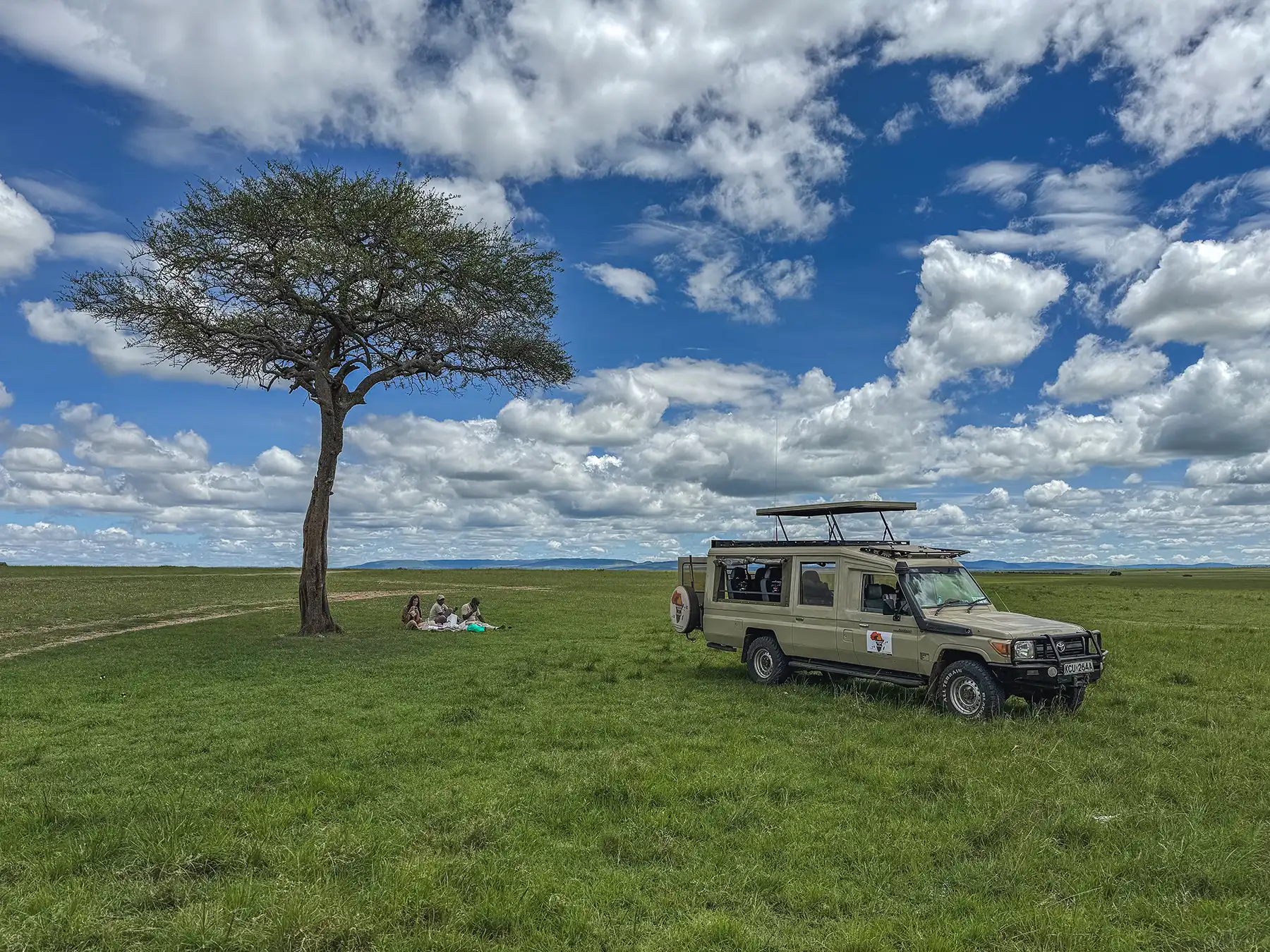
My Recommendation
If your finances allow, you should absolutely go private. The flexibility a private safari gives is invaluable, especially on a busy 7-day safari in Kenya and Tanzania. Opting for a private safari means you and your guide can change the schedule on the fly such as opting for earlier starts or coming back for lunch vs staying out all day with a packed lunch.
I would only really recommend a group safari on this itinerary for solo travellers on a limited budget. While it does offer some savings, these come at the cost of flexibility and potentially a lesser safari experience.
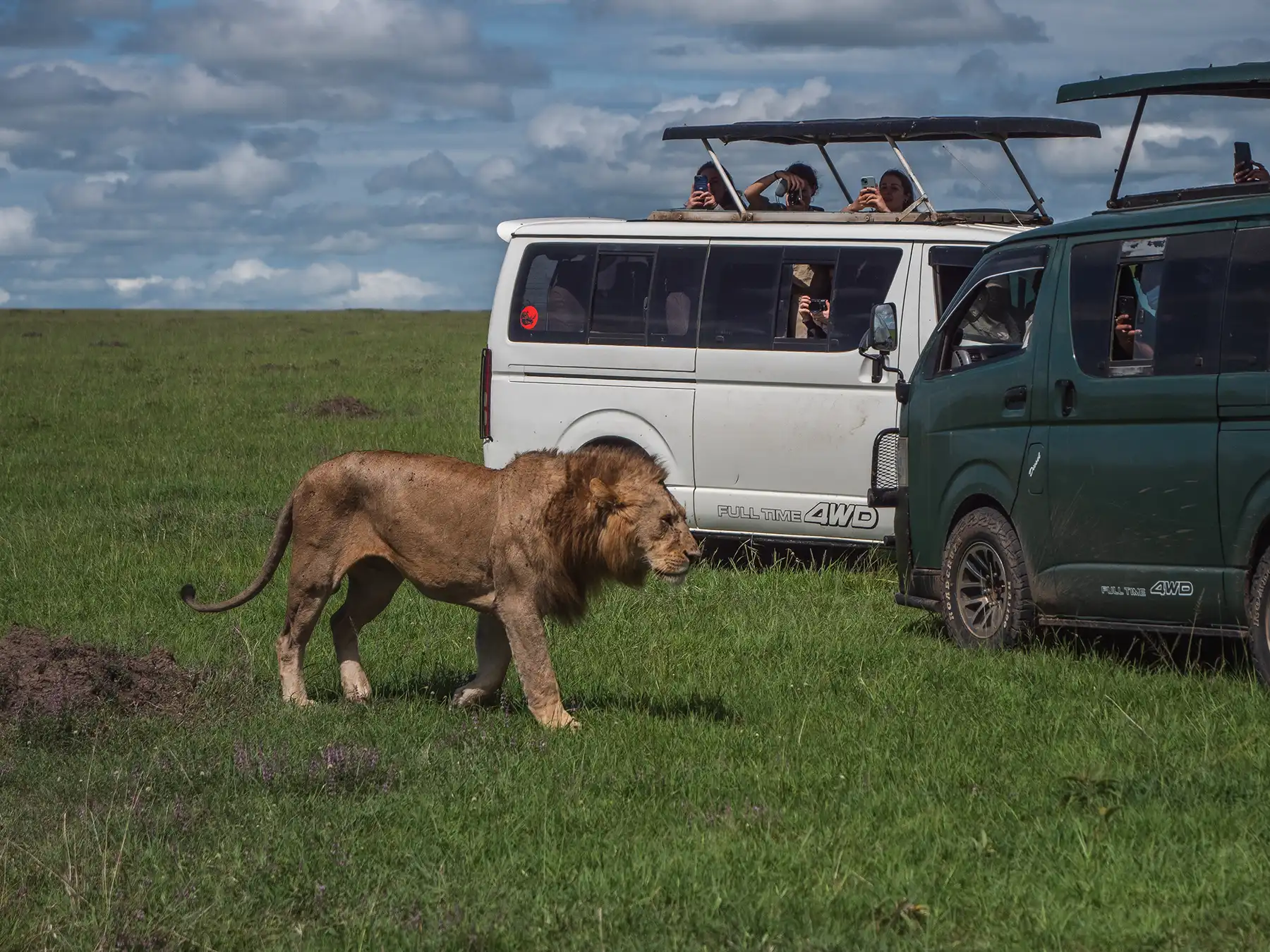
How Much Does a 7-Day Kenya and Tanzania Safari Cost?
A private 7-day Kenya and Tanzania safari costs $2,100-10,500 per person, which includes accommodation, transport, park fees and drives. Budget safaris start from $300 per day, mid-range from around $400 and luxury $600+ per day.
Because this is an action-packed itinerary covering the premier safari destinations in the two countries, it’s pricier than, say, a 7-day Tanzania safari or 7-day Kenya safari, where you’d also spend some time in lower-cost parks.
Average daily costs can be a little lower for a longer 10-day Kenya and Tanzania itinerary because it covers some less expensive locations.
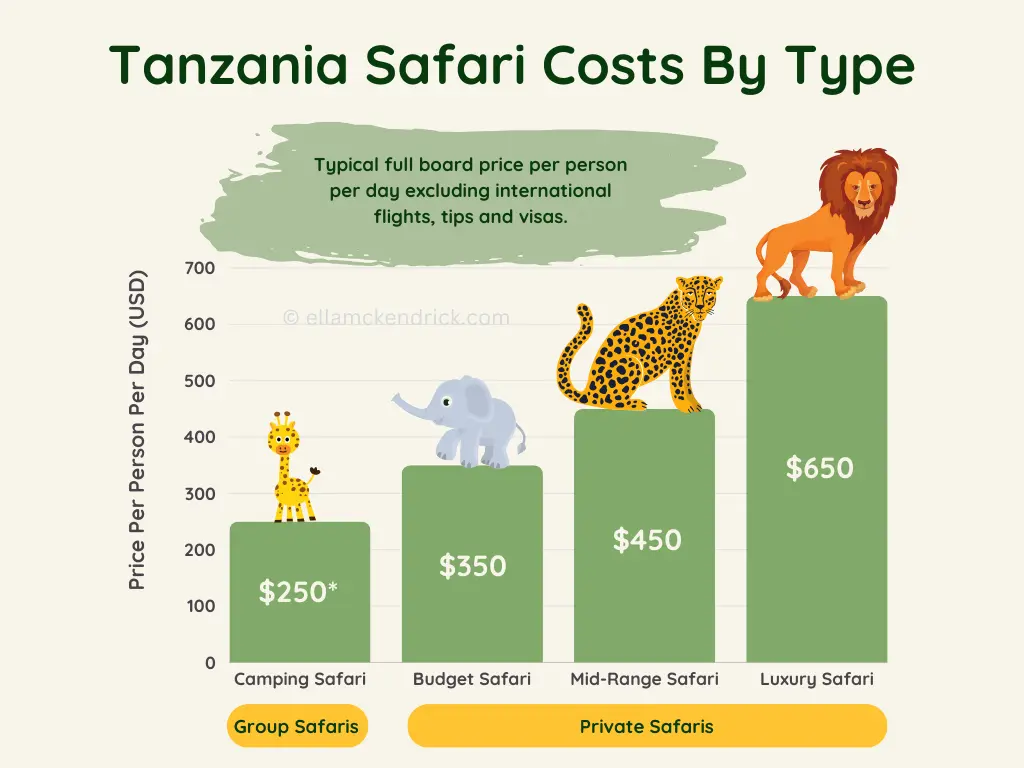
The chart below outlines average Tanzania safari prices by luxury level. A combined Kenya and Tanzania safari is a similar price.
Safari Prices Generally Include
- Park fees
- Unlimited game drives
- Accommodation
- Full-board meals
- Drinks (some tour operators include alcoholic beverages)
- Transport
- Driver guide
- All activities
Safari Prices Generally Don’t Include
- International flights
- Tips/gratuities
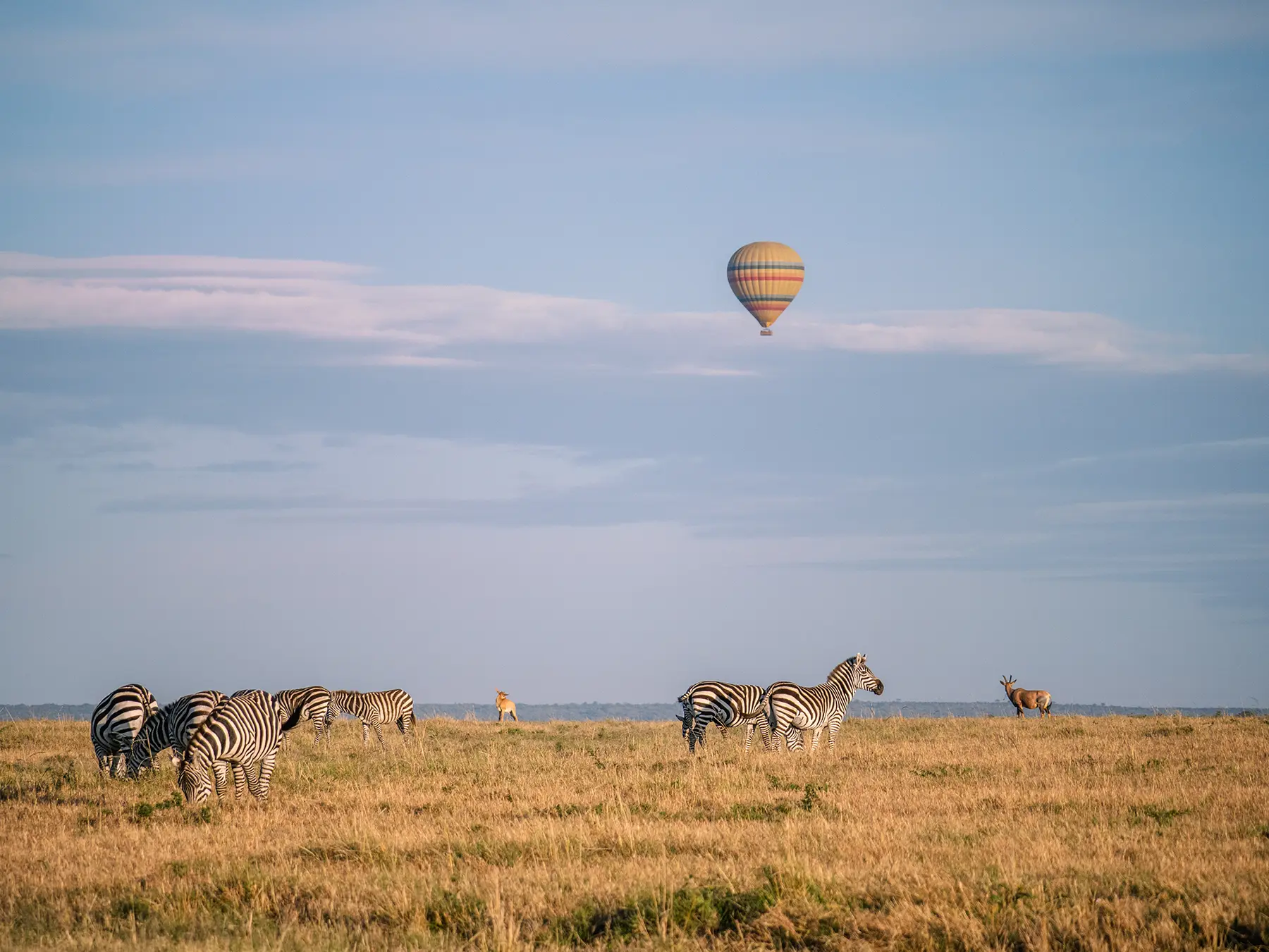
How Do Kenya and Tanzania Safari Costs Compare to Other African Safaris?
Once the most budget-friendly safari destination of all, Kenya increased park fees by 30% in 2024, closing the gap with Tanzania. Nevertheless both remain the most affordable Big Five destinations for private guided safaris, with prices ranging from $300/day (Kenya) to $350/day (Tanzania).
Botswana is Africa’s most expensive safari destination ($450+ per day) while prices in South Africa and Zambia are slightly lower.
You can see how costs compare across popular African safari destinations below:
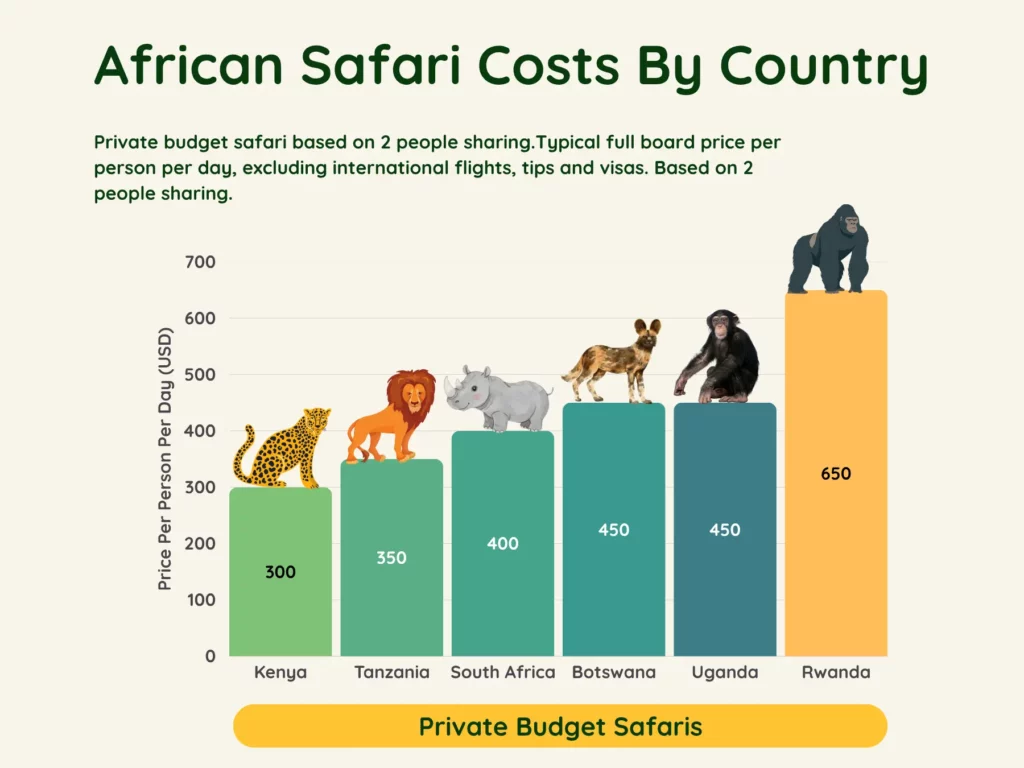
| Destination | Private Budget Safari Cost PP/Day |
|---|---|
| Kenya | 300 USD |
| Tanzania | 350 USD |
| South Africa | 400 USD |
| Botswana | 450 USD |
| Uganda | 450 USD |
| Rwanda | 650 USD |
Kenya and Tanzania Safari Cost Breakdown
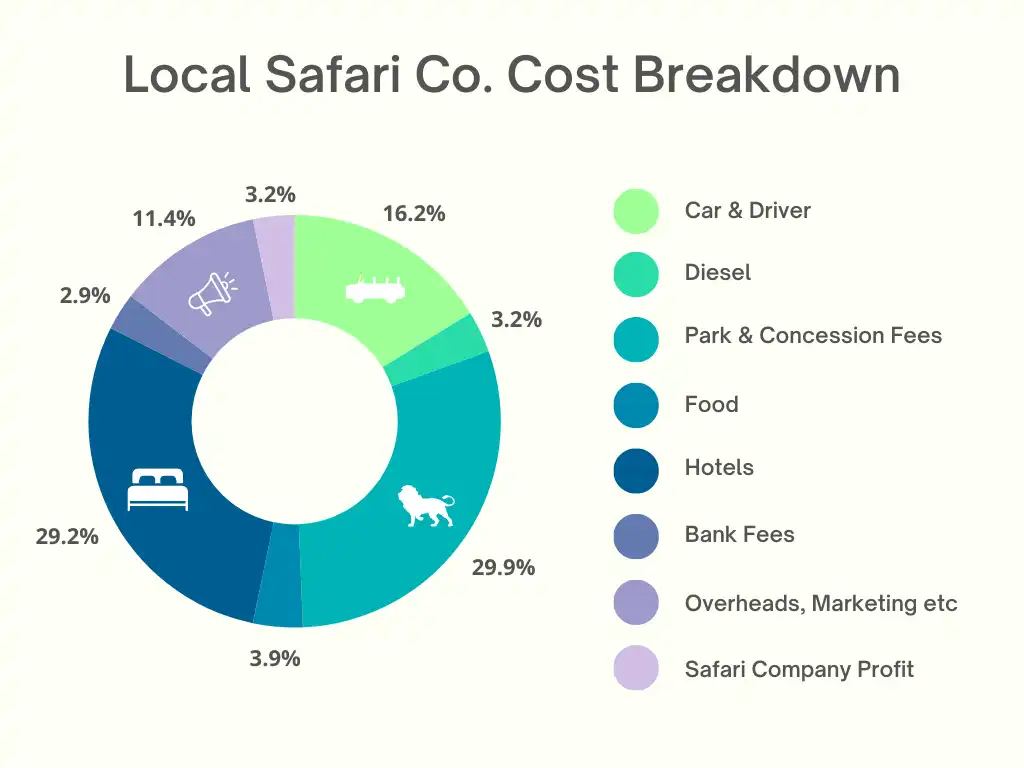
Let’s quickly break down the cost of a locally booked Kenya and Tanzania safari so you can see where your money goes. For a more in-depth breakdown take a look at my Kenya safari cost and Tanzania safari cost guides.
Just over 30% of the cost goes on accommodation and food, assuming you’re looking at a budget safari. The percentage will go up as you increase your level of luxury.
A further 30% goes towards park and concession fees. Peak season fees at Kenya’s Maasai Mara are $200 per adult per day whilst Tanzania’s Serengeti charges $70 plus 18% tax (total $82.60) with an additional $60 fee per night (TANAPA).
Ngorongoro Crater is Tanzania’s most expensive destination, costing $70.80 per person per day plus $295 per vehicle.
Factors Impacting Kenya and Tanzania Safari Costs
Your total safari cost depends on your chosen reserves and accommodation type, the time of year and transfers between parks. Let’s examine each of these factors below.
Click below to jump to any of the factors:
How You Book Your Safari
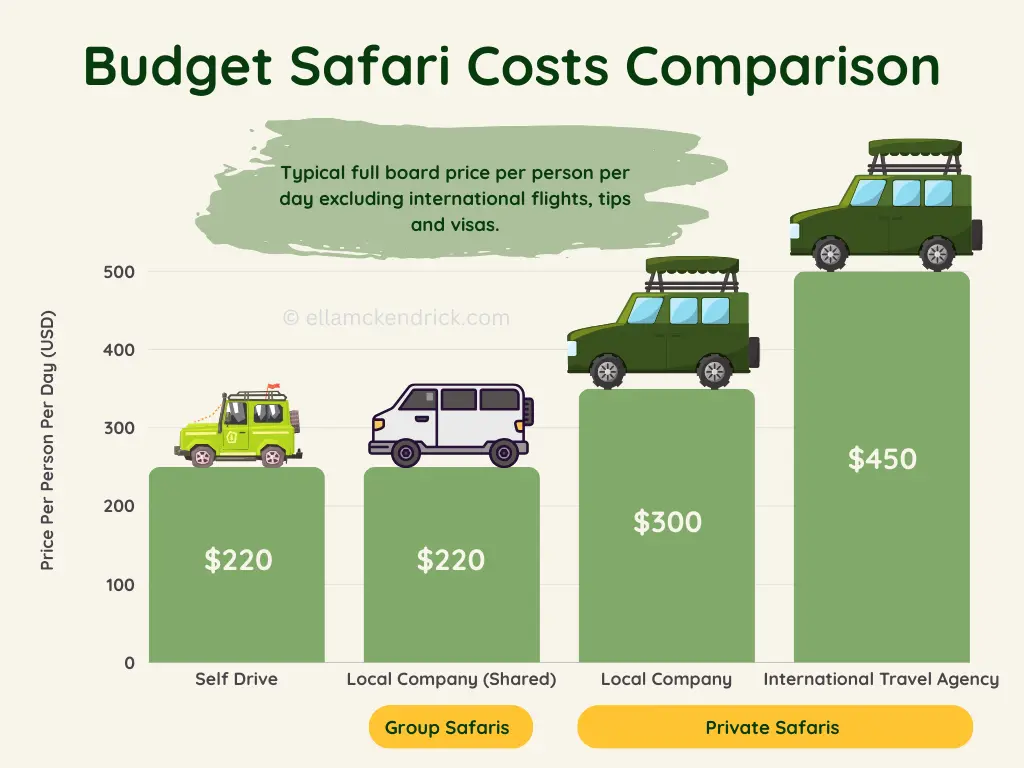
There are three key ways to book your safari: by yourself (DIY self-drive safari), through a local tour operator or through an international travel agent.
Booking through an international travel agent is costliest, with markups of 30-50% on local operator rates for the same providers.
Cost savings between booking everything yourself and using a local tour operator are minimal as when booking yourself, you are really only saving on having an expert driver guide as in order to self-drive in the national parks, you need to hire a sturdy 4×4 vehicle comparable to that which is provided for guided safaris.
My preference: I always book my safaris directly with local operators – it’s the best balance of value and experience.
Accommodation
Your accommodation choices have a big impact on your total safari cost.
Budget tented camps and lodges near/within wildlife areas cost between $50 and $150 per person/night, depending on location. Generally, rooms are smaller than in mid-range facilities, with no additional amenities, e.g. swimming pools.
You can expect to pay from $200 per person per night for a mid-range camp or lodge. In return, rooms are slightly larger with plusher decor, and there’s often a communal swimming pool.
With prices starting from $400 per person per night, luxury camps and lodges offer large rooms and often come with extra seating areas, balconies and even private pools. Communal areas are also higher-end, with swimming pools, spas and gyms.
Accommodation Prices in Kenya and Tanzania (Peak Season)
| Accommodation level | Price per person/night |
|---|---|
| Budget (tented camps) | $50-$150 |
| Mid-range (camps and lodges) | $200-$400 |
| Luxury (lodges and tented camps) | $400-$1,000 |
| Luxury Plus | $1,000-$3,000+ |
My Preference: Mid-range accommodation for most of the trip. As well as the added comfort, food and hygiene standards are markedly better.
Choosing accommodation within the national parks and reserve costs a bit more but there are several benefits to doing so, such as being able to return to your lodge or camp for lunch rather than having picnic lunches.
Due to how the park fee systems work, you have to pay extra to leave and return to the parks within the same day. In the Maasai Mara you pay double the park fees. In Serengeti, when you stay outside the park your fee is valid for only 12 hours, compared to 24 hours if you’re within the park.
Time of Year
The time you travel impacts the price of accommodation and some park fees.
Pricing at lodges/camps can be up to 50% lower during the long wet season especially at luxury camps.
Park fees can also change at different times of year, for example, peak season fees at Maasai Mara are double the low season rate ($200 per person/day July – end of December versus $100 January – end of June).
My Preference: January or February offer the best value. Despite much lower park fees in Maasai Mara, wildlife viewing is still amazing with lots of baby animals to spot.
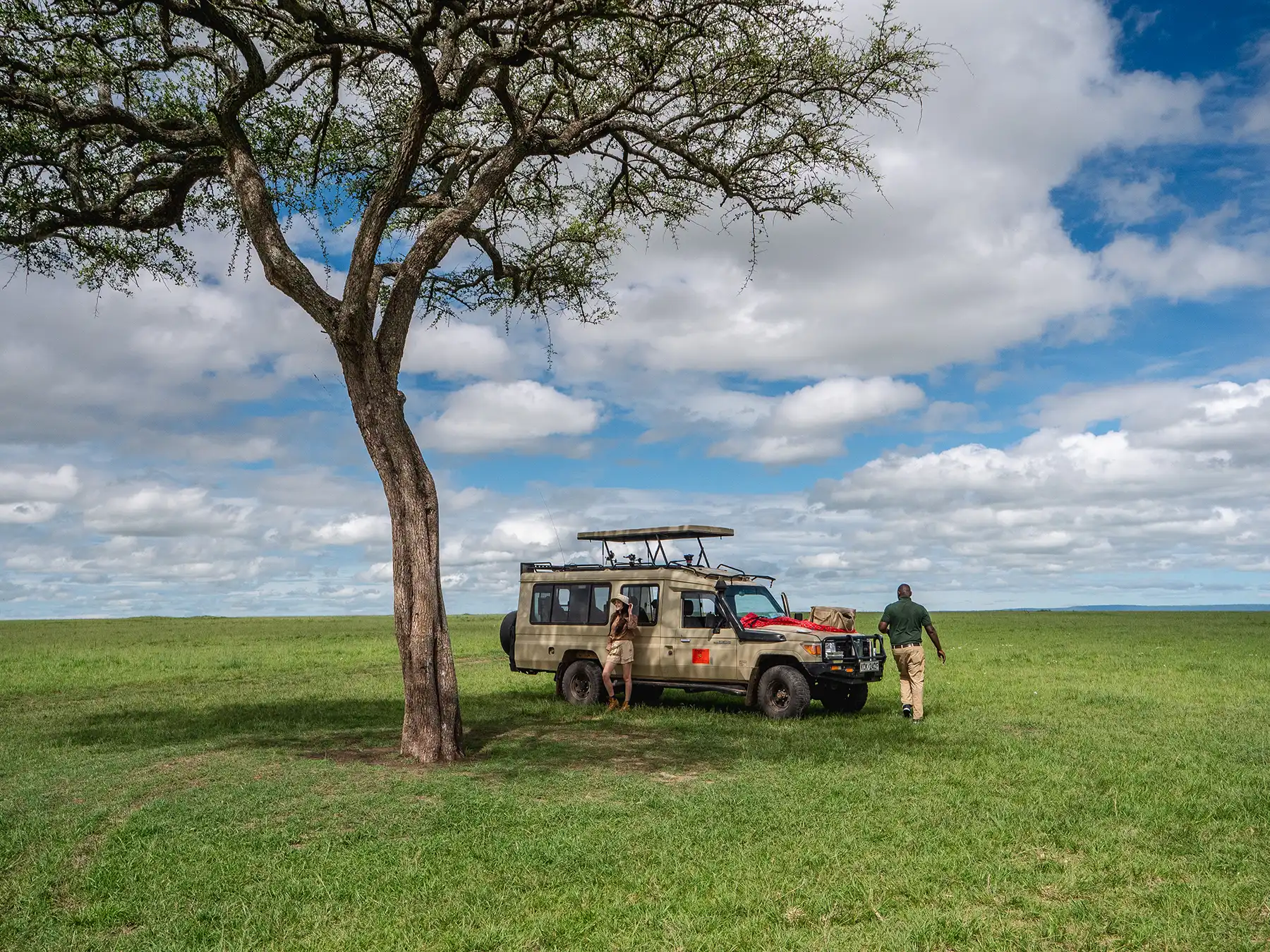
Transport Between Parks
How you travel between locations on safari will also affect the cost.
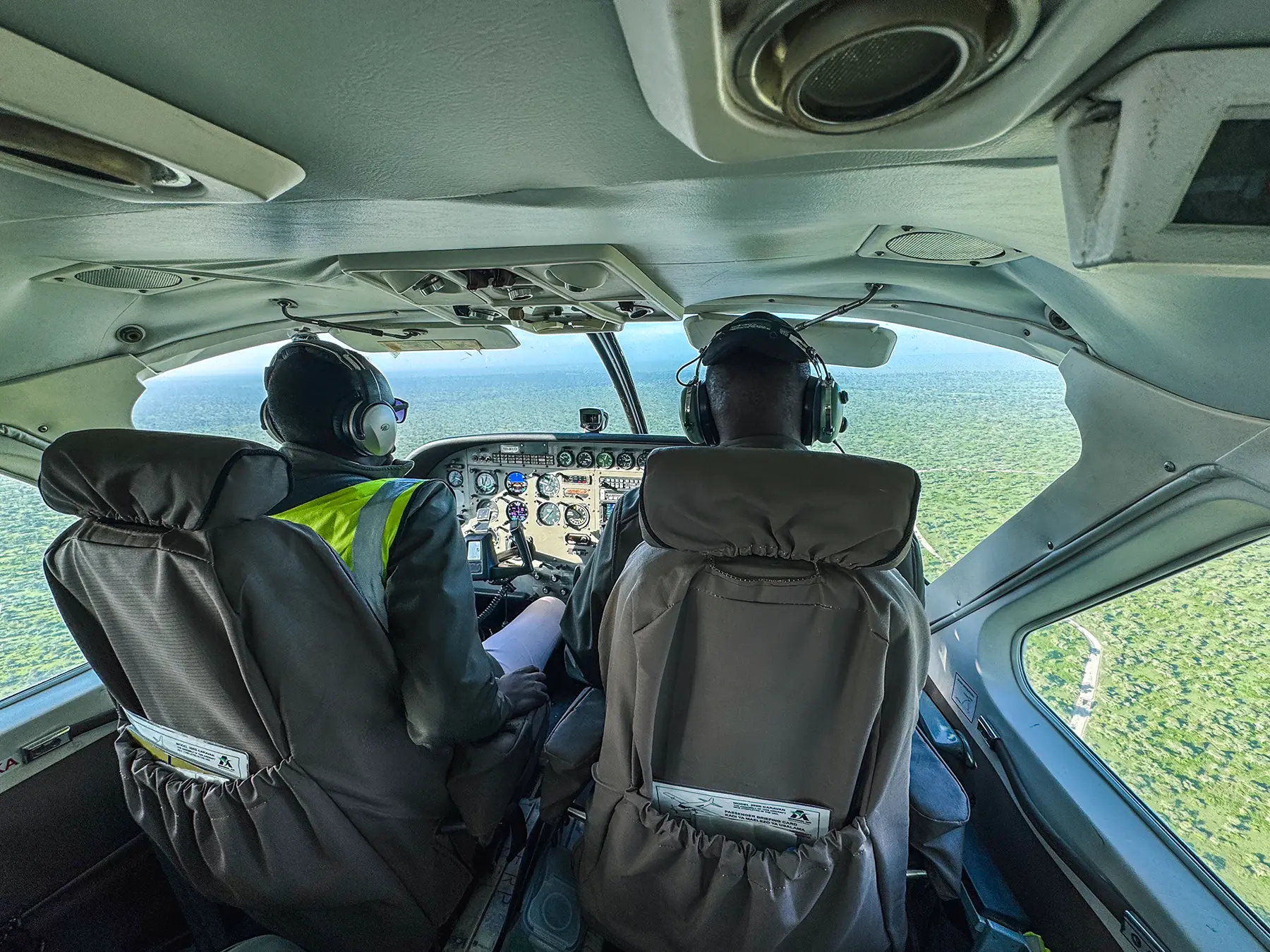
The main cost difference can be seen between driving between parks or flying between parks. Although flying is faster, it’ll add around $300 per person per flight to the price of your trip. Driving is cheaper, but drive times can be long, for example it takes approximately 10 hours from the Maasai Mara to the Serengeti.
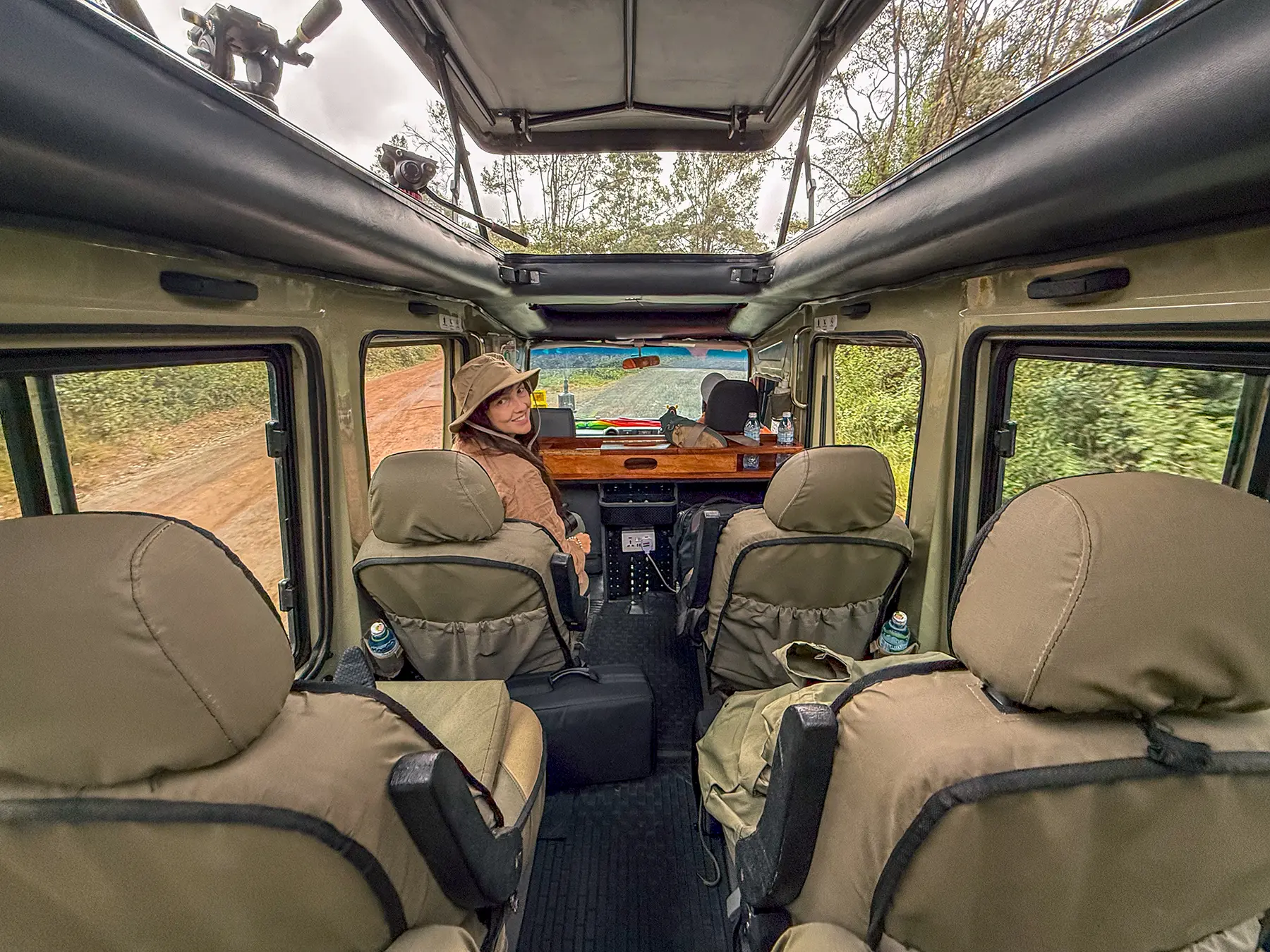
The type of vehicle that you have for your safari can also affect your safari price. In Tanzania a Land Cruiser is the typical safari vehicle that you will be provided with. In Kenya, however, minivans are a more-cost effective alternative, around $100 per day cheaper. In both countries you can pay extra to have an upgraded photography-specific Land Cruiser.
My Preference: I generally prefer to travel by road to enjoy the scenery, but I do like to fly if the drive exceeds 6 hours. When it comes to vehicles, I always opt to have a Land Cruiser as they are more comfortable and can access roads that minivans cannot.
Group Size
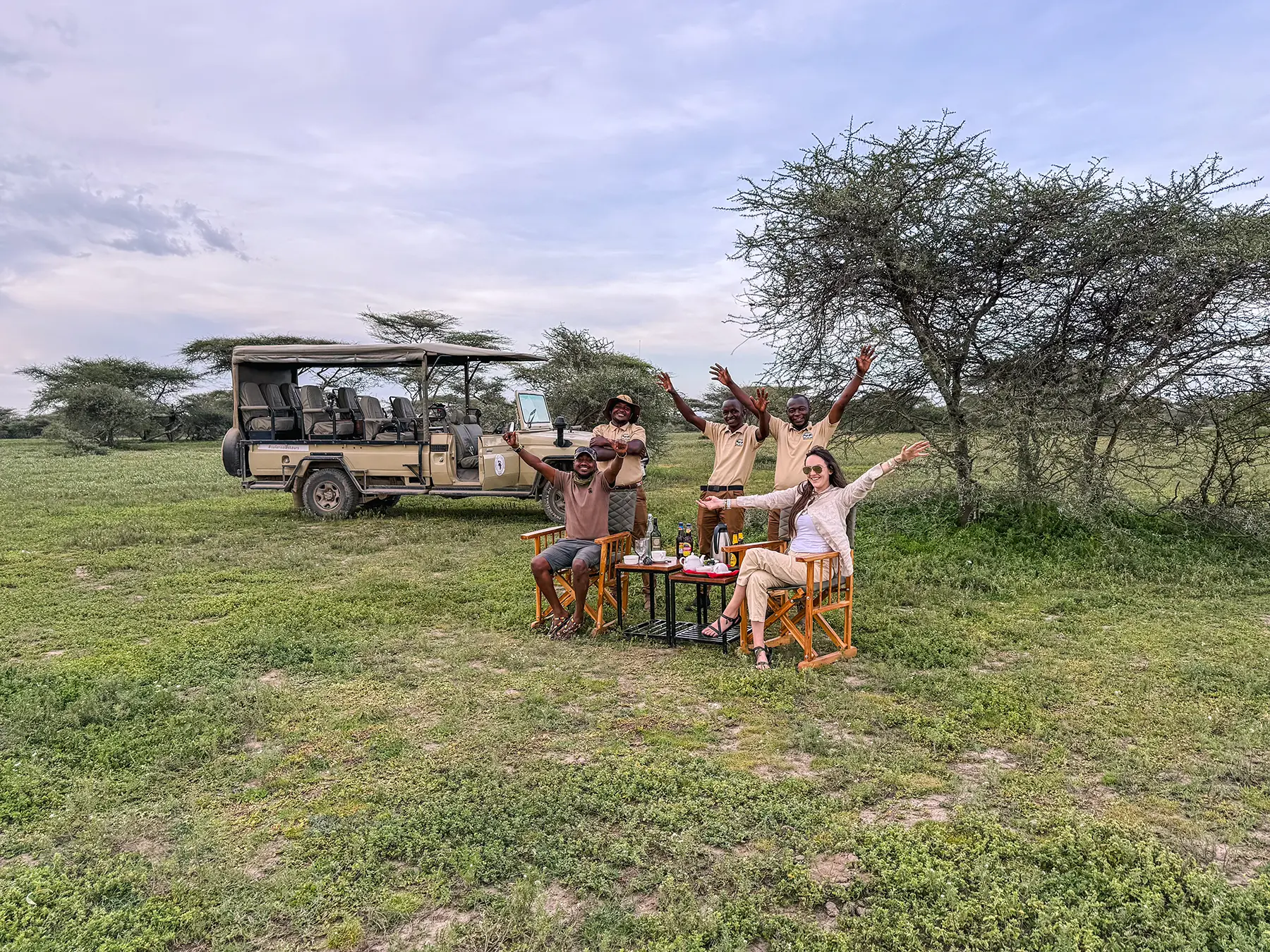
As a general rule, the more people you travel with, the greater the savings.
Fixed costs for group safaris are divided among the members of the group and therefore the larger the group, the less you pay (maximum group no. = 7 people per vehicle).
This also means that the costs of travelling solo are higher. If you’re travelling solo, expect to pay around $500 per person/day versus $300 for two people.
My Preference: I generally like to have a maximum of 2-3 people in the back of the safari truck to allow free movement for sightings and photographs.
When Is the Best Time to Visit Kenya and Tanzania?
In terms of weather, the dry season is the ideal time to visit Tanzania and Kenya, offering pleasant, mild temperatures and little or no rain. Wildlife can be seen more clearly amid the sparse vegetation and animals are drawn to waterholes, making for more reliable viewing than in other seasons.
The period between July and October is particularly spectacular, with more than a million wildebeest travelling from the Serengeti to the Maasai Mara as the Great Migration peaks.
That said, wildlife viewing is outstanding all year round in both Kenya and Tanzania. Every season has its own magic, from the long dry season’s Great Migration river crossings to the countless baby animals born in the short rainy season.
The similarity of their seasonal patterns makes Kenya and Tanzania ideal for a combined trip at any time of year. The four main seasons are the short dry (mid-December to February), the long rains (March to May), the long dry (June to mid-October), and the short rains (mid-October to mid-December).
My Preference: Unless you have your heart set on seeing the Great Migration river crossing, I’d recommend visiting in shoulder season (January/February or November).
I’ve been to both Tanzania and Kenya during the short rains in November and it’s quite possibly my favourite month to visit. The parks were quieter, there were baby animals everywhere and the vegetation was green and lush but not too long so visibility is still good.
I’ve also been to Tanzania in February to see the wildebeest calving, witnessing the adorable baby wildebeest take their first steps. While the weather is more settled at this time of year than November, the parks are also busier. That can be especially bothersome in the Ndutu plains in Southern Serengeti where off-road driving is permitted, as it can cause crowds at wildlife sightings.
I’ve ranked each month of the year for safari in Tanzania as Excellent, Good, OK, or Poor, based on typical game viewing and weather conditions.
If you want to dig deeper, the chart below shows what you can expect in each month in Tanzania in terms of cost, weather, wildlife and hiking Kilimanjaro.
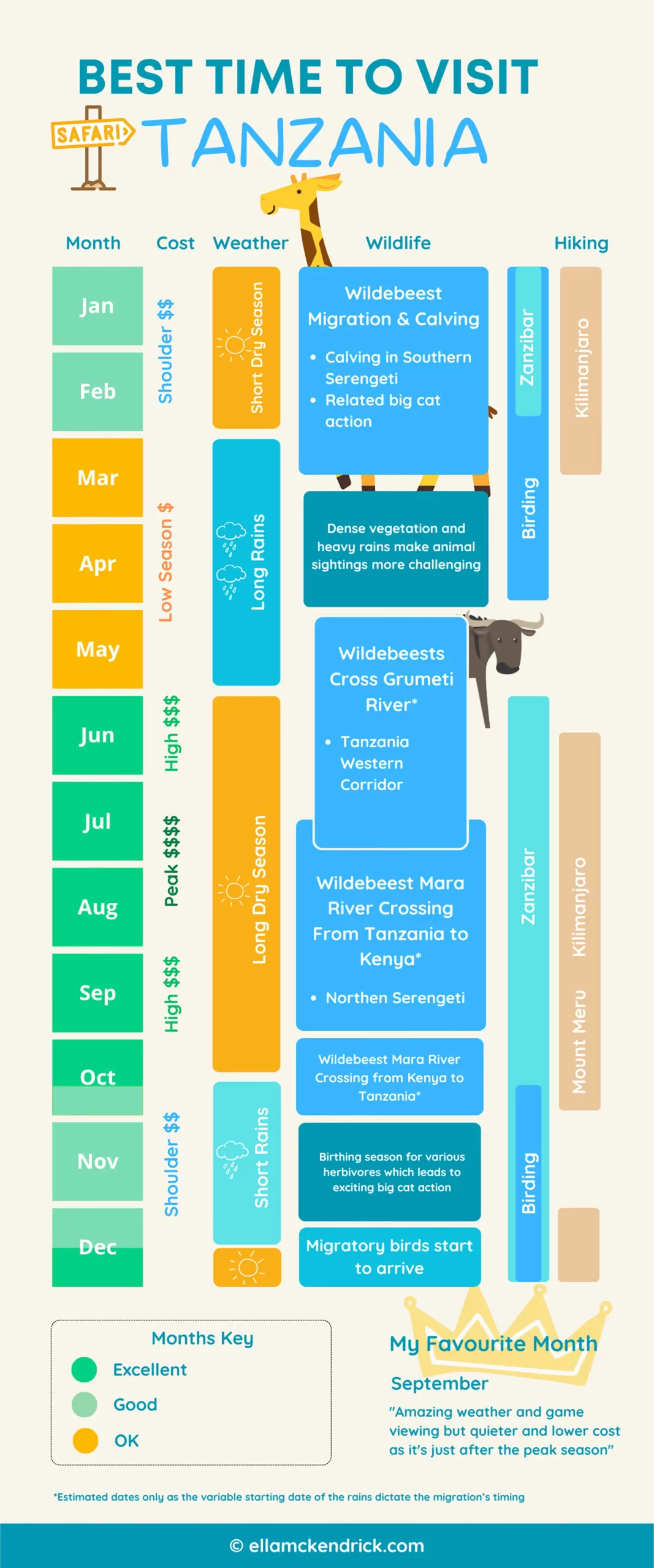
For more information take a look at my ultimate guide on the Best Time to Visit Tanzania.
The long dry season (July to October) offers the most classic safari experience for first-timers with the Great Migration crossing between the Serengeti and the Maasai Mara.
However, we all have different preferences and priorities, so read on to find out more about the advantages and disadvantages of each time of year so that you choose the time that suits you best!
Click the links below to jump to the details on each season.
The Short Dry Season (Mid-December – February)
The Long Rainy Season (March – May)
The Long Dry Season (June – Mid-October)
The Short Rainy Season (Mid-October – Mid-December)
The Short Dry Season in Kenya and Tanzania (Mid-December – February)
The short dry season means sunny weather, baby animals and fewer crowds than peak season. It’s also calving season on the southern Serengeti plains near Ndutu, Tanzania.
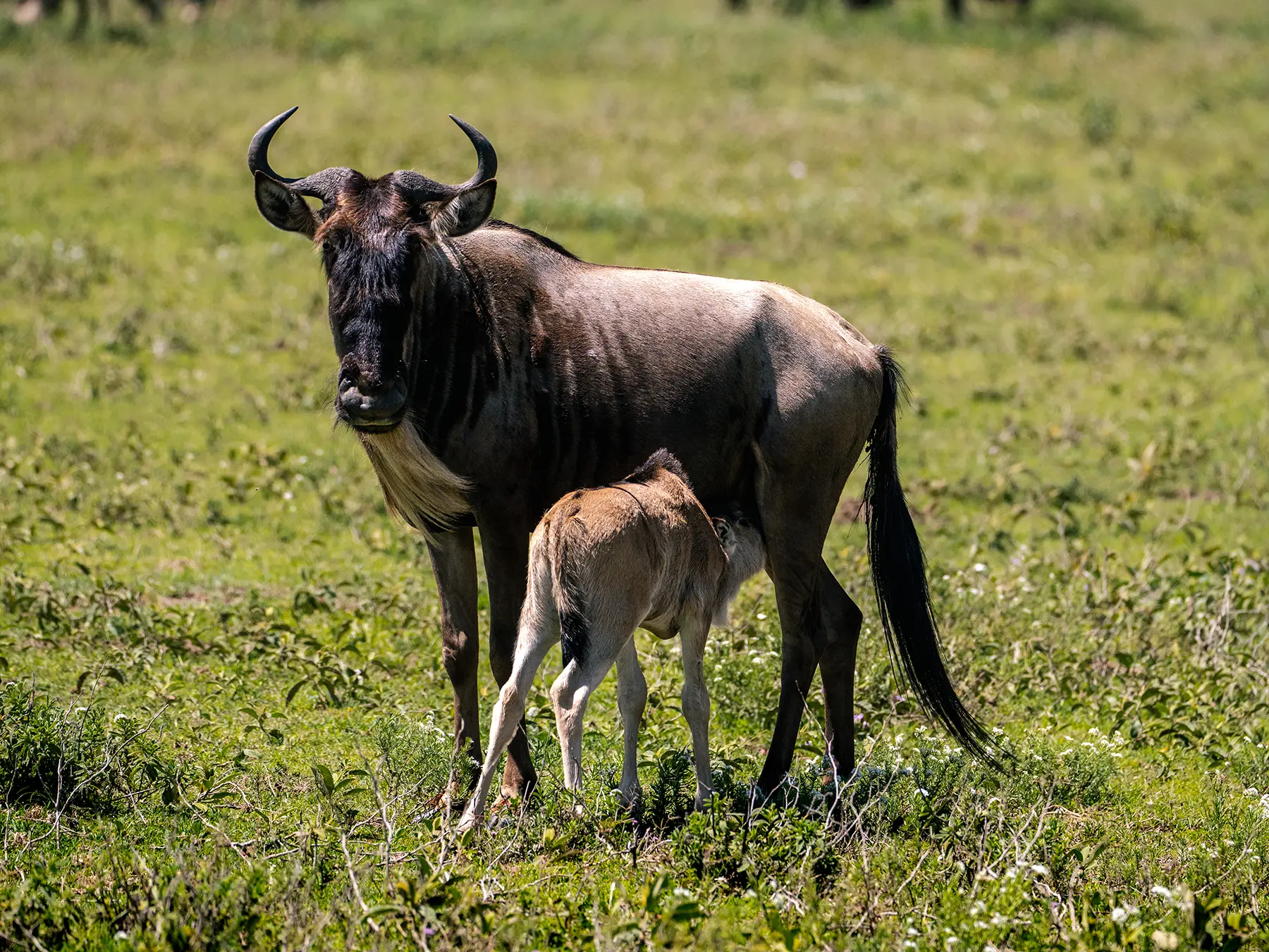
The weather is sunny and dry in both Kenya and Tanzania, with warm temperatures. This is a great time to spot baby animals and related predator activity, and is the second most popular time to visit Kenya and Tanzania after the long dry season. The wildebeest calving season on Tanzania’s Ndutu plains sees up to 8,000 calves born per day during the peak.
At this time of year, Maasai Mara park fees are half the price of the peak season.
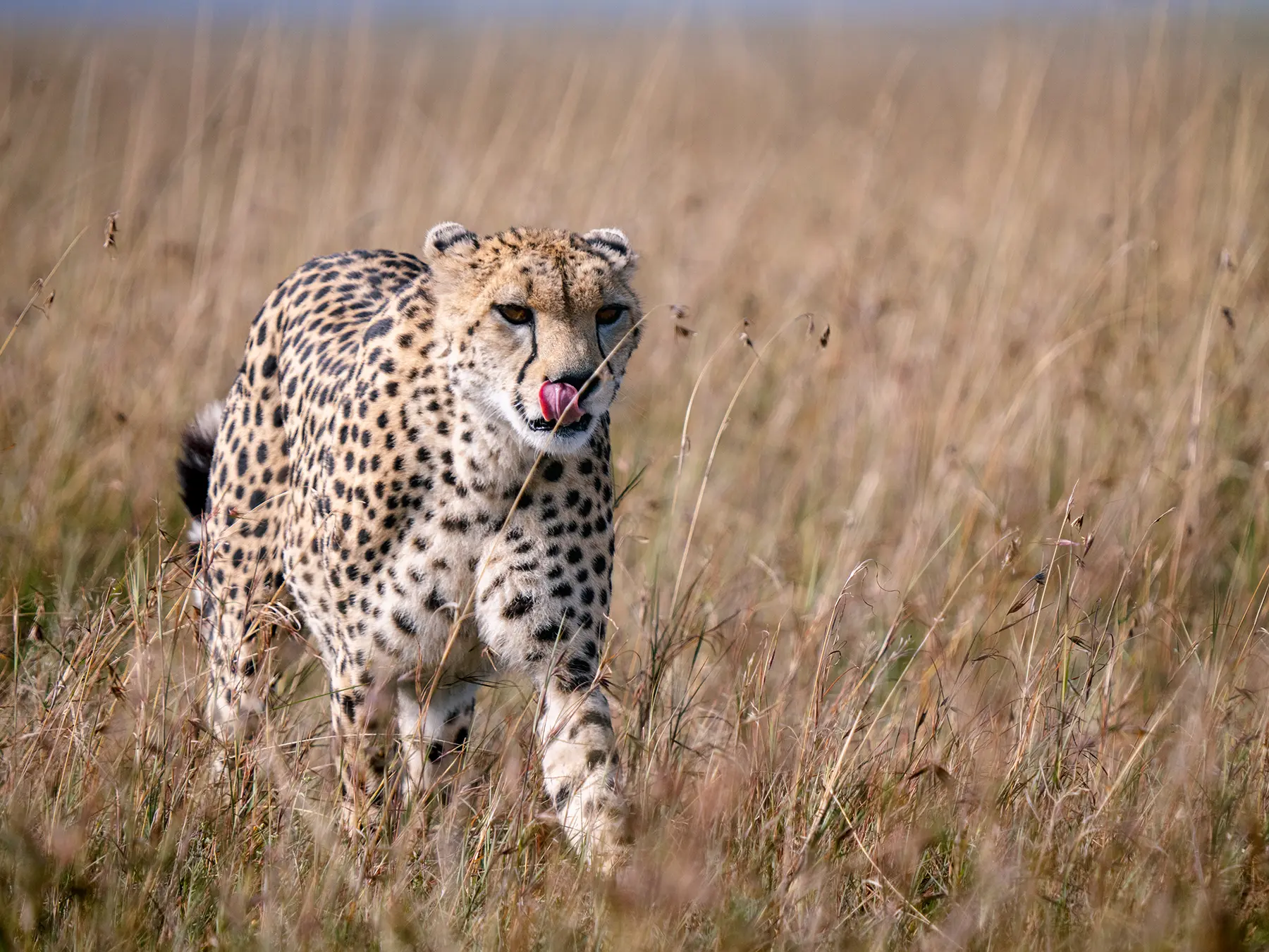
My experience visiting in The Short Dry Season: I found this a great time of year to visit. The days were warm, sunny and dry. I saw the wildebeest calving in Ndutu plains of central Serengeti. The big cats were abundant there too! A particularly memorable sighting was of a mother cheetah and her two six month old cubs. The cubs were leaping on their mother and chasing each other. It was delightful!
You can see a video of my experience visiting the Serengeti in the short dry season.
Quick Facts
Prices: Moderate in Kenya, peak in Tanzania due to the wildebeest calving.
Weather: Sunny and dry, temperatures of 15-30C in both countries.
Wildlife: Baby animals across both countries with related predator activity. Great predator action during calving season on Tanzania’s southern Serengeti plains.
Birding: Breeding season for native birds, with local species in breeding plumage. Northern hemisphere migratory species from Europe and Asia are present in abundance.
Unique features: Ndutu calving in Tanzania peaks in February (up to 8,000 calves per day).
Reasons to Visit in the Short Dry Season
- Sunny, dry weather makes for excellent wildlife viewing
- Both countries enjoy consistently pleasant temperatures
- Very little rainfall in Kenya and Tanzania
- Fewer crowds than long dry season
- Lots of predator activity during Ndutu calving season in Tanzania
- Baby animals are abundant
- The green foliage makes it great for photography
- Park fees in Maasai Mara are lower in January/February than the second half of the year
- A great time to hike Kilimanjaro and enjoy Zanzibar beach, Tanzania
Considerations When Visiting in the Short Dry Season
- Weather at its hottest in both countries
- Water is plentiful, so less wildlife around water holes
- Wildlife can be harder to see due to dense vegetation
- More mosquitoes and higher humidity than in dry season
- Christmas and New Year bring higher prices in Tanzania
- No Great Migration river crossings
Check out my best time to visit Kenya and best time to visit Tanzania guides to learn more.
The Long Rainy Season in Kenya and Tanzania (March – May)
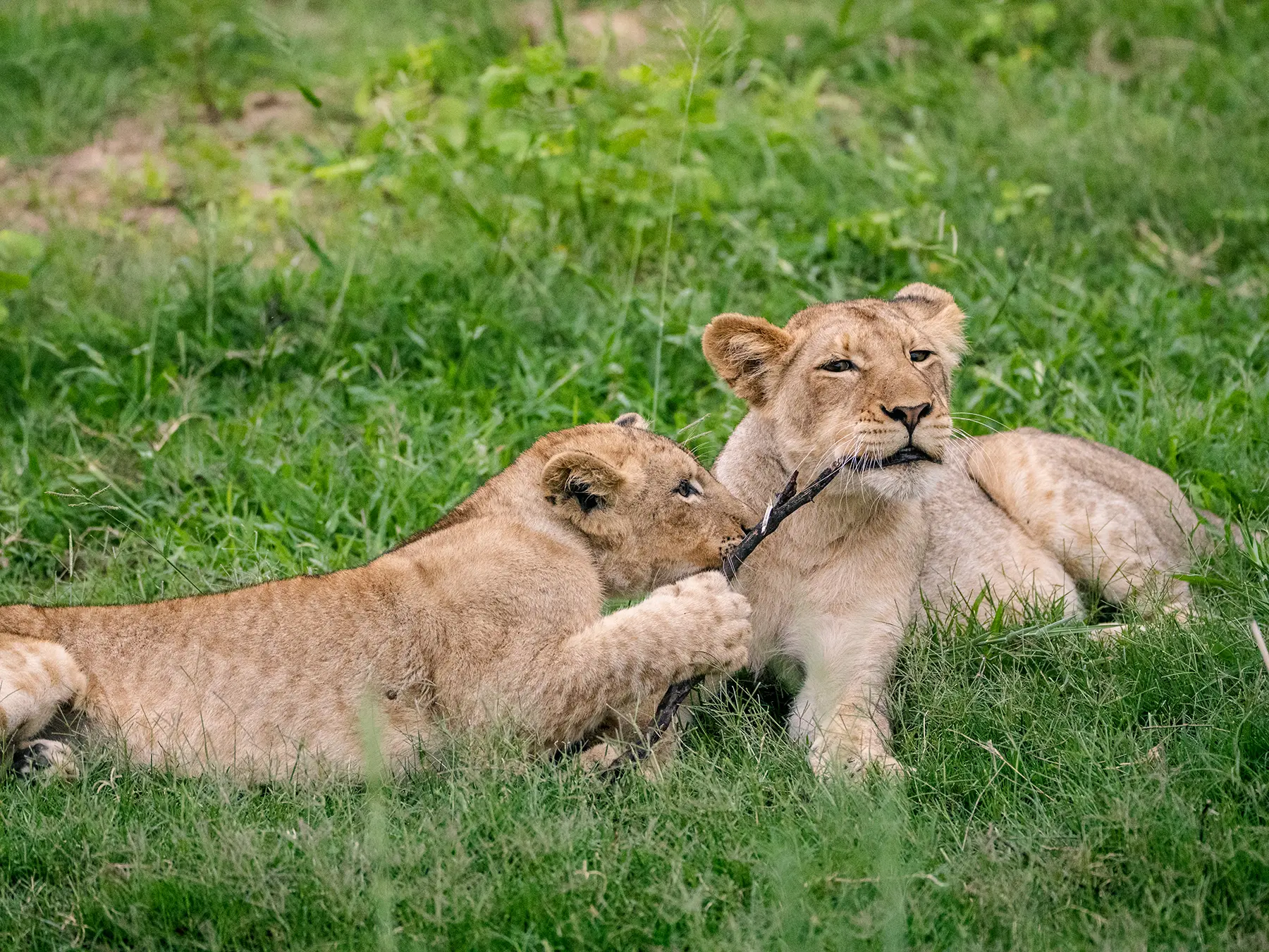
Both countries have their wettest weather between March and May, with heavy rains and sometimes even flooding. This is low season in Kenya and Tanzania.
As you might expect, this season is when visitor numbers are lowest in Kenya and Tanzania, and the prices reflect this. Some camps and lodges even close altogether. While the rain makes everything lush and green, it can be heavy and flooding is possible.
My experience visiting in The Long Rainy Season: Whilst it’s a challenging time of year to visit, the wildlife doesn’t go anywhere and you still have high chances of seeing everything you wish to see. I actually had my best ever black rhino sighting at this time of year.
The main challenges were that some roads were too wet to travel down so we focused on the main tracks through the park. This significantly reduced our traversable area. We also avoided river crossings altogether, further reducing the area.
It rained everyday for our safari. Thankfully the rain seemed to respect our safari schedule, however! Only one of our game drives was affected by some rain at the end. Generally, the heavy downpours took place in the evenings and nights.
I’d personally avoid accommodation on river banks at this time due to the possibility of flooding.
Quick Facts
Prices: Lowest in both countries.
Weather: Cooler temperatures, higher humidity, heavy showers, usually in the afternoons.
Wildlife: Wildlife is still present in all parks, but heavy daily downpours and dense foliage can make game drives and visibility difficult. Some roads become impassible and thus reduces the size of your search area.
Birding: Great for birdwatching, with native species and European and Asian migrants still present.
Unique features: Parks quiet, lowest prices of the year, dramatic storms make great photos.
Reasons to Visit in the Long Rainy Season
- Prices at their lowest in both countries
- Quietest time of year in parks
- Beautiful green vegetation, dramatic skies for great pictures
- Birding excellent in both countries
- Rain is mostly in the afternoons
Considerations When Visiting in the Long Rainy Season
- Heavy rains and even flooding
- Some camps and lodges close
- Reduced wildlife visibility due to dense vegetation
- Peak mosquito numbers
- Some parts of the parks can be hard to reach due to muddy tracks
Check out my full best time to visit Kenya and best time to visit Tanzania guides for more information.
The Long Dry Season in Kenya and Tanzania (June – Mid-October)
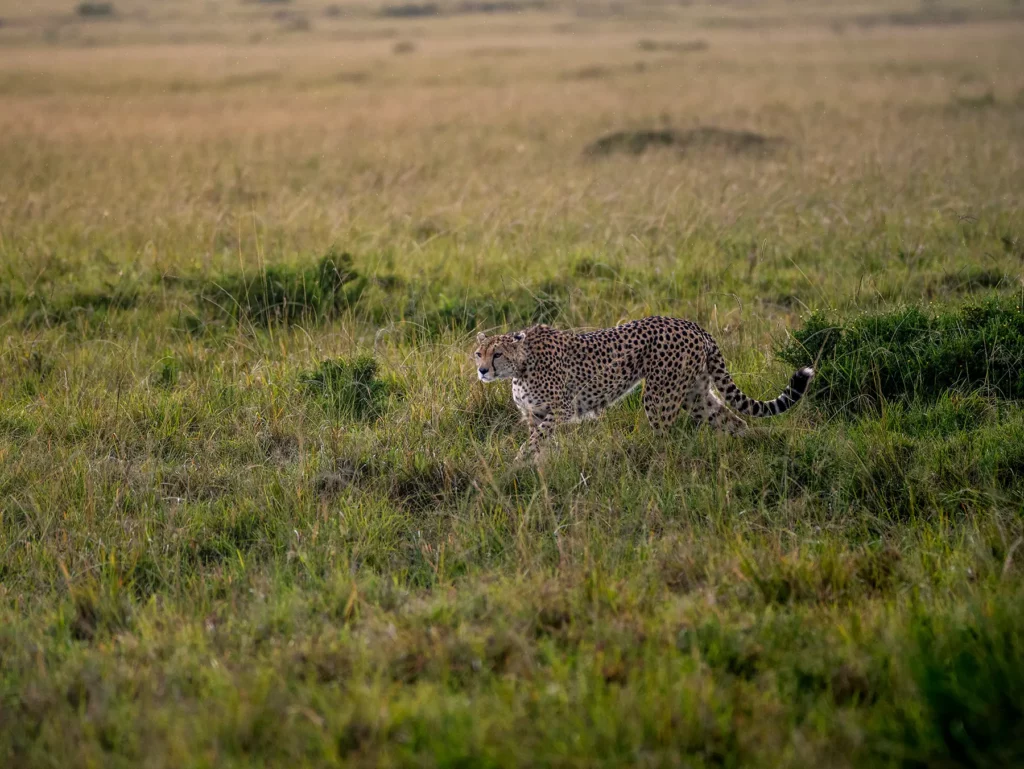
Peak safari season in both countries falls between June and October, with huge herds of wildebeest passing from the Serengeti into the Maasai Mara as part of the Great Migration. This is the most popular time to visit both Kenya and Tanzania, with higher costs and busier parks.
With dry conditions drawing wildlife to water sources, sightings are very reliable. The Mara River crossings between mid-July and mid-October are one of Africa’s greatest wildlife spectacles. This is the best time of year for wildlife viewing, with cloudless skies, cool nights and warm days.
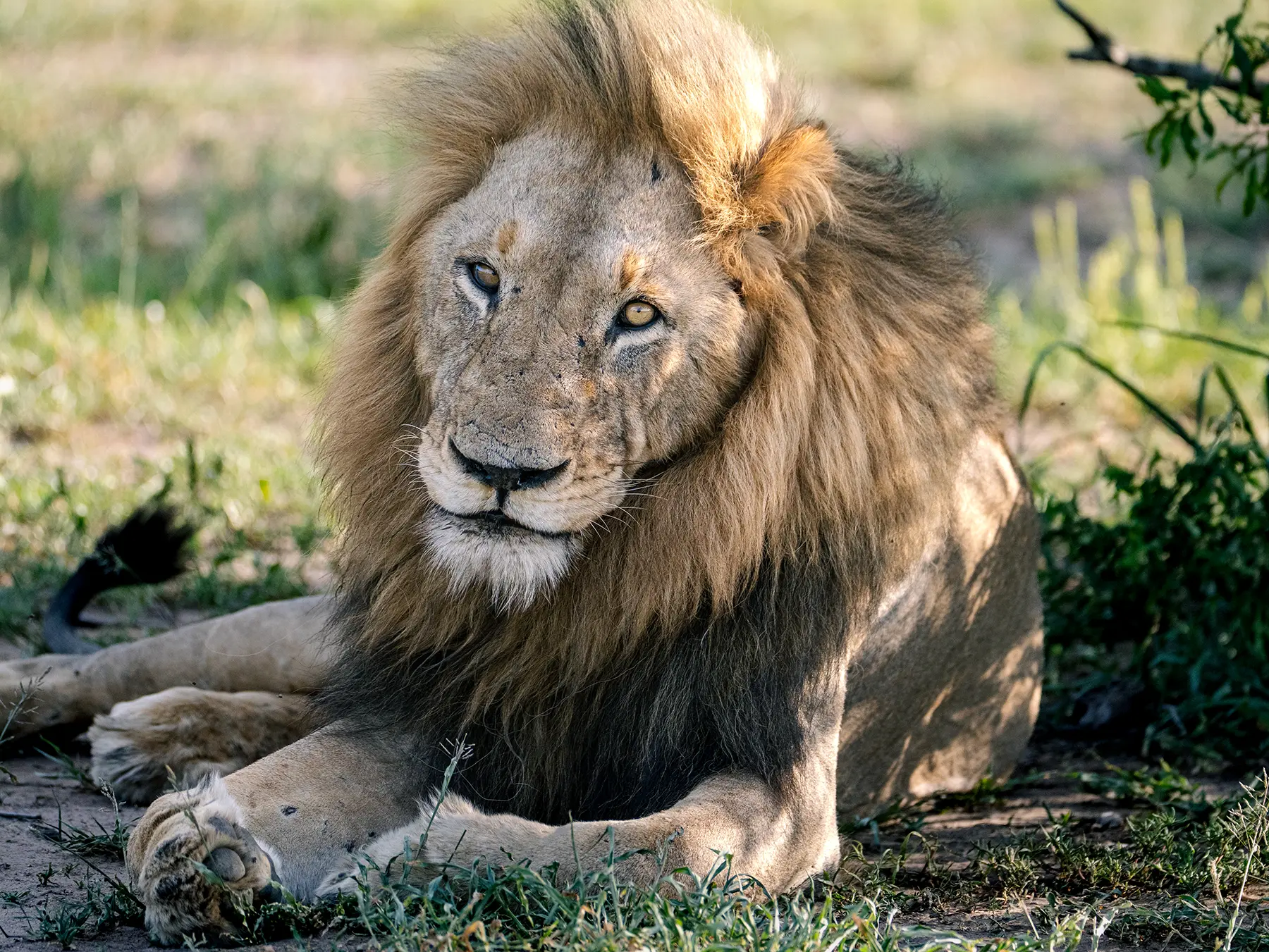
My experience visiting in The Long Dry Season: As to be expected, the best weather I’ve had on safari occurred in the long dry season. Days were sunny yet cool and there was extremely limited rain.
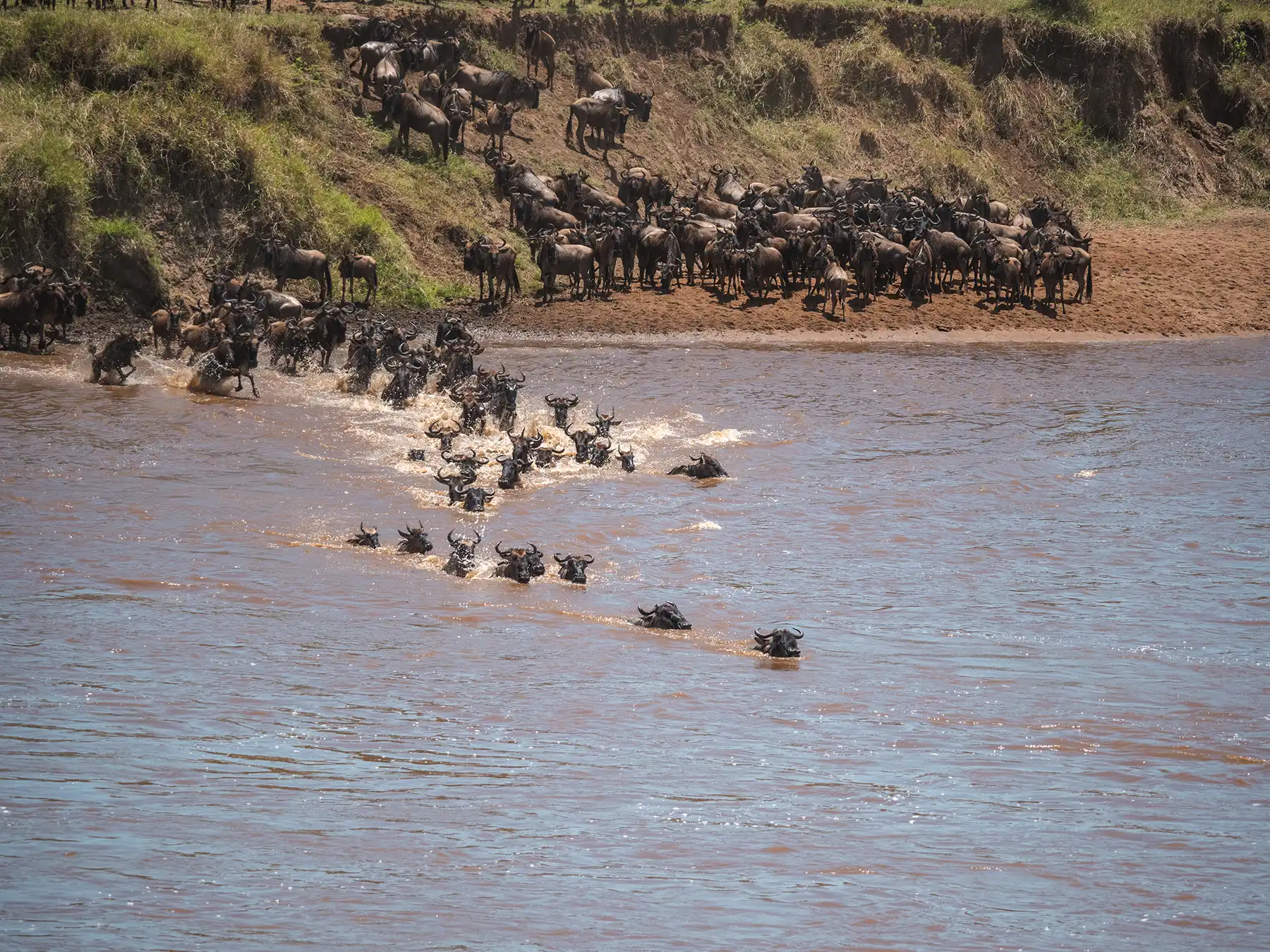
Nothing can quite prepare you for the grandeur that is the great wildebeest migration river crossing. I feel incredibly lucky to have witnessed two separate crossings in one day. It took my breath away as I watched the great herds battling against the raging current. Hungry crocodiles waited at the sidelines and one young wildebeest wasn’t strong enough to escape a set of snapping jaws.
Parks were busy, meaning it was rare to have a sighting to ourselves and we’d sometimes have to wait to have access to sightings. But the high number of vehicles out searching did mean that there was no shortage of sightings and we spent the days moving from one great sight to another.
You can see a video of my experience visiting the Serengeti in the long dry season.
Quick Facts
Prices: Peak season, so prices are higher.
Weather: Dry and sunny with hardly any rain. Cool nights of 10C and warm days up to 25C. This is the coolest time of year in both countries.
Wildlife: Dry conditions draw animals to waterholes for best game viewing. Great Migration in the Mara/northern Serengeti.
Birding: Birding is at its quietest compared to other seasons. Migratory species have departed, leaving only resident species, though there are still many birds to see.
Unique features: The famous Mara River crossing starts in mid-July.
Reasons to Visit in the Long Dry Season
- Animals gather at water sources for unrivalled wildlife viewing
- Great Migration river crossings from mid-July to mid-October
- Cloudless skies, cool nights and warm days
- Sparse vegetation for easy viewing
- Fewer mosquitoes means lower malaria risk
Considerations When Visiting in the Long Dry Season
- Higher costs and busier parks
- Popular parks at their most crowded
- Maasai Mara National Reserve peak fees ($200 per day) from July
- Accommodation books up months in advance
To find out more, read my full best time to visit Kenya and best time to visit Tanzania guides.
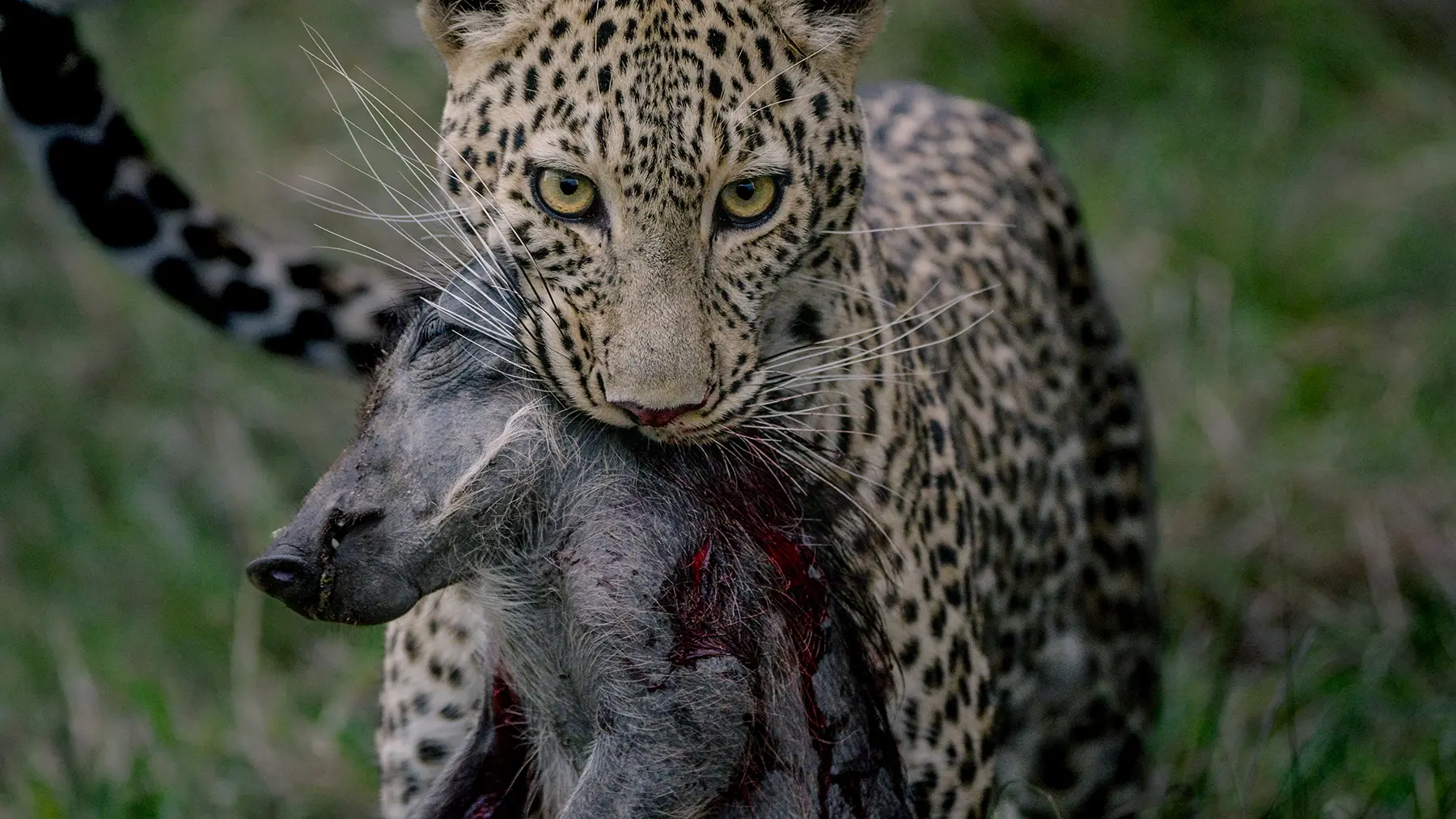
The Short Rainy Season in Kenya and Tanzania (Mid-October – Mid-December)
The short rains is the shoulder season, offering the perfect balance of good weather and quieter parks, with brief afternoon showers that allow vegetation to thrive but don’t disrupt game drives.
Showers are lighter and shorter in both countries than during the long rains, and wildlife is still plentiful, making for excellent viewing. The grass is greening up but isn’t long enough to make wildlife viewing challenging.
My experience visiting in The Short Rainy Season: I have visited both Tanzania and Kenya in November during the short rains and loved it. Baby animals were everywhere, the landscapes were green and lush, and the parks were quieter than peak season. November is perhaps my favourite month overall for visiting East Africa.
I’ve had some of my best ever wildlife sightings at this time of year! In a single day I saw five different groups of lions in the Maasai Mara, including two groups on kills and one pride with tiny baby cubs.
You can see a video of my experience visiting the Maasai Mara in the short rainy season.
Quick Facts
Prices: Moderate, lower than peak season in Tanzania.
Weather: Mornings usually sunny and dry, brief afternoon showers.
Wildlife: Wildlife does not really fluctuate throughout the year, so there are plenty of animals to see. Most herbivores have their young at this time, with lots of baby animals and related predator action. Greener vegetation makes game slightly harder to spot than in the dry season
Birding: Migratory species start arriving from the Northern hemisphere, and flamingo numbers build at Lake Natron for breeding season. This is considered the best birding season in Tanzania.
Unique features: Green landscapes, baby animals born, quieter parks.
Reasons to Visit in the Short Rainy Season
- Prices lower than peak season
- Lovely weather and good sightings but fewer crowds
- Baby animals and related predator action
- Lush, green vegetation – great for photos
- Dry, sunny mornings
- Great for bird watching and photography
- Ideal balance of good weather and fewer crowds
Considerations When Visiting in the Short Rainy Season
- Brief afternoon showers possible
- Roads can be muddy in both countries
- More mosquitoes, higher humidity
- Wildlife can be harder to see among denser greenery
- Maasai Mara park fees still at their highest
Read my full best time to visit Kenya and best time to visit Tanzania guides to discover more.
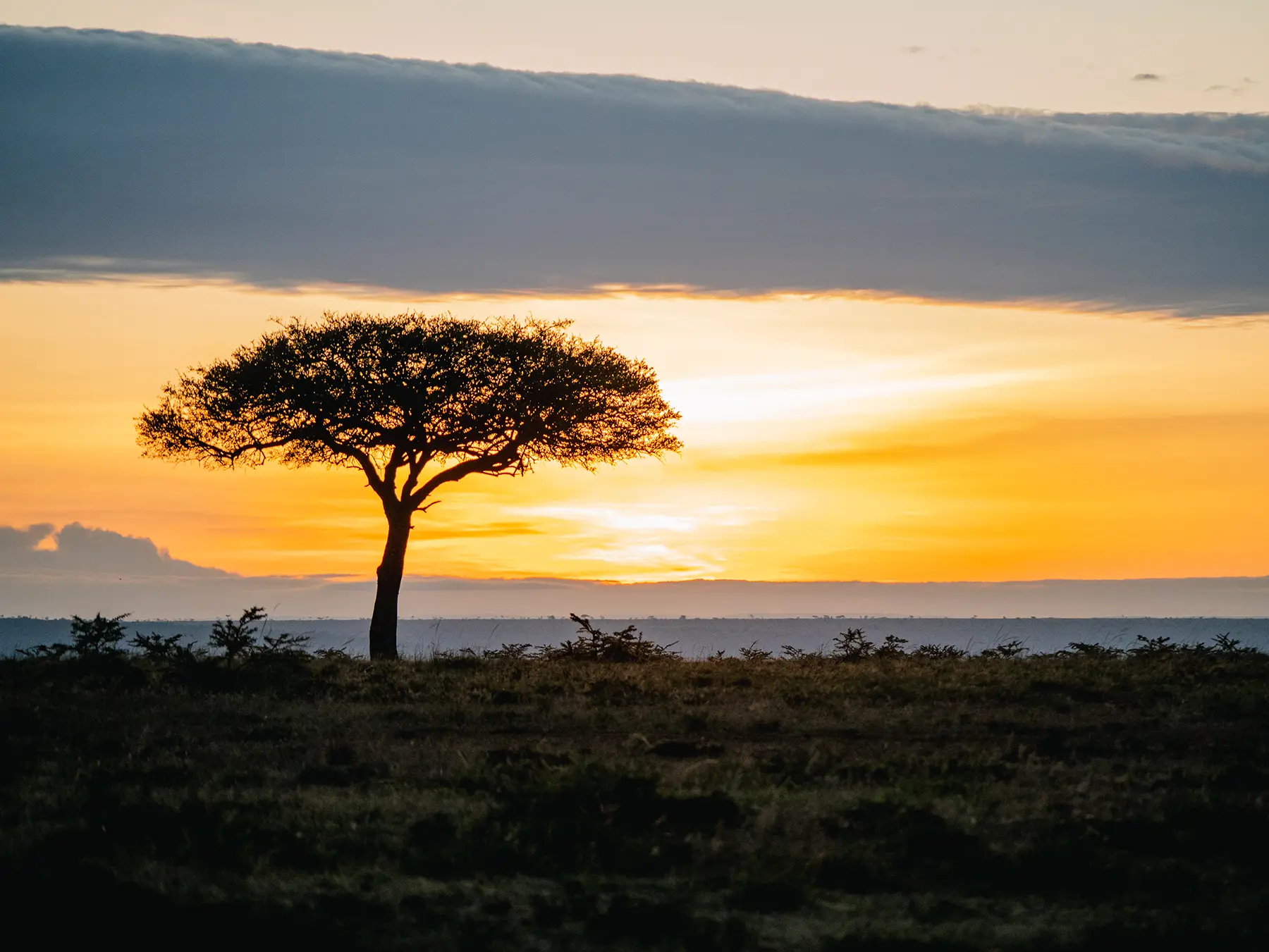
How Long Should You Spend on a Kenya and Tanzania Safari?
You’ll need seven days minimum for a combined Kenya/Tanzania safari. This gives you time to see the Maasai Mara, Serengeti and Ngorongoro Crater without rushing too much, although the itinerary will still be fast-paced.
What 7 Days in Kenya and Tanzania Gets You
- Maasai Mara (2 nights): Game drives across Kenya’s premier reserve, exceptional Big Five sightings and the Great Migration river crossings (July-October)
- Isibania border crossing (Day 4): The 30-90 minute crossing from Kenya to Tanzania is an experience in itself
- Serengeti National Park (2 nights): Full-day games drives across Tanzania’s flagship park, boasting endless plains, over 4,000 lions and large leopard and cheetah populations
- Ngorongoro Crater (1 night): A safari of the crater floor, offering Tanzania’s best black rhino sightings and super-high big cat density
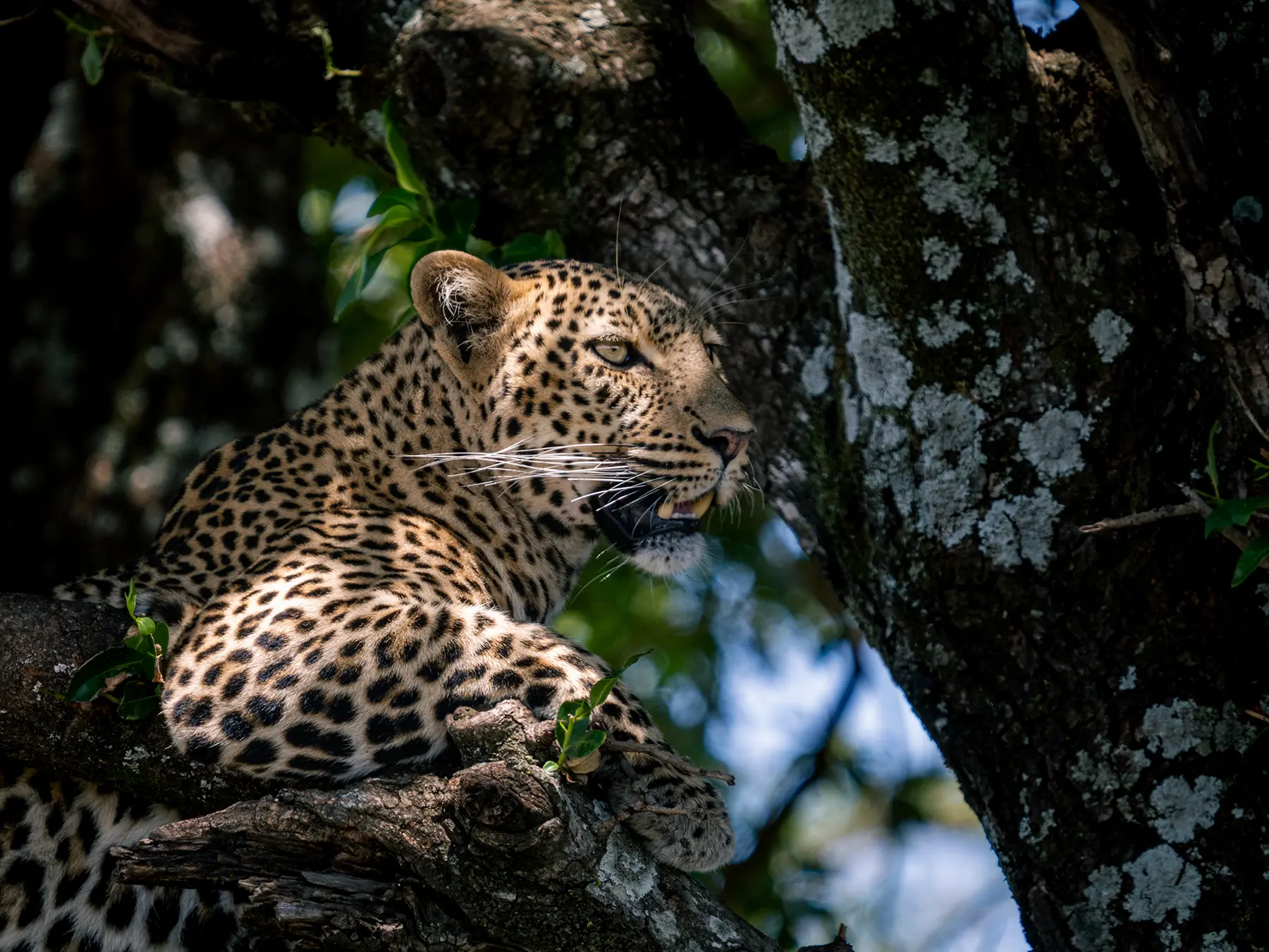
If you have time, a 10-day or 2-week itinerary will allow you to explore Kenya and Tanzania at a slightly slower pace.
- 10-Day Kenya and Tanzania Safari includes Tarangire with its elephant herds and baobab landscapes
- 2-Week Kenya and Tanzania Safari allows time to discover both countries, including Lake Nakuru and Zanzibar beach
If you only have 7 days but prefer a less packed itinerary, you may prefer to tour just one country more extensively.
- 7-10 Day Kenya Safari focuses on Kenya, allowing more time per park
- 7-10 Day Tanzania Safari is an in-depth tour of Tanzania’s northern circuit
My Preference: I’d reserve at least seven days for a combined trip to experience both the Maasai Mara and Serengeti. However, a 10-day itinerary will be more leisurely, with fewer long drives between reserves.
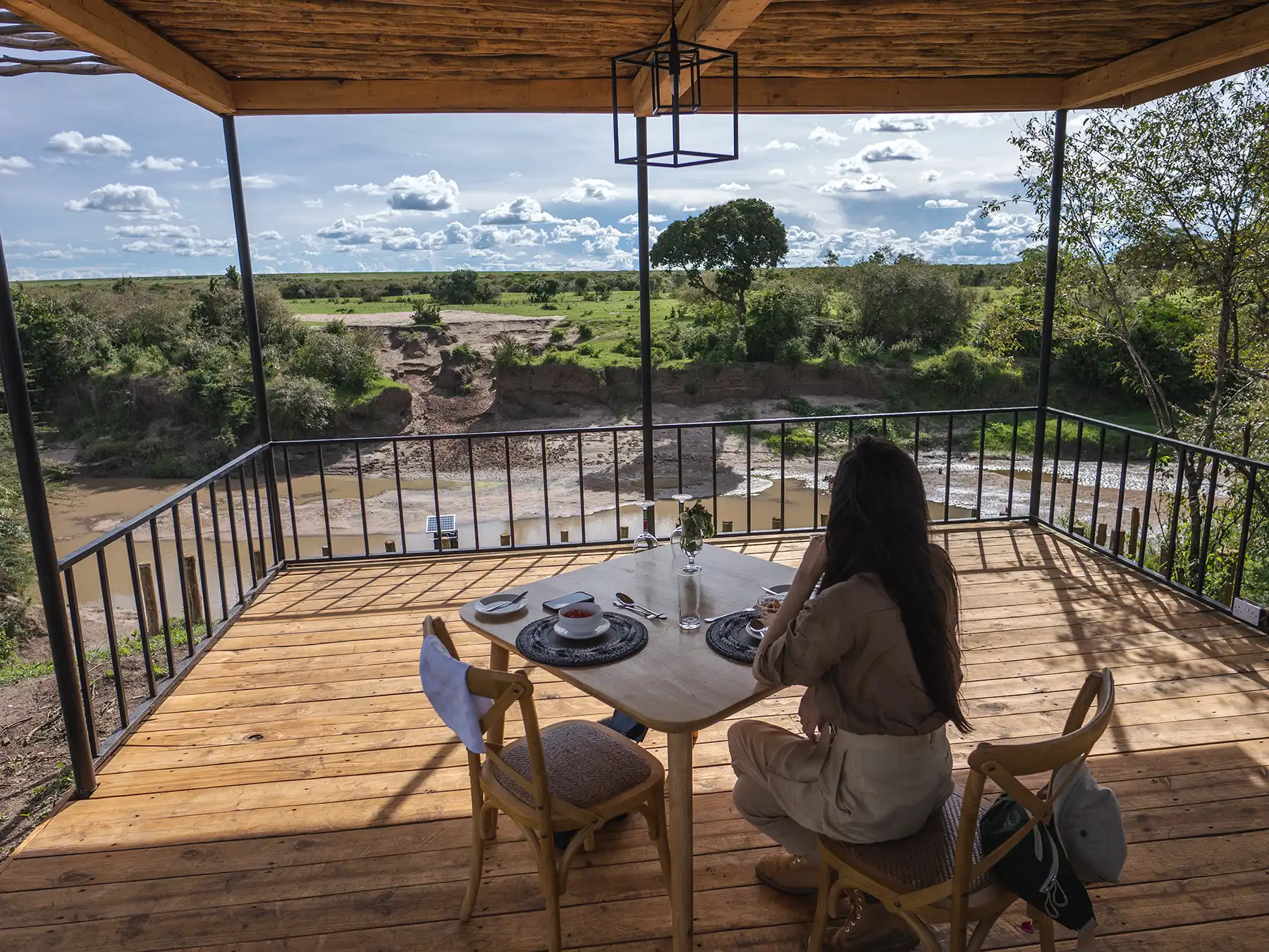
7-Day Kenya and Tanzania Safari Itinerary Overview
This 7-day Kenya and Tanzania safari itinerary covers three of East Africa’s most iconic wildlife destinations, from the world-famous Maasai Mara National Reserve to the vast Serengeti National Park and the breathtaking Ngorongoro Crater. You spend 2 nights in the Mara, cross at Isibania on Day 4, then have 2 nights in the Serengeti and 1 night at the Ngorongoro Crater before departing from Arusha.
I designed this route based on my own experiences travelling around both Kenya and Tanzania, balancing game driving time with the border crossing and keeping transfers manageable.
Quick Facts
Average driving time per day: 3-5 hours
Best times of year: July to October (dry season, Great Migration) or January to February (calving season, lower prices).
7-Day Kenya and Tanzania Safari Map
The Perfect 7-Day Kenya and Tanzania Safari: Day-by-day Breakdown
With so much to see and do, your 7 days in Kenya and Tanzania will fly by! This itinerary will help you make every moment count.
Click on any day for full details.
Day 1: Nairobi to Maasai Mara
Drive Time (Excluding Game Drives): 5 – 6 hours
Welcome to Kenya, the birthplace of safari! What’s more, the word “safari” is derived from the word for “journey” in Kenya’s national language, Kiswahili!
Today you will depart from the lively city of Nairobi and journey to the world-famous Maasai Mara National Reserve!

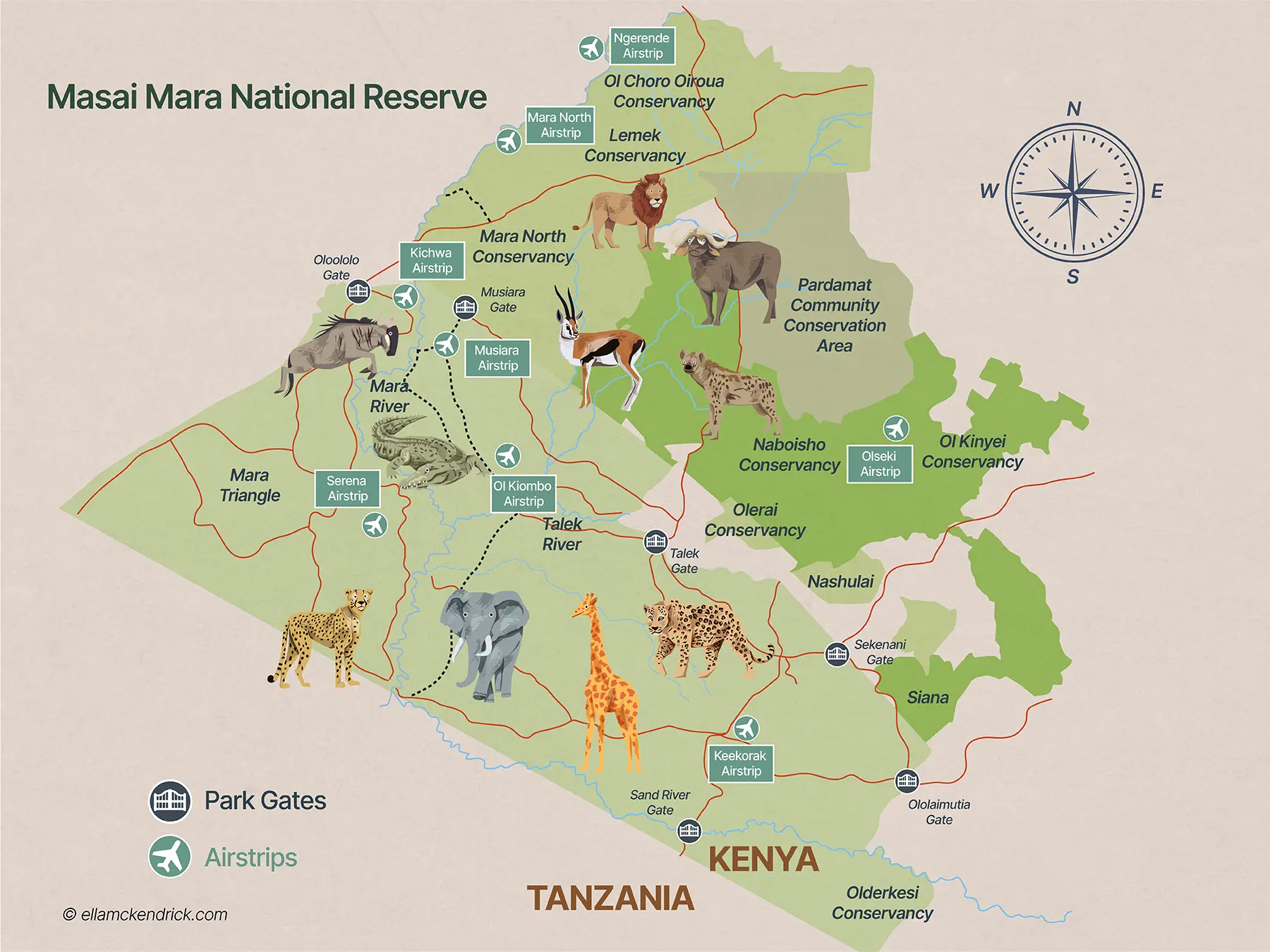
Map of Maasai Mara National Reserve
Here is a map I made showing the key features of the Maasai Mara National Reserve.
Itinerary
If you’re arriving on an early morning flight, you can start your onward journey straight from the airport. If landing in the afternoon or evening, however, it might suit you better to spend the night in Nairobi and embark on your safari adventure the next day. That will give you the chance to see a little of the city if you’re not too tired.
It takes around 5-6 hours to drive from Nairobi to the Maasai Mara via the Great Rift Valley. Your tour operator will arrange for a driver to pick you up at the airport if you’re travelling directly from there or from your hotel if you’ve decided to spend the night in Nairobi first.
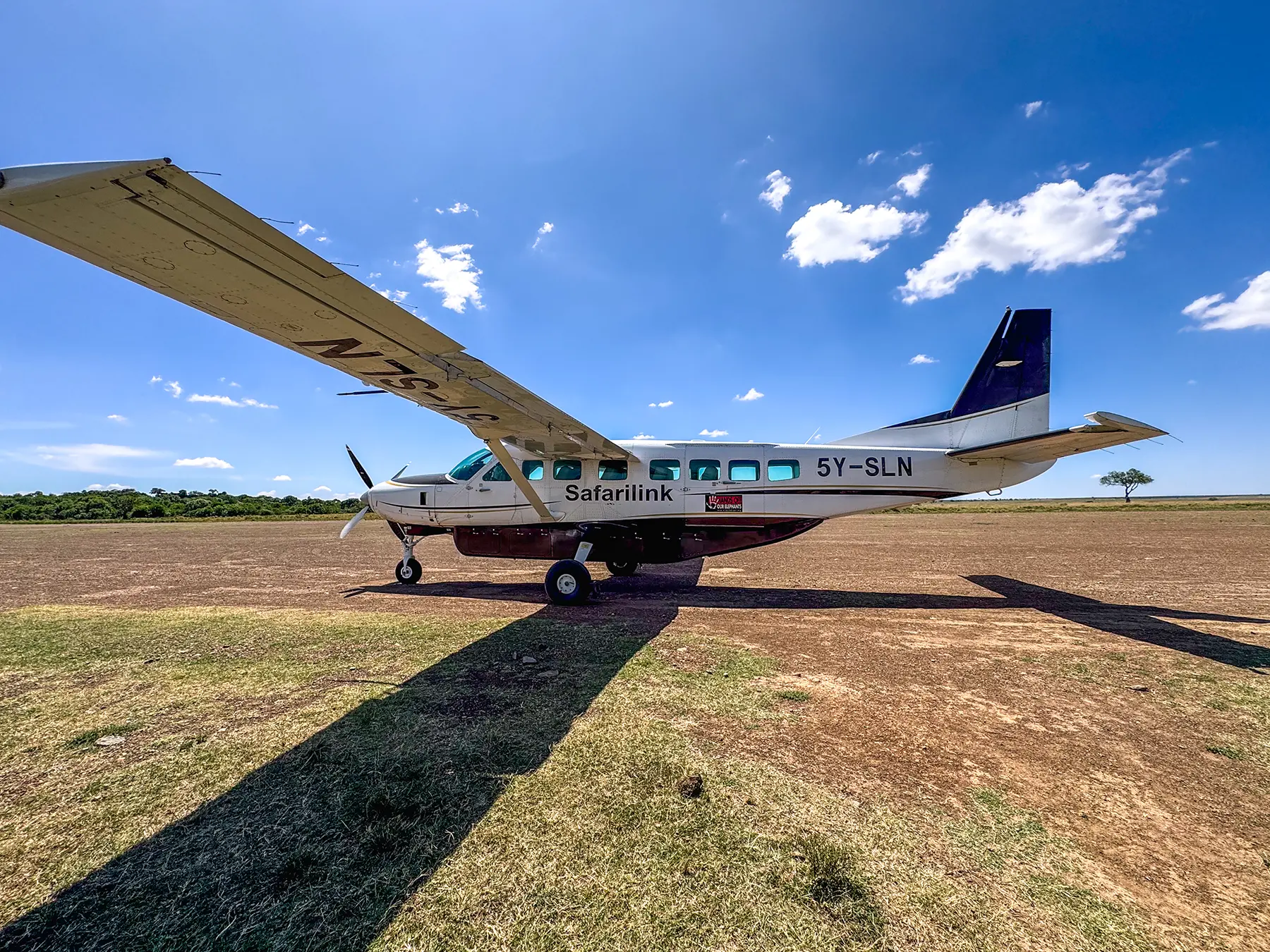
You also have the option of an internal flight on a Cessna Caravan safari plane which takes less than an hour but adds around $300 per person.
You will be making 2 stops on your drive from Nairobi to Maasai Mara. The first of these will be at the Great Rift Valley viewpoint, where you’ll find washrooms as well as a restaurant and a curio shop. The second stop is in Narok, which is the final town before you reach the Mara. Here, too, you can use the washroom and buy drinks and snacks or even a few local craft items.
Once you arrive at the reserve, you will have time to head out on an evening game drive before returning for a welcome dinner at your camp and turning in for the night.
About Maasai Mara National Reserve
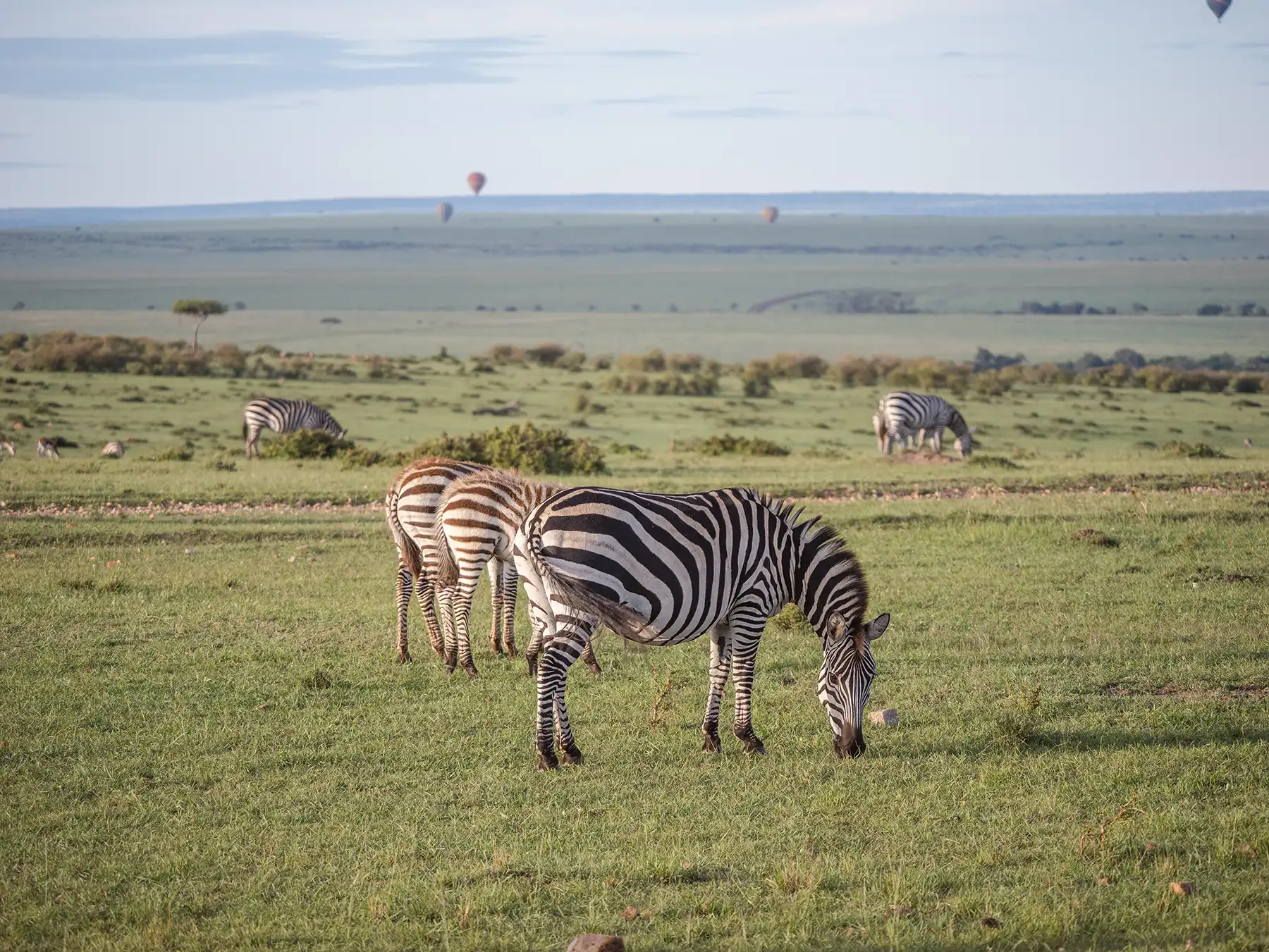
First established as a wildlife sanctuary in 1961, the Maasai Mara was awarded National Reserve status in 1974. The park forms part of the wider Serengeti ecosystem and has no boundary fences, allowing animals to move freely between the reserve and the larger wilderness area.
Spanning over 1,510 km2 and comprising largely open grassland, the Maasai Mara is home to all of the Big Five along with a wealth of other mammals and in excess of 570 species of bird.
Its diverse landscape includes vast expanses of savannah, swathes of lush riverine forest along the Mara River and the Olooloo Escarpment to the west, with its spectacular sheer drop to the valley below.
Because the reserve is managed by Narok County rather than the Kenya Wildlife Service, park fees are set independently. Self-driving has been banned in the Maasai Mara since June 2024.
What Wildlife Can I See in the Maasai Mara?
You can look forward to the chance to see all of the Big Five.
The Maasai Mara has exceptional big cat sightings as the reserve is home to large lion, cheetah and leopard populations. Boasting a lion density of 16.5 per 100 km2, it is statistically one of the best reserves in Africa for lion encounters.
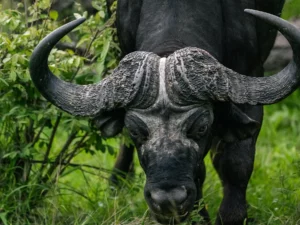
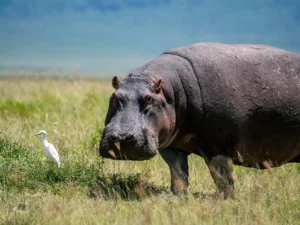
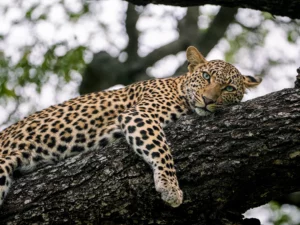
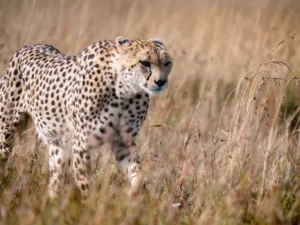
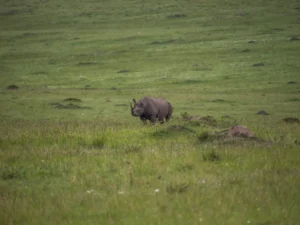
Black rhinos are the most challenging of the Big Five to spot with only around 40 individuals in the Mara area, however, I did recently have my best black rhino sighting to sate in the Maasai mara and it was incredibly close up too!
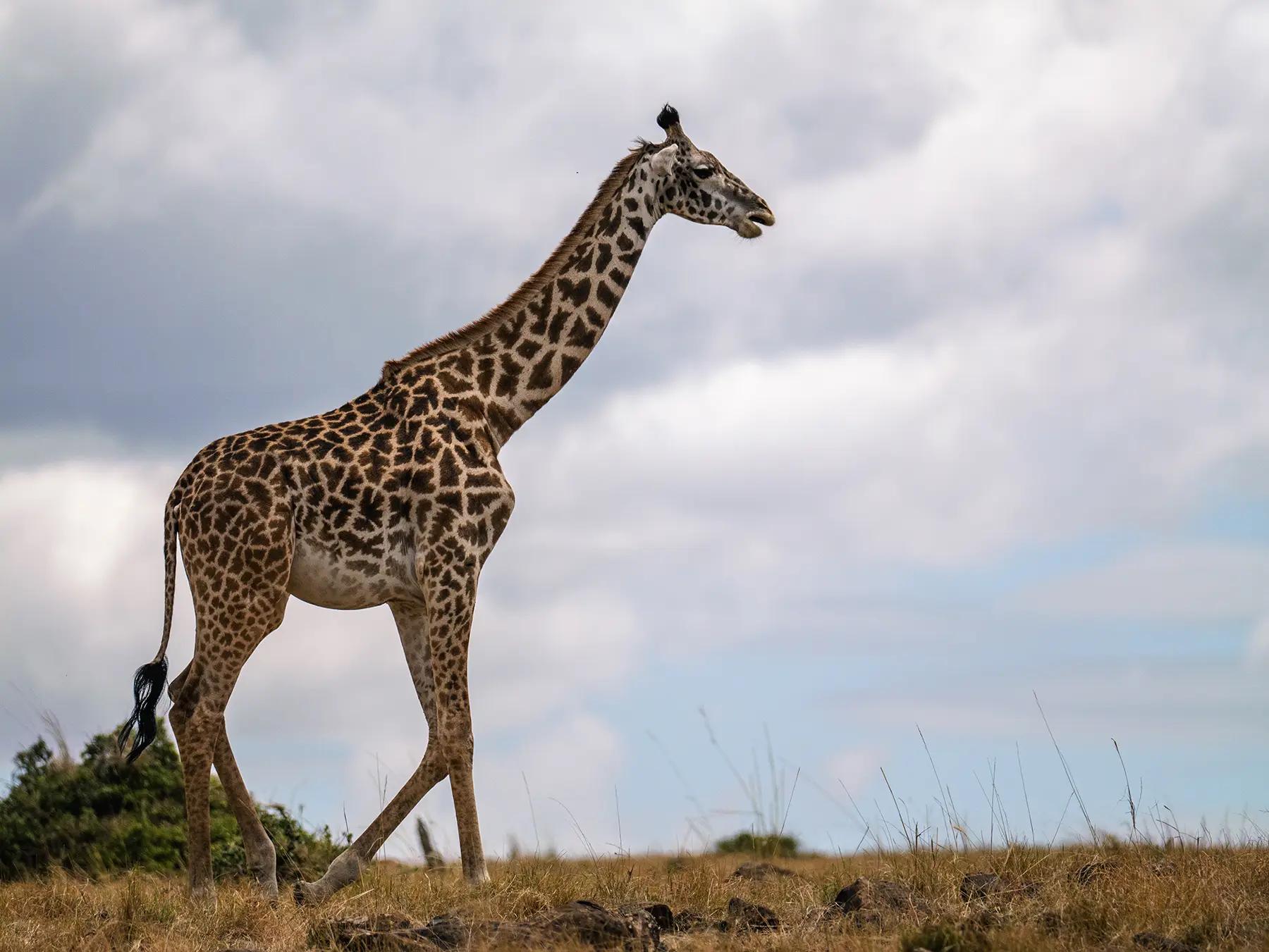
Elephants are a common sight here, as are buffalos and giraffes.
During the Great Migration between July and October, more than two million wildebeest, zebras and gazelles make their way from the southern Serengeti to the lush grasses of the Maasai Mara. The dramatic scenes as they cross the Mara River, attempting to avoid the hungry crocodiles which lie in wait as they go, make for unforgettable viewing.
The Maasai Mara is also a fantastic destination for birders, with a huge variety of species recorded within its grounds.
The grasslands harbour secretary birds, ground hornbills and white storks, while the swampy land on the riverbanks is a great place to spot sacred ibis, crowned crane and several species of heron. Meanwhile, spectacular birds of prey such as the Martial eagle and bateleur soar overhead.
The reserve is filled with birdsong from dawn until dusk, not to mention the multiple species of owl that hunt here at night.
The Maasai Mara and its surrounding private conservancies are my favourite safari destination in Kenya and a must-see if you’re visiting the country. I have had so many incredible wildlife encounters here – some of the best I’ve ever experienced. You are sure to leave this park with some amazing memories and wonderful photos.
Tips for Travelling to Maasai Mara National Reserve
Here are my top tips for the journey to the Maasai Mara!
- The final leg of the 6-hour drive from Nairobi can be a bit bumpy if you’re based in Talek as you hit the dirt roads, so be prepared!
- I’d recommend leaving Nairobi early to skip the traffic and avoid prolonging the drive unnecessarily. Between 7am and 8am is ideal.
- Tsetse flies are present in areas of the Maasai Mara and are especially drawn to navy blue and black. Wearing light neutral colours can help discourage them.
- You can skip the drive with an internal flight on a safari plane which costs around $300 per person each way and takes less than an hour.
My Experience of the Journey to Maasai Mara National Reserve
Depending on the location of my accommodation in the Maasai Mara, sometimes I drive and sometimes I fly. If the accommodation is deep in the park or in one of the conservancies flying becomes more compelling.
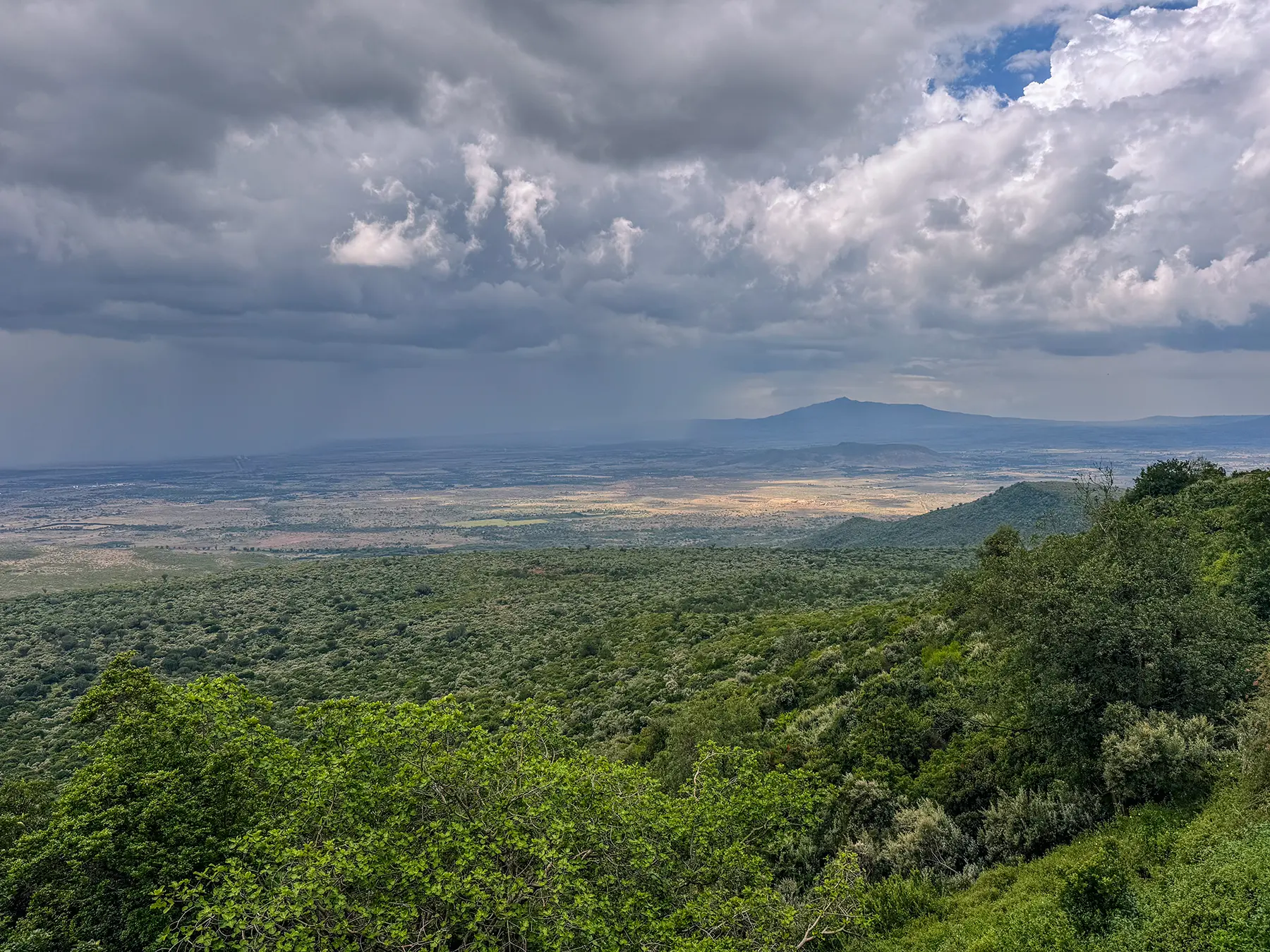
During a 6-hour drive to Maasai Mara, we were spoiled with panoramic views of the Rift Valley and rural Kenya. Although it was a bit cloudy when we stopped at the Rift Valley Viewpoint, which obscured the view a little, I still enjoyed the chance to stretch my legs and get something to eat.
The final stretch of road to Talek after our second stop at Narok was pretty rough, but I honestly didn’t mind the bumpiness as my safari had already begun! I saw zebras, impalas, baboons and giraffes on the way to camp. What a great way to set the mood!
On a subsequent visit to the Maasai Mara, I was based near Sekenani Gate. When journeying to this part of the Maasai Mara, it’s tarred roads all the way up to the gate. Although there are a few gaping potholes in the road to contend with.
You can watch a video of my experience visiting the Maasai Mara below and get a real feel for this amazing safari reserve.
Where to Stay in Maasai Mara National Reserve
During your visit to Maasai Mara, you’ll be spending the night at a lodge or tented camp near or inside the reserve.
Accommodation near the Talek or Sekenani gates is a bit less costly than staying inside the reserve itself. From here, you can also enjoy convenient access to the park and prime wildlife spots.
You can opt to stay at accommodation located inside the reserve, however, this does tend to cost more on a like for like basis compared to accommodation outside.
The benefits of staying inside the reserve are:
- You can set off earlier on your morning game drive 5:45 which is 15 minutes earlier plus you also have a head start being in the reserve, especially if your accommodation is in a good spot. Also visitors from outside the reserve have to queue to enter and queues can get big during the peak season.
- You can return to your accommodation for lunch which can work well as often the best game viewing is in the morning and afternoon as wildlife is not as active in the midday heat. For accommodation outside the reserve they’d give you a packed lunch to eat at picnic spots in the Maasai Mara as if you returned for lunch you’d have to pay park fees again to re-enter which is not cost-effective.
Days 2-3: Maasai Mara
Drive Time (Excluding Game Drives): 0 hours
You now have two full days to explore the spectacular Maasai Mara National Reserve, one of the world’s top safari destinations. Have your camera at the ready because you’re about to enjoy some of the most incredible wildlife encounters of your trip!
Counting all of the Big Five among its residents, the Maasai Mara reserve is especially renowned for its high concentrations of predators, including lions, leopards, and cheetahs.
If you visit between July and October, you may be lucky enough to witness the Great Wildebeest Migration crossing the Mara River. During this phenomenon, over two million animals cross from the Serengeti, navigating the treacherous Mara River crossing along the way. It is a truly awesome spectacle of nature.
Itinerary
You will spend both of your days in the Maasai Mara on full-day game drives from dawn till dusk, bringing packed breakfasts and picnic lunches with you to maximise your time in the reserve.
This will also mean you can cover much more ground and boost your chances of some really great sightings.
If you’re staying in the reserve you can always come back for lunch at your hotel but most visitors are just outside the reserve so stay inside for the full day.
The gates of the reserve open at 6am and shut at 6:30pm, and your guide will likely strive to be there on the dot at opening time (if not well before) to ensure you catch the best dawn sightings. There are usually queues at the gates in peak periods so get there early if possible so you’re at the start of the queue.
If you’re staying inside the reserve you can set off at 5:45 and skip any queues on the gates as you’re already inside.
This is one of the best times to spot much of the park’s wildlife, as animals are at their most active early in the morning. Predators in particular prefer to roam and hunt in the cool of the early morning and tend to retire and rest as the day gets hotter.
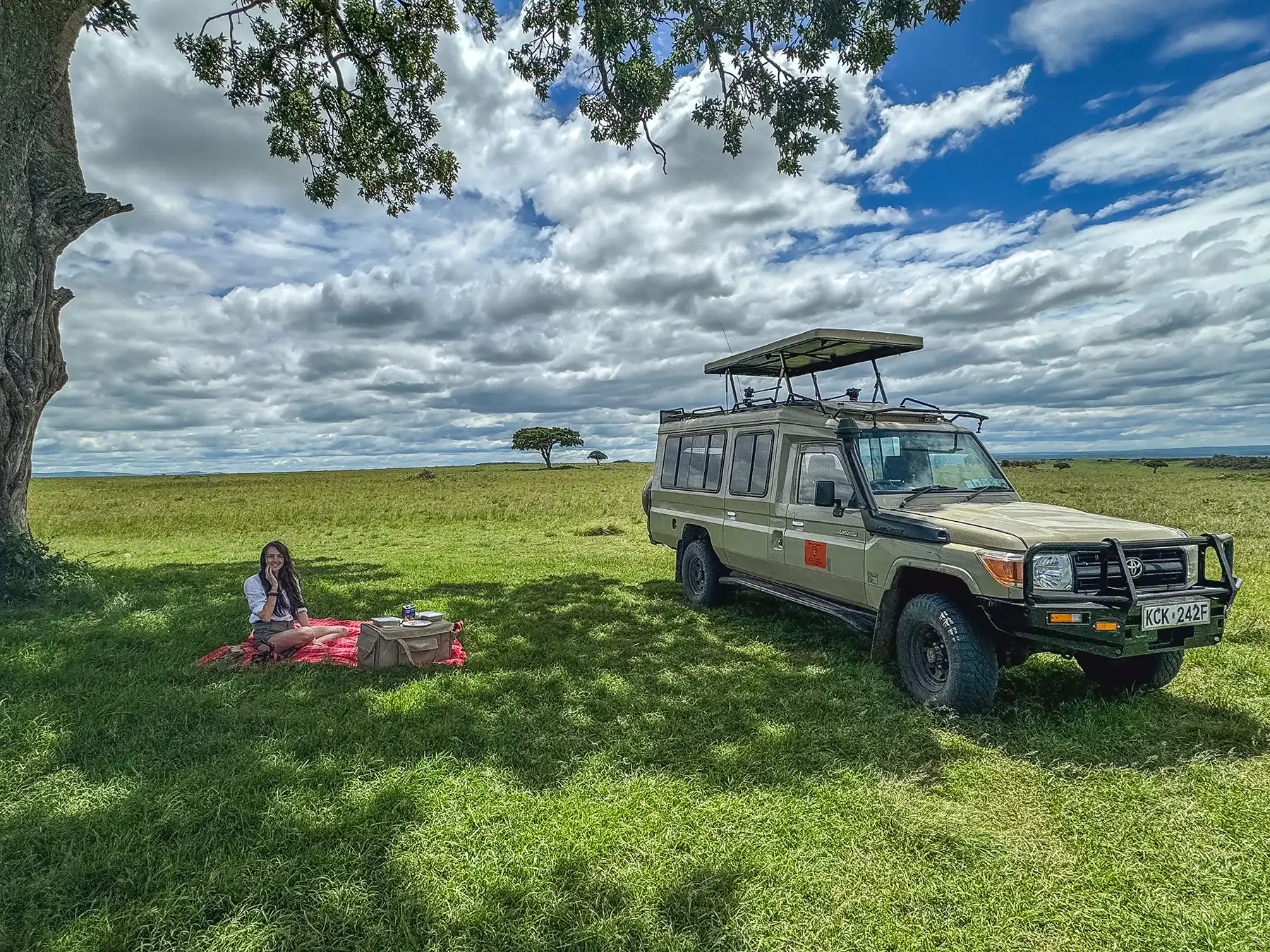
One thing I love about the Mara is that you have the freedom to stop wherever you like for lunch. Whenever the mood takes you, you can simply stop beside a convenient acacia tree, set up your camp chairs and tuck in as you watch the wildlife that surrounds you. You’ll often see zebras and gazelles grazing nearby, totally unfazed by your presence.
Continuing your game drives in the afternoon, you’ll notice the animals getting more active again as the day begins to cool. The conditions for wildlife viewing are excellent during this time, and with some luck, you should be able to enjoy a few fabulous encounters. In addition, the dramatic lighting on late afternoon drives is fantastic for photography.
Your safari adventure will continue right up until dusk (gates close at 6:30pm), when the setting sun seems to bathe the surroundings in liquid gold. This is the ideal time to capture the breathtaking landscapes of the Maasai Mara with your camera before the park closes and you return to your accommodation to rest.
Tips for Visiting The Maasai Mara
I’ve absolutely loved all my safaris in the Maasai Mara, and it is still one of my favourite safari destinations! I’ve put together a few quick tips to help you get the most out of your time here.
- Ask your guide to arrange a packed breakfast and lunch with your accommodation so that you can maximise your safari time. This will enable you to just stop anywhere in the bush to eat and then quickly get going again.
- If you stay in the Talek region, you’ll have access to two different gates, giving you added flexibility on game drives
- If you want to go back to your lodge for lunch, choose a lodge inside the reserve otherwise you have to pay park fees again to re-enter.
- You have a choice between the main Maasai Mara National Reserve and the surrounding private conservancies. Accommodation in the conservancies is more expensive but there are far fewer vehicles and you can go off-road to get closer to the wildlife. The Great Migration Mara River crossing is in the main reserve / Mara Triangle.
- Be sure to get to the gate before 6am for the best early-morning sightings; predator activity is highest at dawn and dusk
- Although the early mornings can be chilly, the savannah really heats up by afternoon: wear layers and don’t forget your sunscreen
- Tsetse flies like dark blue/black colours; wear light neutral colours to discourage them
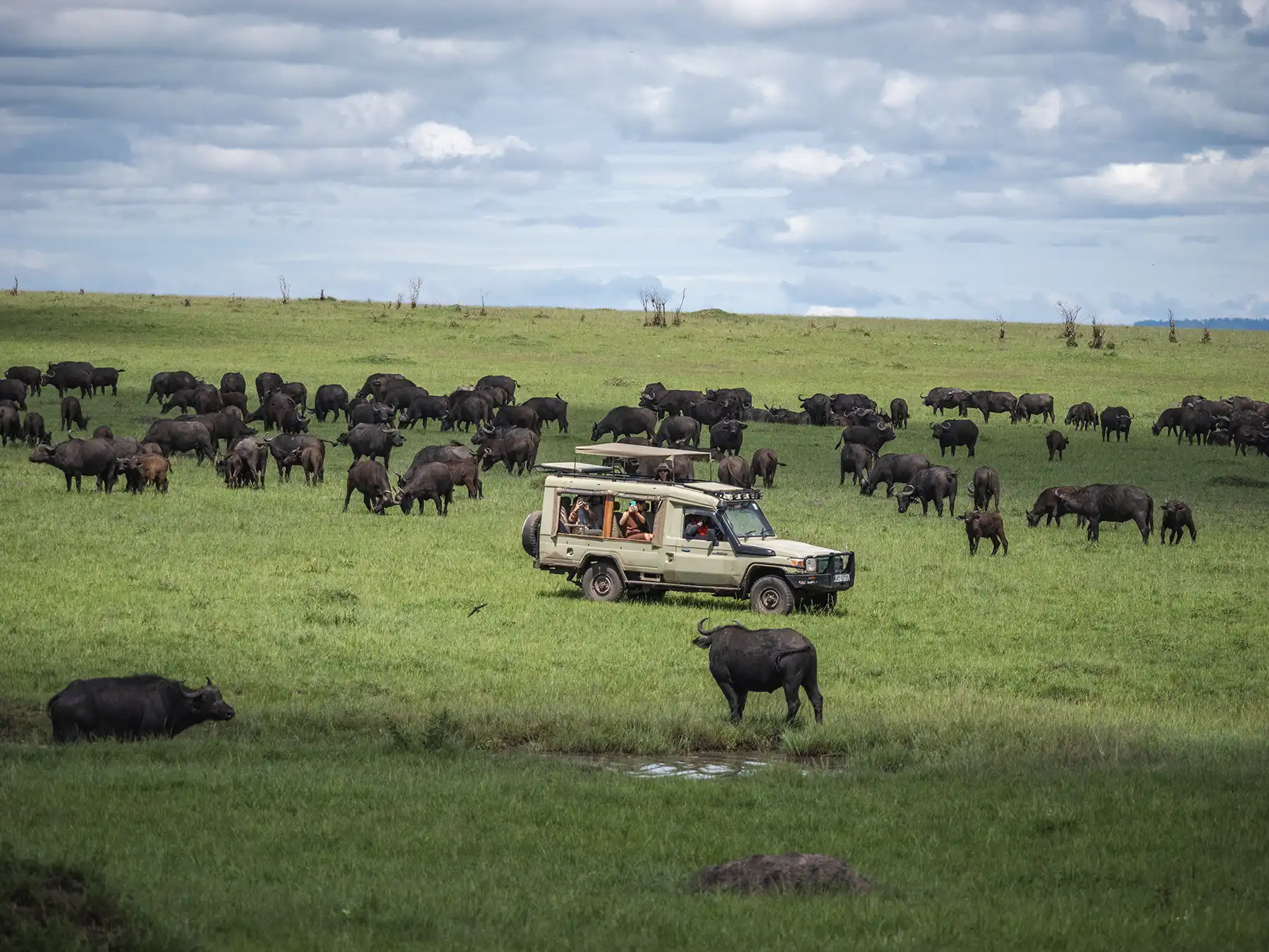
Optional Activities
- For a special treat, why not book a dawn hot air balloon safari over the Mara? This unique experience costs around $600 per person and ends with a luxurious champagne breakfast in the bush.
- A guided bush walk along the Mara River accompanied by an armed ranger is a great way to see crocodiles, hippos and birdlife up close.
- Another unforgettable activity is a visit to a Maasai village. The friendly people you meet will be more than happy to tell you about their customs, show you their traditional dances and explain the Maasai way of life (make sure to request an authentic, lesser-visited boma as some have become a little commercialised).
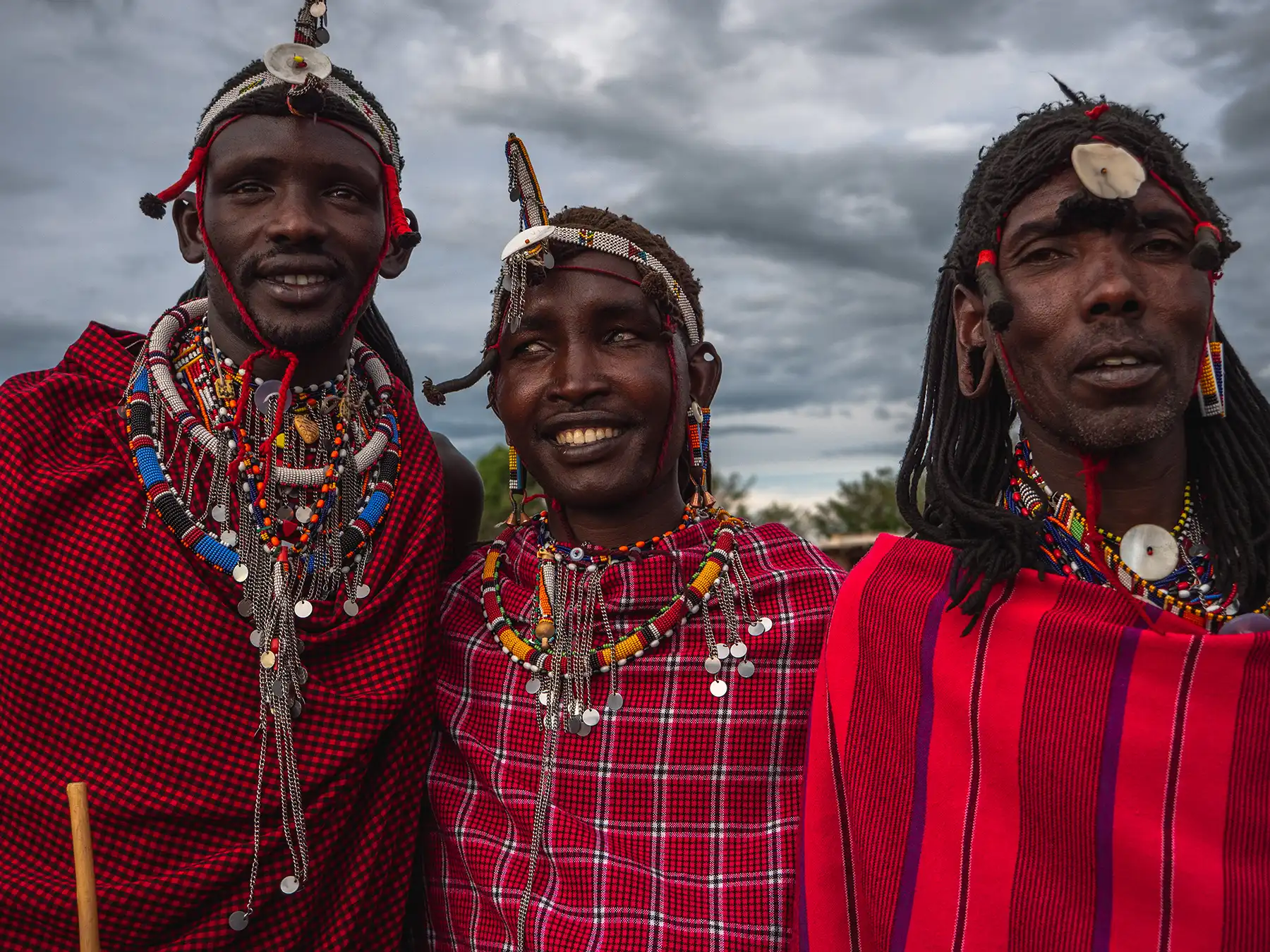
My Experience in the Maasai Mara
Of all the places in Kenya I’ve visited, the Maasai Mara and sourounding conservancies was and remains my absolute favourite.
I enjoyed some of my best ever wildlife sightings in all of Africa here. I first visited during the short rainy season in November and there were so many baby animals everywhere I looked! But the real highlight was seeing a baby giraffe tottering behind its mother on its lanky, wobbly legs. It was the first time I’d ever seen a baby giraffe and it was just so adorable!
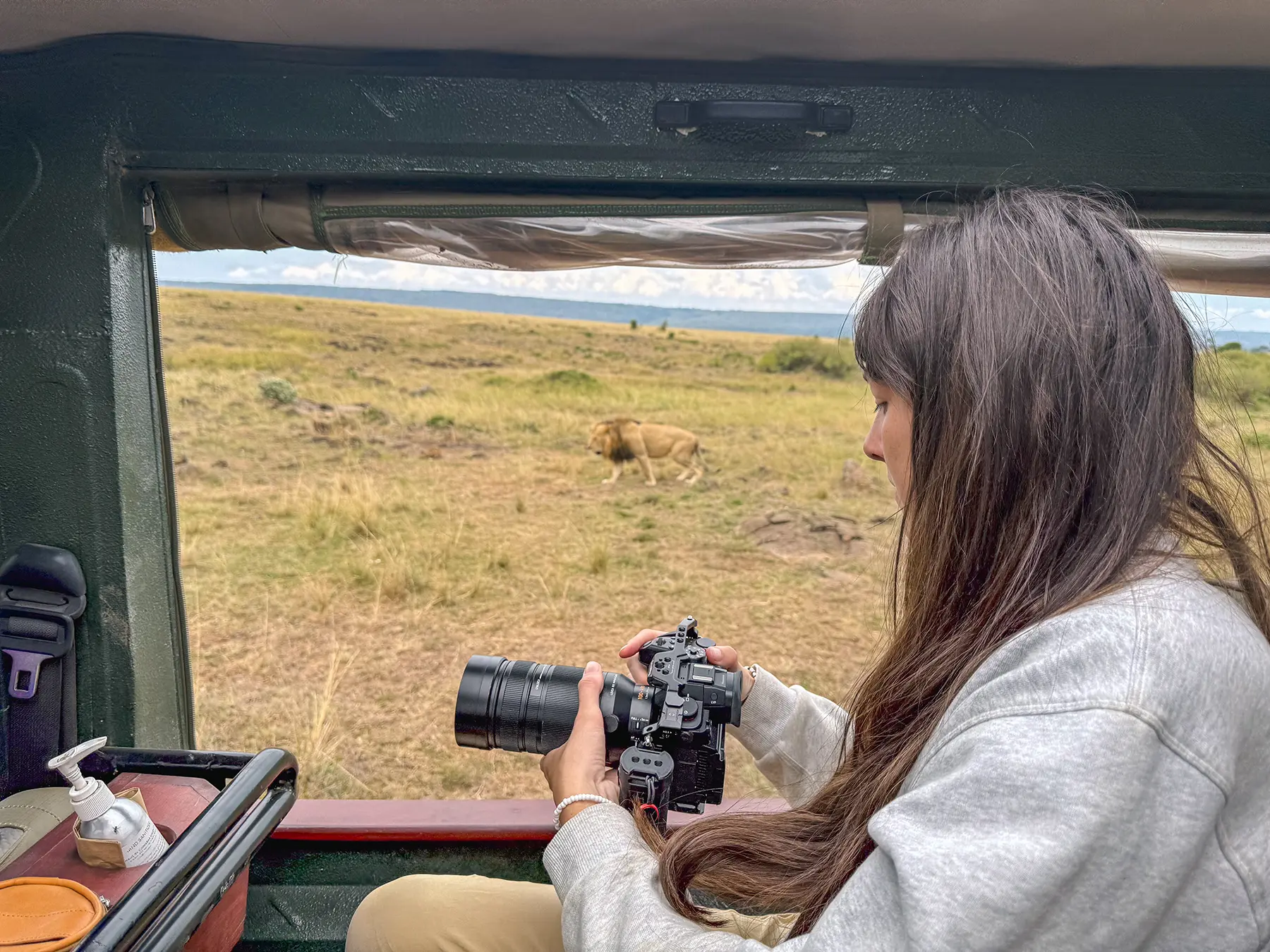
One encounter with the Offbeat lion pride in Mara North really got my adrenaline pumping. I was filming through my 400mm lens as a young male lion walked directly towards our vehicle from about 150 ft away. He came so close that he filled my frame and then became a blur. I looked up from the camera to find him standing right beside me, barely a metre away! With the vehicle sides lowered, there was nothing between us. I could practically count the whiskers on his face.
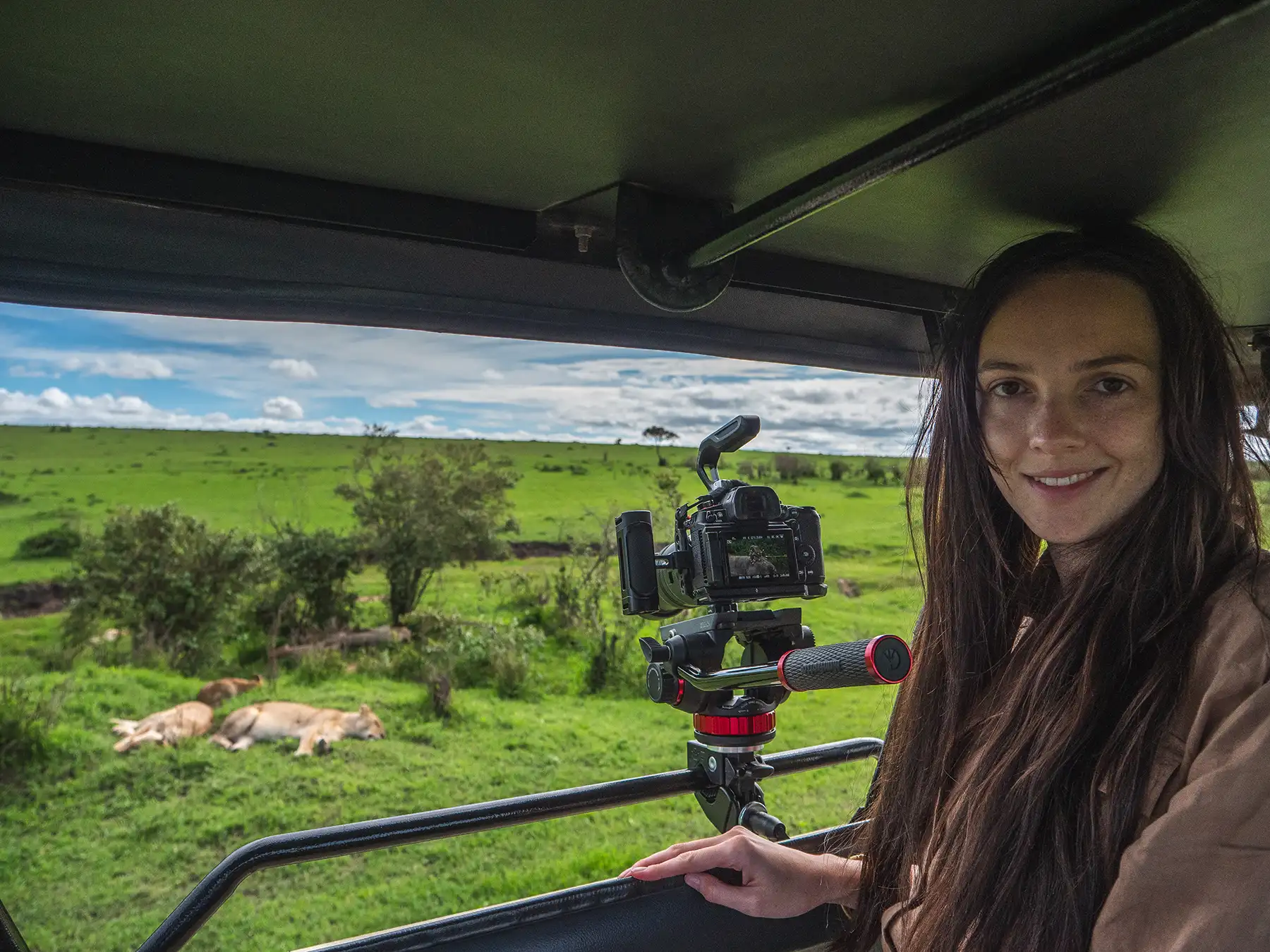
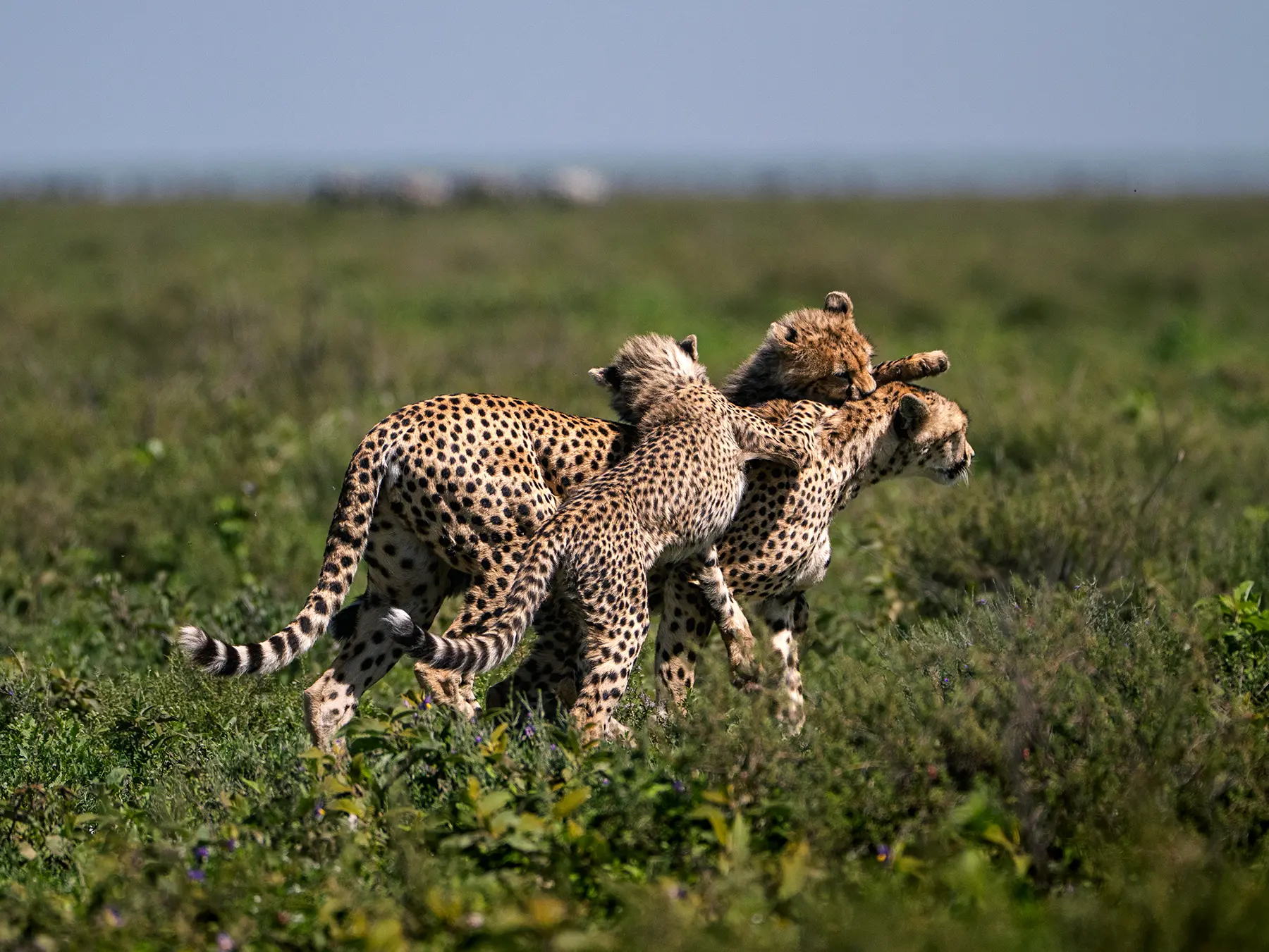
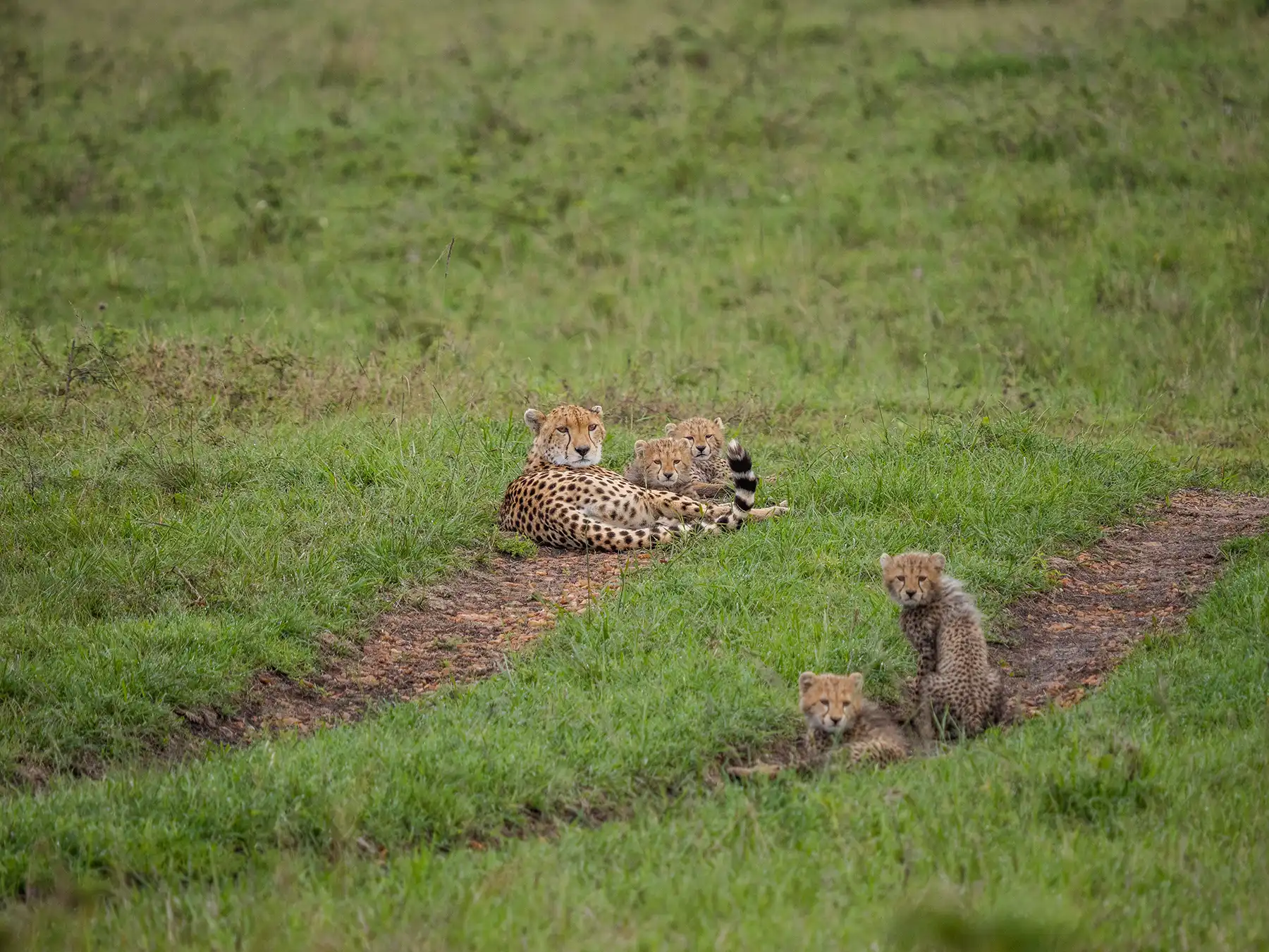
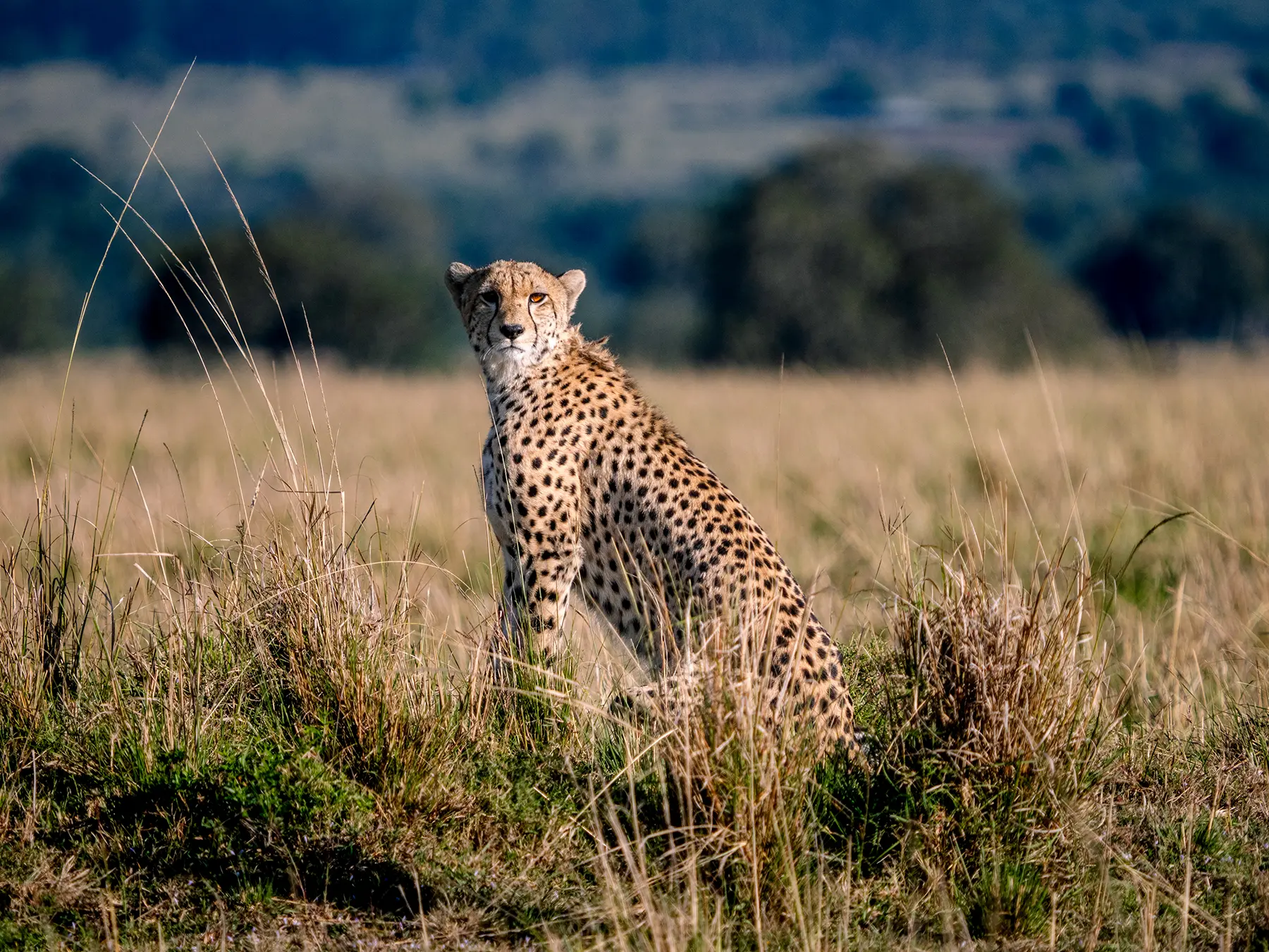
One of my most memorable encounters was when we happened upon a mother cheetah called Nashipae, surrounded by her four gorgeous, fluffy cubs. They were only a few months old and constantly on the move, play-fighting and running around and even jumping on their very patient mother! We were lucky enough to see the family twice during our visit, which was so special.
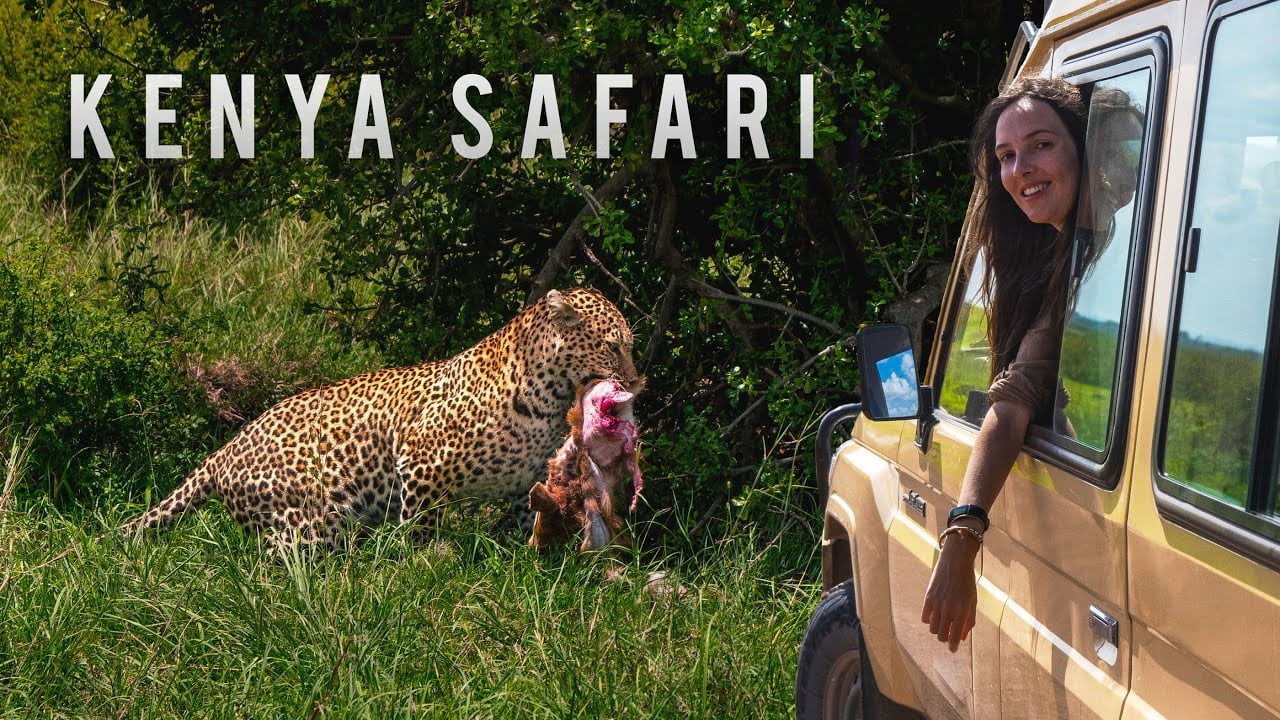
The Maasai Mara was also the place where I had one of my all-time best leopard sightings. It was a female who had just caught a Thomson’s gazelle, and she was lounging on a tree branch with her kill wedged in a fork beside her. We were close enough to see the rosette pattern perfectly defined against her golden fur.
As we watched, she grabbed the carcass and carried it down the tree trunk, her muscles bulging with the effort before she dropped to the ground. We expected her to drag it into the dense bush to feed, but instead she settled right beside our vehicle and got stuck in!
We could hear her tearing flesh and crunching bone as she ate. What made this encounter even more incredible was that the couple of other vehicles that had stopped by eventually left, so it was just us and this magnificent leopard. The intimacy of it made it utterly magical.
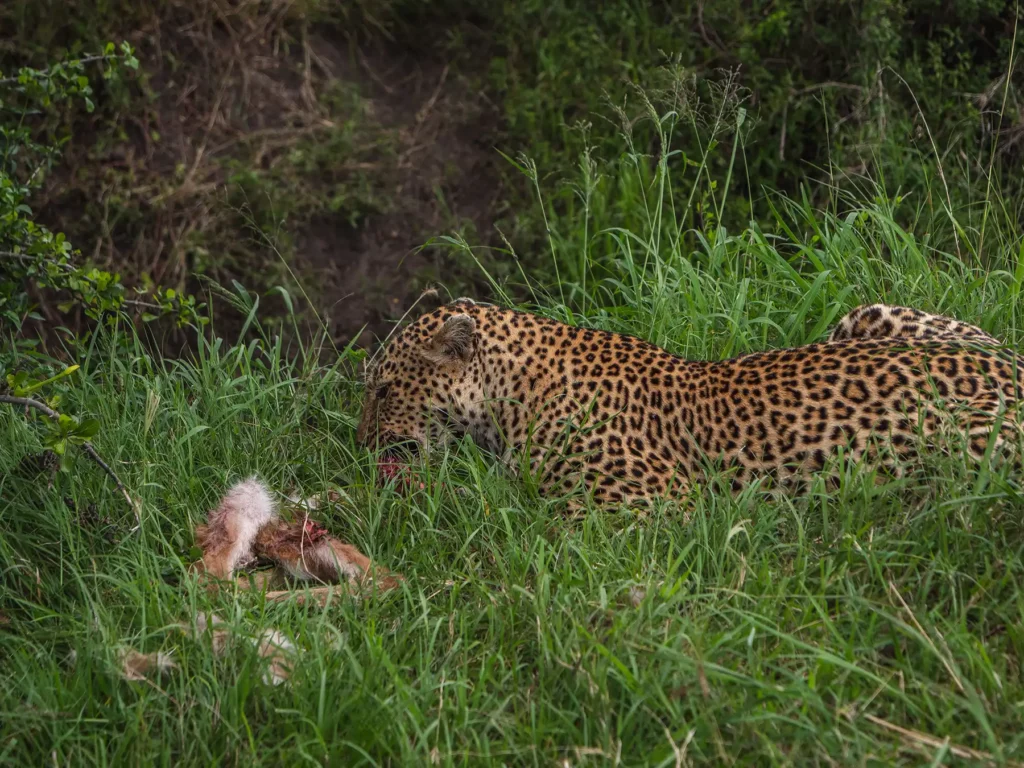
I’ve included a video of my experience visiting the Maasai Mara below for you to watch.
Where to Stay in the Maasai Mara National Reserve
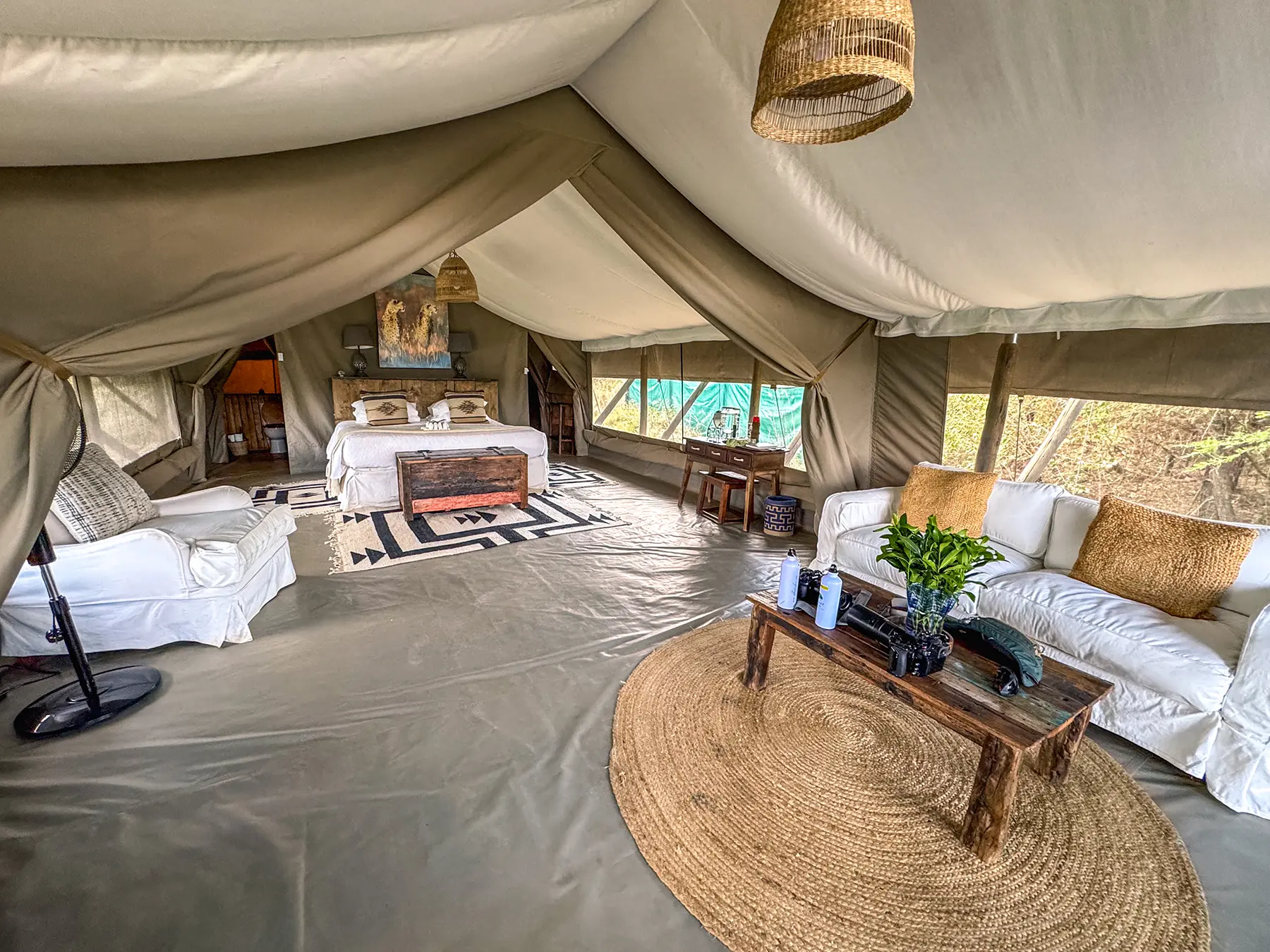
You’ll be staying at the same tented camp or lodge as you did on the first night, so you can get settled straight away when you return from the reserve. A good night’s sleep will set you up nicely for the next day!
Day 4: Maasai Mara to Serengeti (Border Crossing)
Drive Time (Excluding Game Drives): Approximately 10 hours including border crossing
Today you’ll be crossing the Kenyan border into Tanzania before making your way to the iconic Serengeti National Park. The 10-hour drive will bring you through Maasai lands before crossing at Isibania, and is filled with spectacular scenery.
Although the Maasai Mara and Serengeti National Parks are actually part of the same area, having to cross the border between Kenya and Tanzania makes the trip between the two a little more complex.
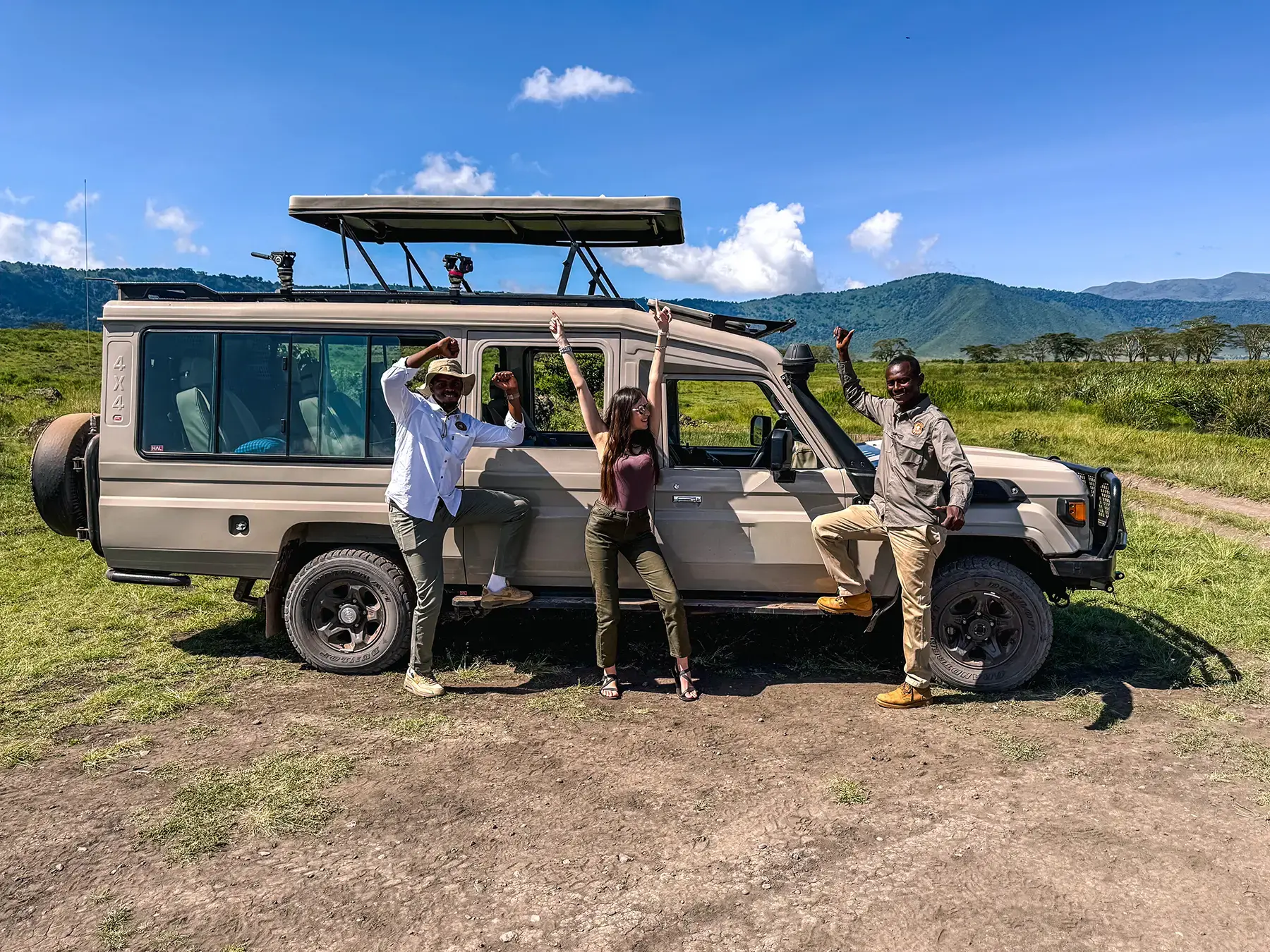
Fortunately, however, your local guide makes this journey all the time and will handle it beautifully! You’ll be transferred to a new vehicle with a new driver guide over the border as each country has its own licensed vehicles and guides.
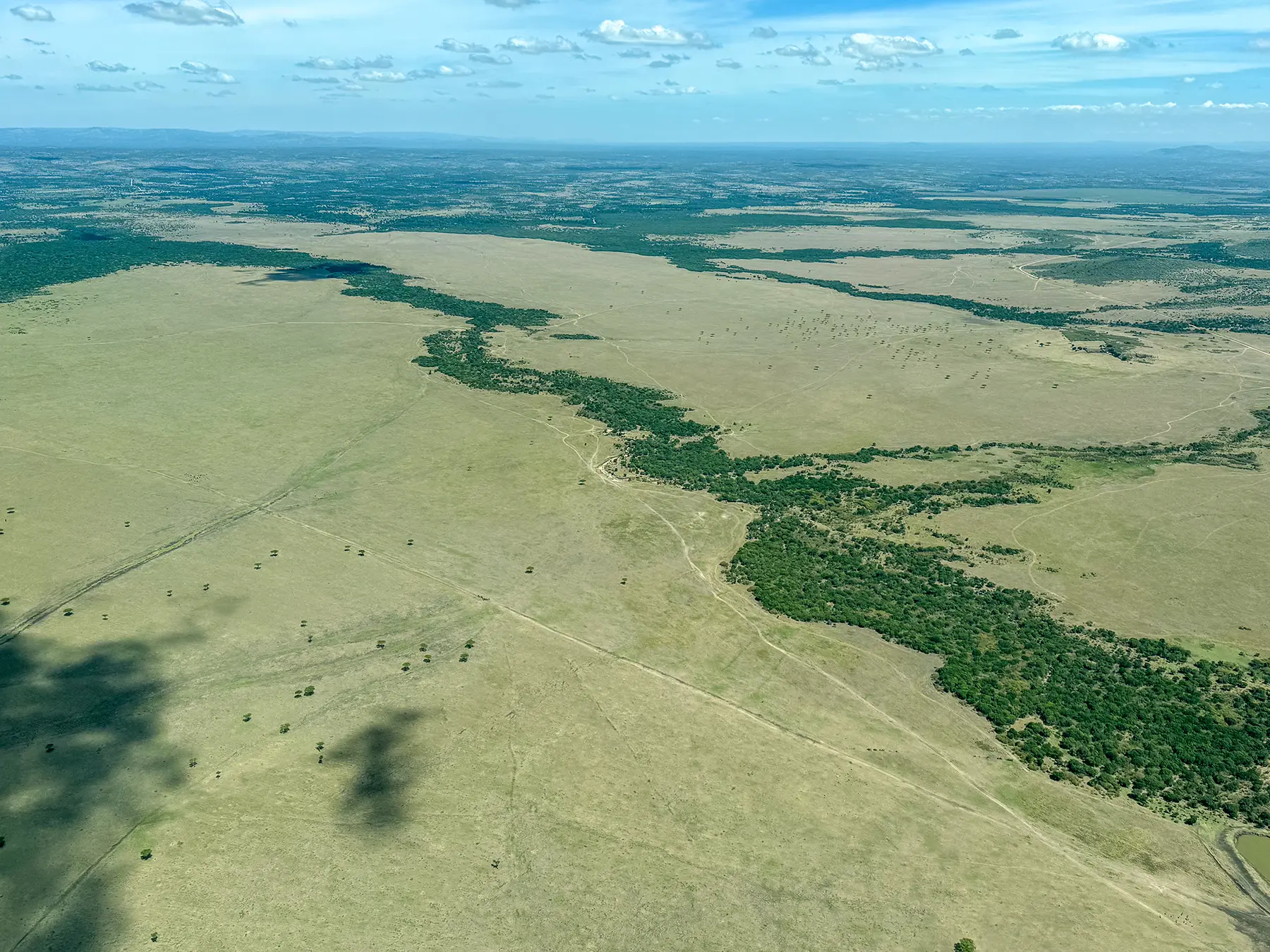
As you move from Kenya into Tanzania, you’ll be crossing from one world-class ecosystem into another. There is a marked difference in size between the two reserves, however: the Serengeti extends over almost 14,750 square kilometres, and is almost ten times larger than the Maasai Mara!
The long drive is very scenic, but the roads can be pretty bumpy along the way.
You could choose to fly instead if your budget allows. This will reduce your travel time to about 3 hours, which includes transfers to and from the airport. What’s more, you’ll be treated to amazing aerial views of the landscape below, traversed by the winding Mara River.
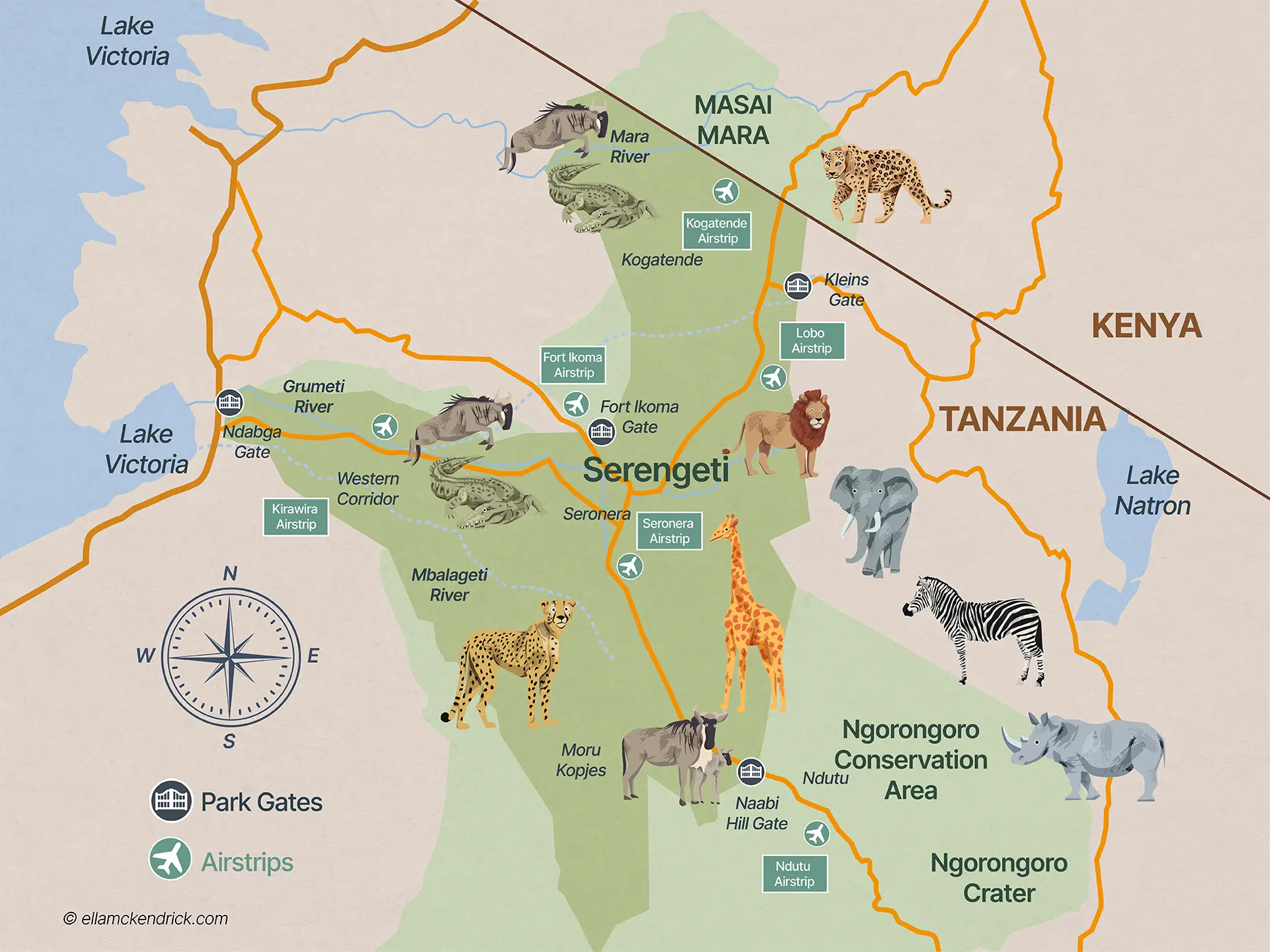
Map of Serengeti National Park
Here is a map I made showing the key features of Serengeti National Park.
Itinerary
If you’ve opted to drive to the Serengeti, you’ll be making an early start ahead of the long journey. Plan on being ready to leave at around 7 am.
Lasting about 5 hours, the first leg of the drive will bring you to Isibania, where you’ll cross the border between Kenya and Tanzania. Here, you can expect to spend around 30 minutes dealing with paperwork and formalities. The process is pretty simple, though, plus there’s also the excitement of entering a completely new country. Welcome to Tanzania!
Once you’ve crossed the border, you’ll drive for about 5 more hours until you reach your lodge in the heart of the Serengeti. As a large portion of this leg brings you through the Serengeti itself, you will have ample opportunities to spot wildlife as you go. Believe it or not, I was lucky enough to see a leopard in the tree right by the road as I made this drive!
Opting to fly instead will mean substantially shorter travel time (around 3 hours total) and allow you to take in the beautiful landscapes below. It also means you’ll have more time to relax when you arrive at your destination.
If you plan to fly rather than drive, you’ll need to fly to the Migori Airstrip (still in Kenya) from the Maasai Mara first. This airstrip is a 30-minute drive from the Isibania border post. Here, you’ll cross the border, then drive 14 minutes to Tarime Airstrip. Afterwards, you’ll fly from Tarime to Seronera in Central Serengeti.
Border Crossing Tips
I found that the border crossing from Kenya to Tanzania was easier than expected! These tips should help yours go as smoothly.
- Documents required: You must present your passport, a Tanzanian visa (apply for an e-visa in advance) and a yellow fever vaccination certificate
- Wait times: The border post at Isibania is open 24 hours a day, 7 days a week. It can take 30 minutes to 2 hours to complete the process, and the post is busier during peak season
- Kenya registered vehicles cannot operate safaris in Tanzania and vice versa, so you’ll be changing vehicle at the border. You might be a bit daunted at the prospect, but rest assured, it’s a very simple process and both vehicles park side by side to ensure you’re always accompanied by a guide throughout.
About Serengeti National Park
The Serengeti is one of the world’s most renowned wildlife sanctuaries and covers a jaw-dropping 14,750 square kilometres of grassland, savannah, and woodland. Rather aptly, it derives its name from the Maasai word “Siringet”, meaning “Endless Plains”. The park has been designated a UNESCO World Heritage Site in recognition of its unique character and value.
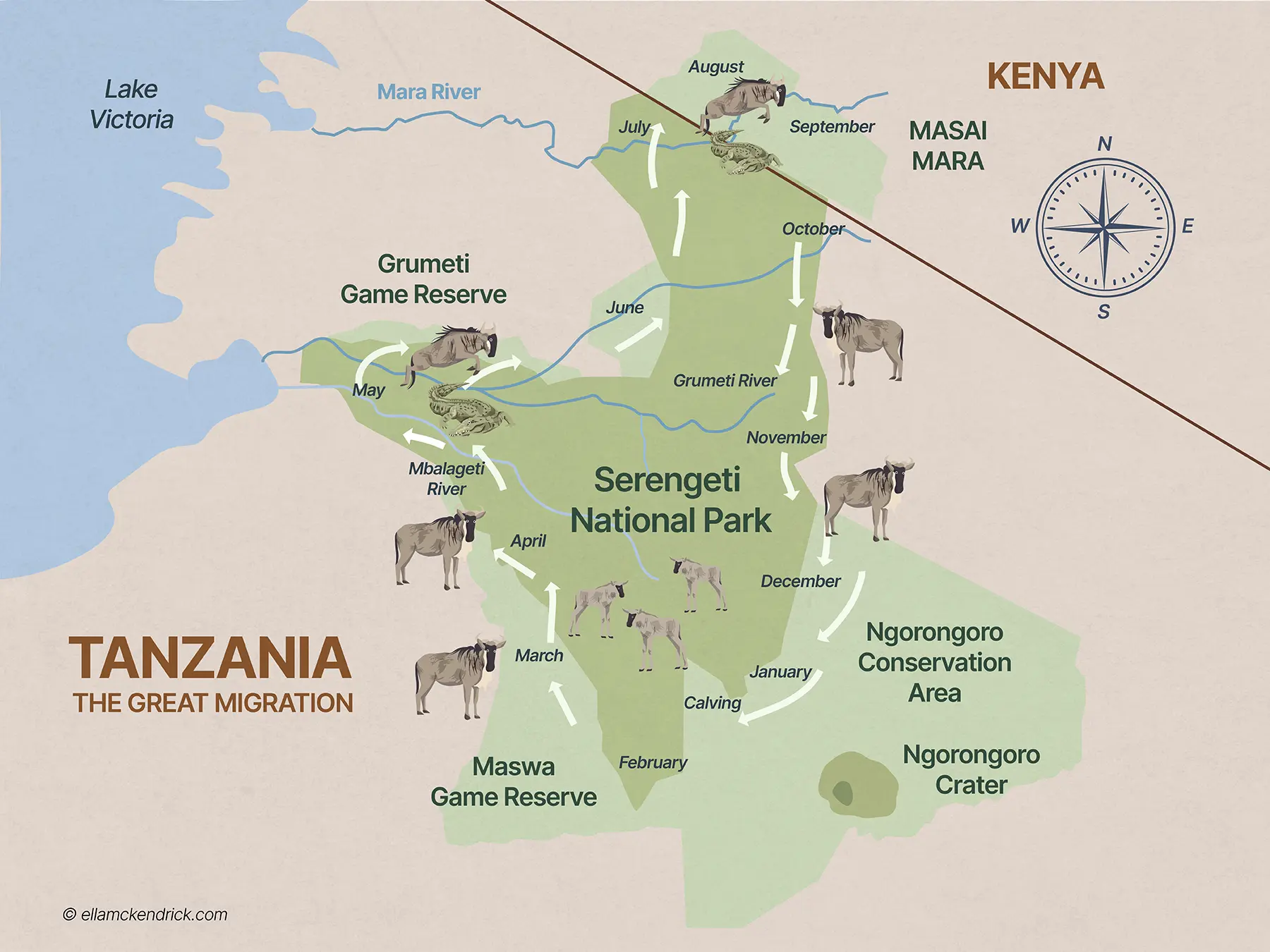
The Serengeti is the main stage for the annual Great Migration, when more than 1.5 million wildebeest travel north into Kenya’s Maasai Mara region alongside hundreds of thousands of zebras and gazelles. The animals follow a never-ending, circular migration route covering around 1,000 kilometres, which takes roughly a year to complete.
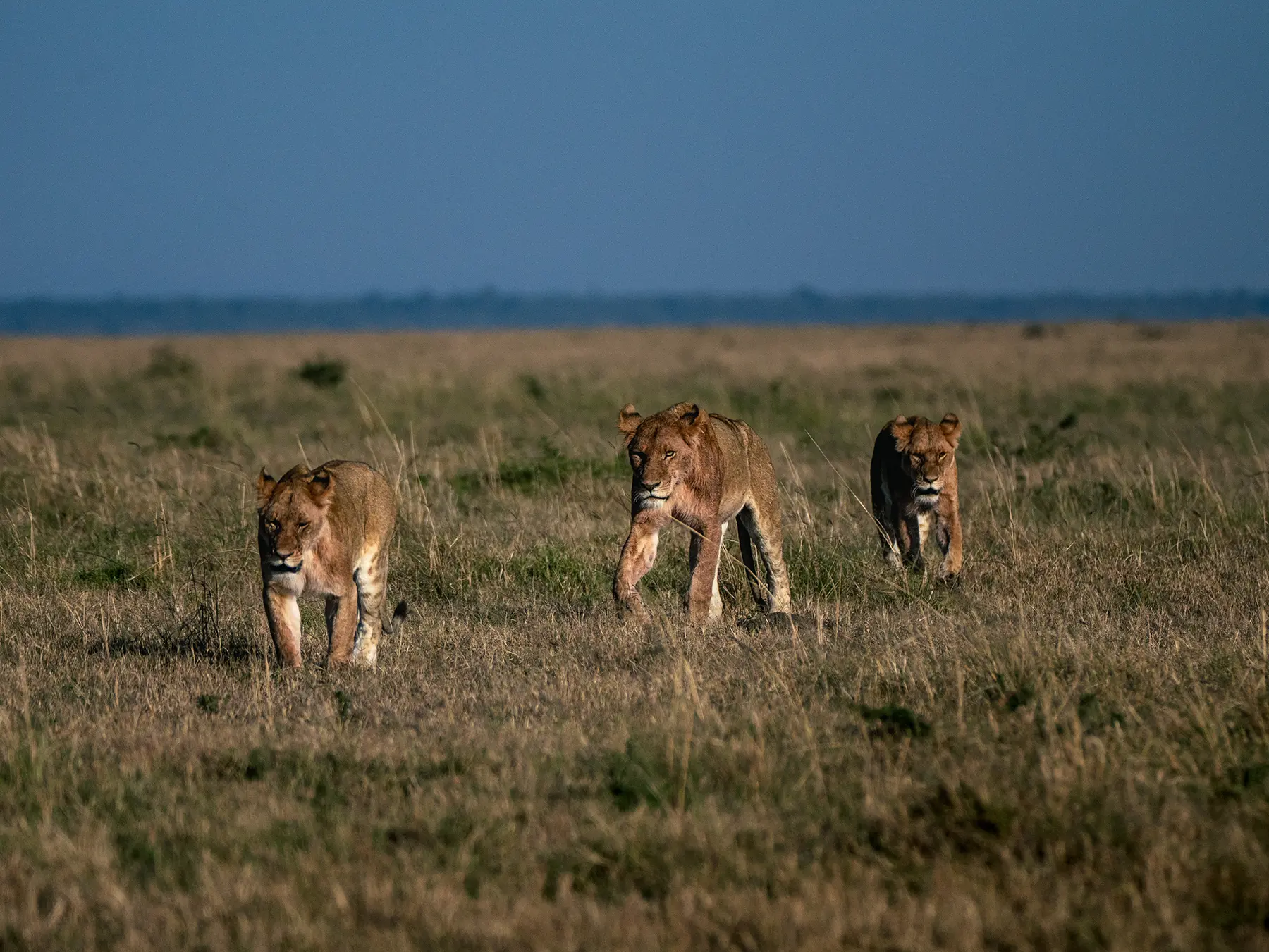
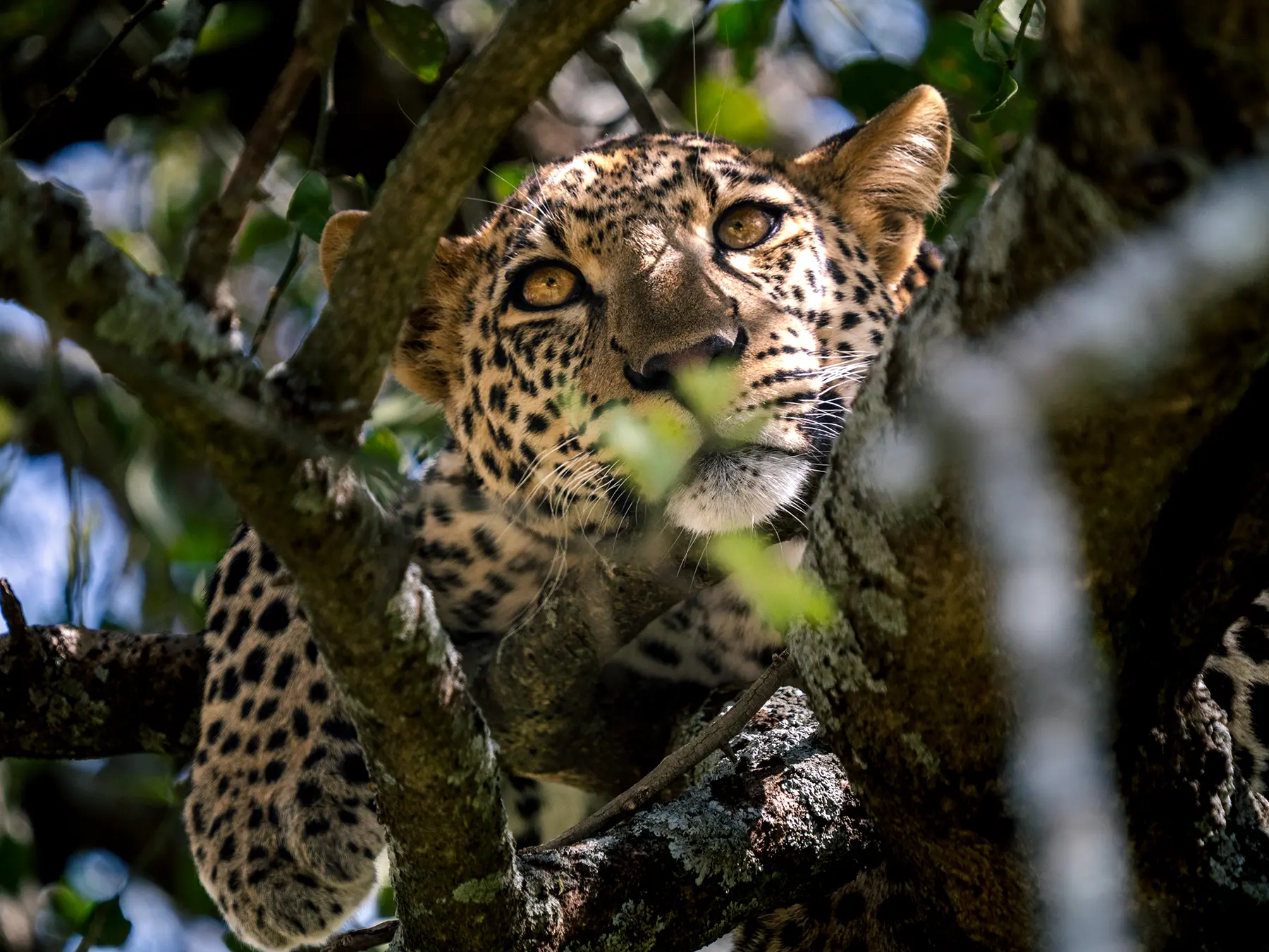
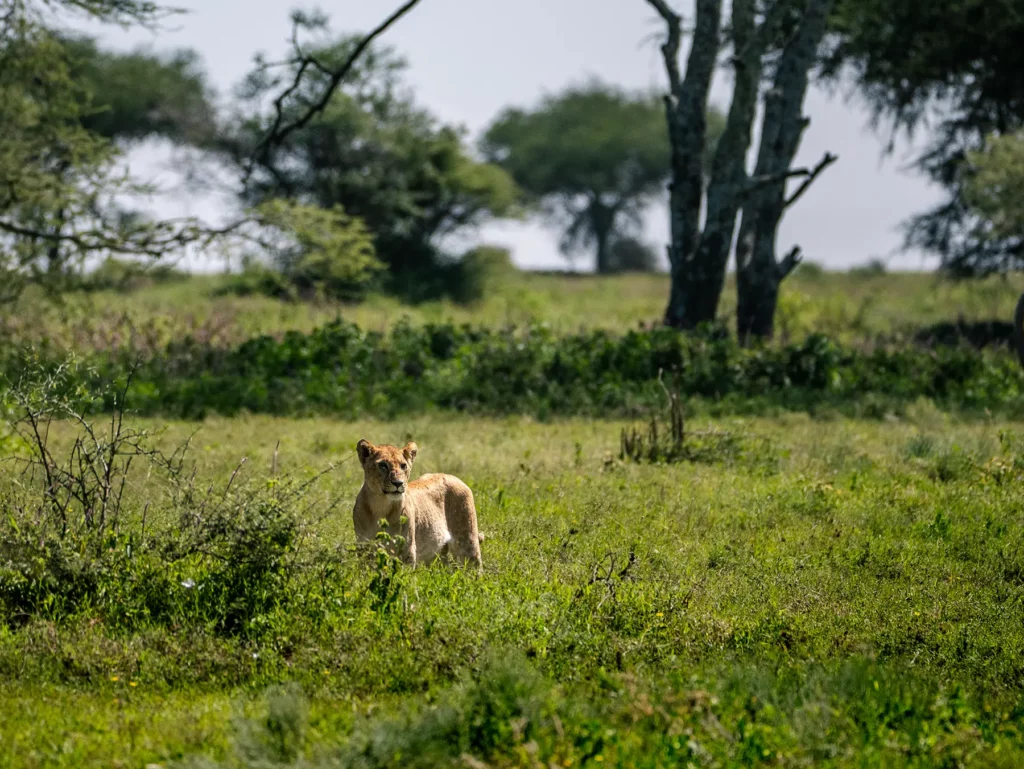
With approximately 14,000 individuals in residence, Tanzania boasts the largest global lion population. Some 2,500 lions are found in the Serengeti alone – the largest population in Africa. During the wet season, the reserve has nearly 6 leopards per 100 square kilometres.
What Wildlife Can I See in the Serengeti?
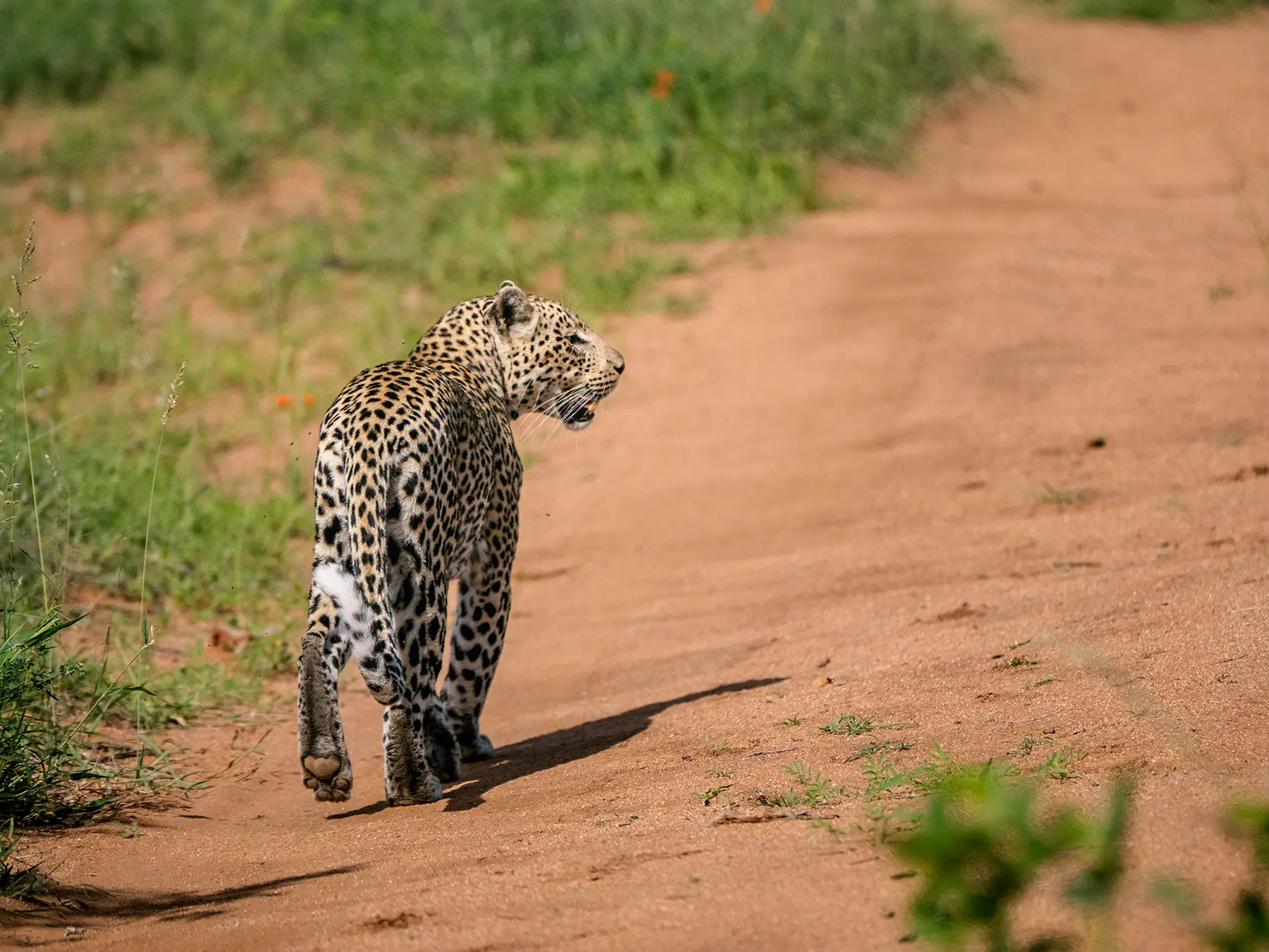
The Serengeti is one of the rare places where it’s possible to spot all of the Big Five, though rhinos are rare. With healthy lion, cheetah, leopard, and hyena populations, it also boasts one of Africa’s highest large predator concentrations. Central Serengeti (Seronera) is particularly good for leopard viewing, with particularly high densities in the riverine woodland.
The Great Migration passes through different areas of the Serengeti year-round. While the Mara River crossings (July to October) are arguably the most dramatic sight, calving season in the southern Serengeti (January to March) is equally spectacular, seeing up to 8,000 calves born per day.
Tips for Your Journey to Serengeti National Park
- The drive from the Maasai Mara to Serengeti took me 10 hours. My accommodation was near Ololaimutiek Village, in the bottom right corner of the Maasai Mara, which is possibly the worst location if you’re making the drive as it’s so far from the border.
- I’d recommend basing yourself in Talek to shorten the journey, or you can stay in the Mara North Conservancy to minimise the drive time and save yourself 2 hours on the road.
- The drive between the Maasai Mara and Serengeti is very long, so bring neck pillows, books and other personal items to make it as comfortable as possible.
- As you’ll be changing vehicles at the border, you should make sure all your belongings are stowed and ready ahead of the switch. I’d also recommend having your passport, visa and yellow fever certificate at hand so that your border crossing goes as smoothly as possible.
- Don’t worry – you’ll have access to bathroom facilities at multiple points along the way. There are bathrooms at all park gates (exiting the Maasai Mara and arriving in Serengeti, for example) and also at the border post. While these are clean and orderly, they don’t always have toilet paper: be sure to have some with you just in case.
- Flying will save you a full day on the road if your budget allows (2-3 hours inc transfers, versus 10).
Where to Spend the Night
During your visit to Serengeti National Park, you’ll be staying at a tented camp or lodge within the reserve.
The Seronera region is a great choice most of the year. Situated at the very heart of the park, it’s a wildlife hotspot all year round. As well as outstanding leopard and lion sightings, this area boasts a good selection of lodges and camps for various tastes and budgets.
That said, Kogatende might be a better option if you’ll be visiting between July and September. The Great Migration is the main focus during this period, and Kogatende offers the ideal vantage point to observe the dramatic river crossings.
Staying outside the park gates costs less. However, given the sheer size of the Serengeti, it’s worth paying the extra to stay inside the reserve and avoid having to drive for hours every morning before you get to the core wildlife areas and potentially missing out on the best sightings.
In addition, your 24-hour Serengeti pass is only valid if you stay the night inside the reserve, so it becomes void as soon as you leave if you’re staying outside the park. As a result, you might find yourself paying double the park fees – causing any savings you may have made by booking external accommodation to diminish significantly at best.
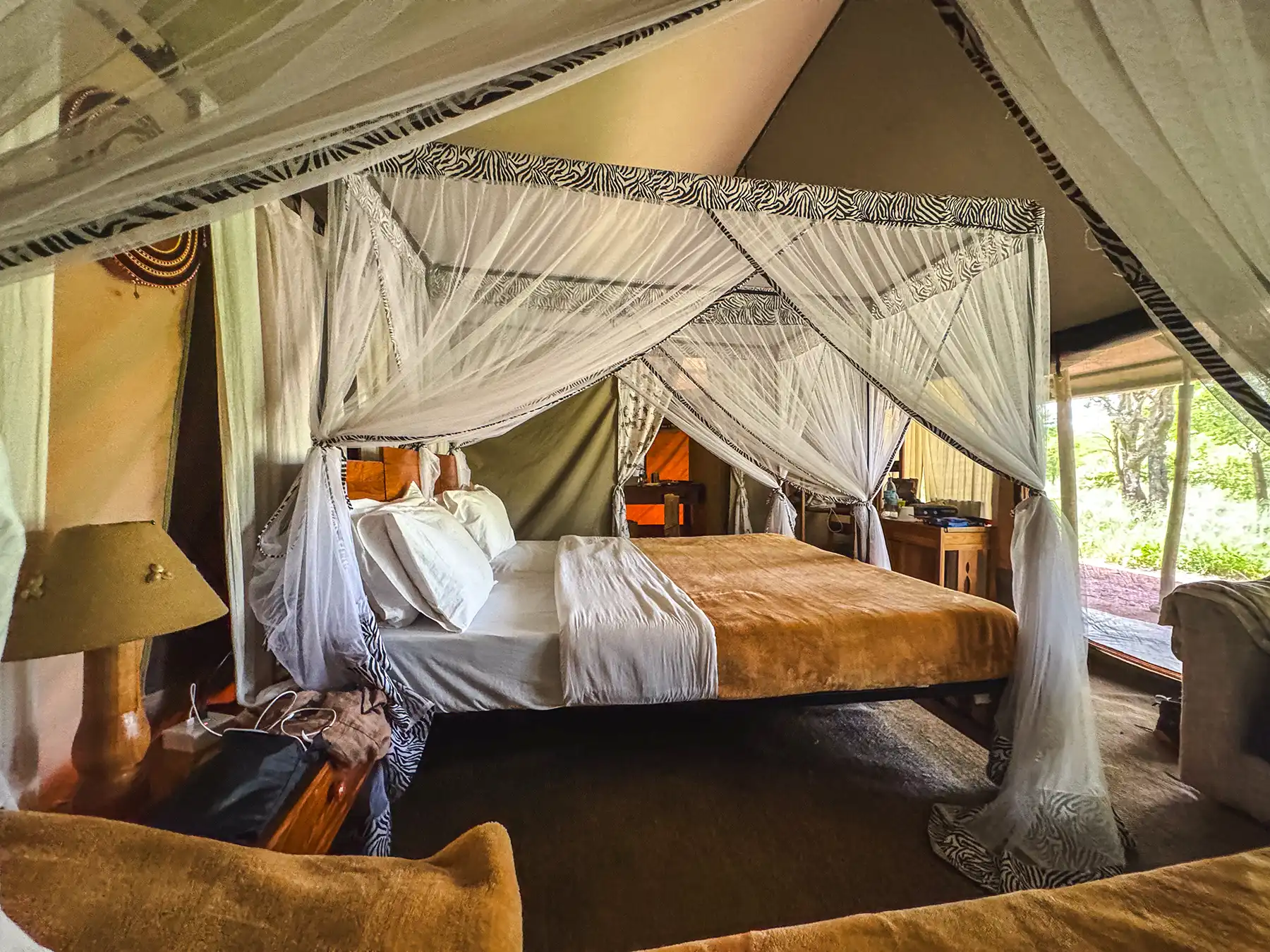
My Experience Driving From Maasai Mara to Serengeti
The trip from my lodge in the south-eastern corner of Maasai Mara to Serengeti took me 10 hours. If I were to do it over, I would definitely book accommodation in Talek or Mara North and save myself 2 hours of driving.
The first half of the drive is the most difficult, as the road between Maasai Mara and Isibania is in pretty bad shape with numerous huge potholes, making driving very slow.
While the majority of the roads you’ll be navigating are dirt roads, there is a welcome stretch of tarred road that starts shortly before reaching Isibania and continues into Tanzania for around an hour.
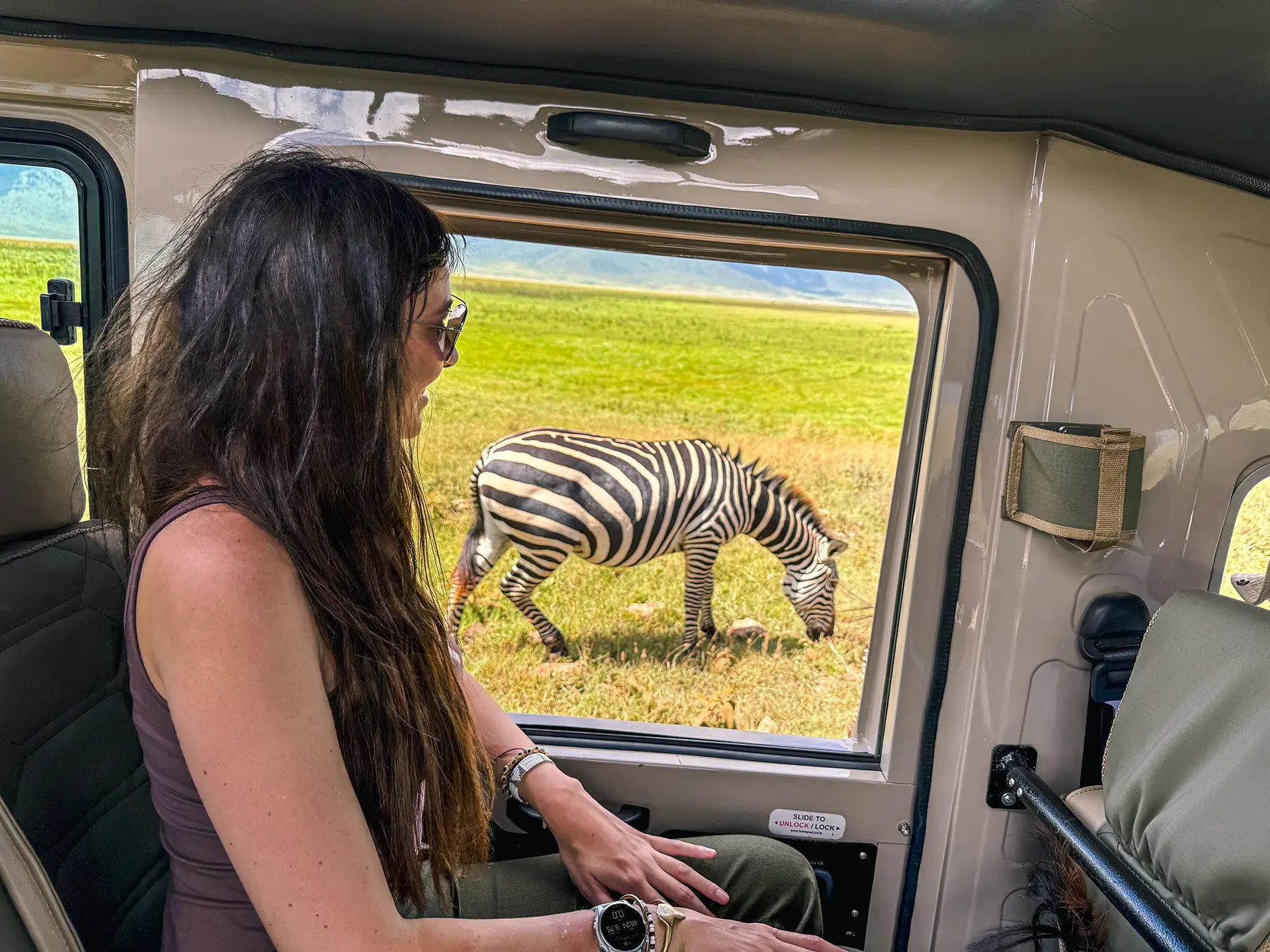
Though they can be tiring, I must say I love long drives. Looking out the window and taking in the amazing scenery is just so relaxing. Along the way, you’ll drive through quaint villages, stop for about a dozen cow crossings and even see some wildlife with a bit of luck. Zebras grazing amongst cows were a surprisingly common sight on my drive!
For me, the border crossing was very simple, taking just 10 minutes to officially leave Kenya and enter Tanzania. I should say, though, that I made the trip outside of peak season and had also purchased my Tanzanian visa online in advance. There could be queues between June and October, when parks are busier.
The final 3-hour leg of the journey is pretty much a game drive through the Serengeti as you make your way to your lodge in the heart of the park. I saw a leopard, a pride of lions, a huge troop of baboons, dozens of giraffes and much more on my drive!
I’ve included a video of my experience journeying from Maasai Mara to Serengeti below.
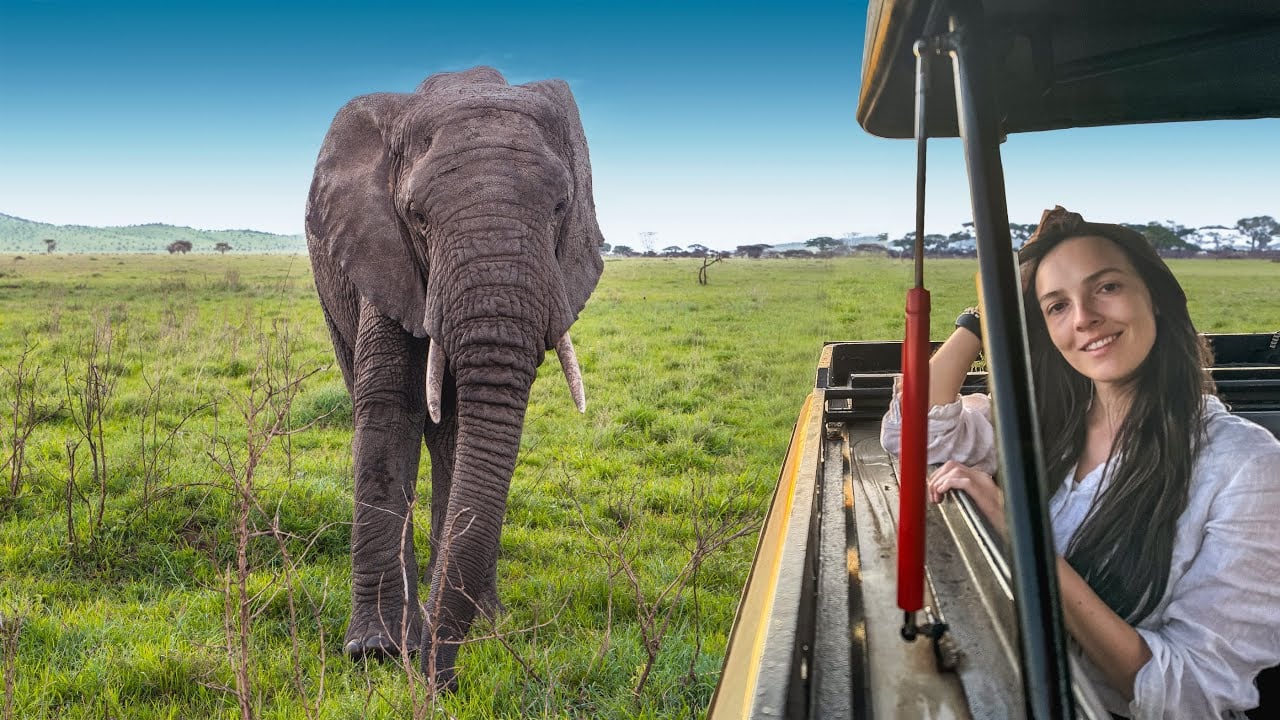
Day 5: Serengeti
Drive Time (Excluding Game Drives): 0 hours
You’ll be spending the entire day today exploring the enormous Serengeti National Park, one of the world’s greatest safari destinations.
Your morning and afternoon game drives across the endless plains will cover a substantial portion of the park’s nearly 15,000 square kilometres.
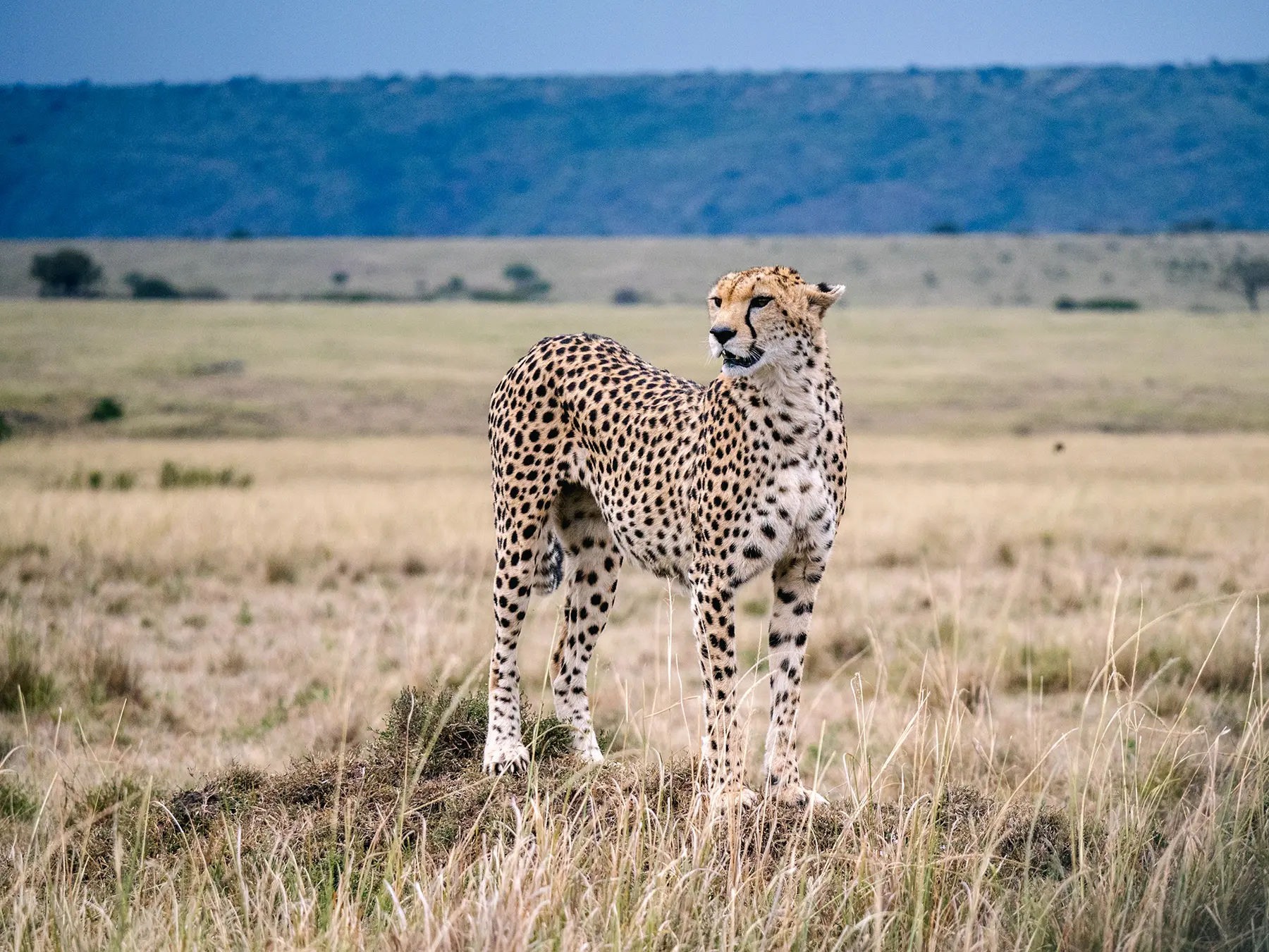
With over 4,000 lions, 1,000 leopards, and 500 cheetahs in residence, extraordinary predator encounters are possible every time you embark on a game drive in the Serengeti. As you can spend the full day exploring, you’ll be able to take in the Seronera region, known for big cat sightings as well as more remote areas to the east.
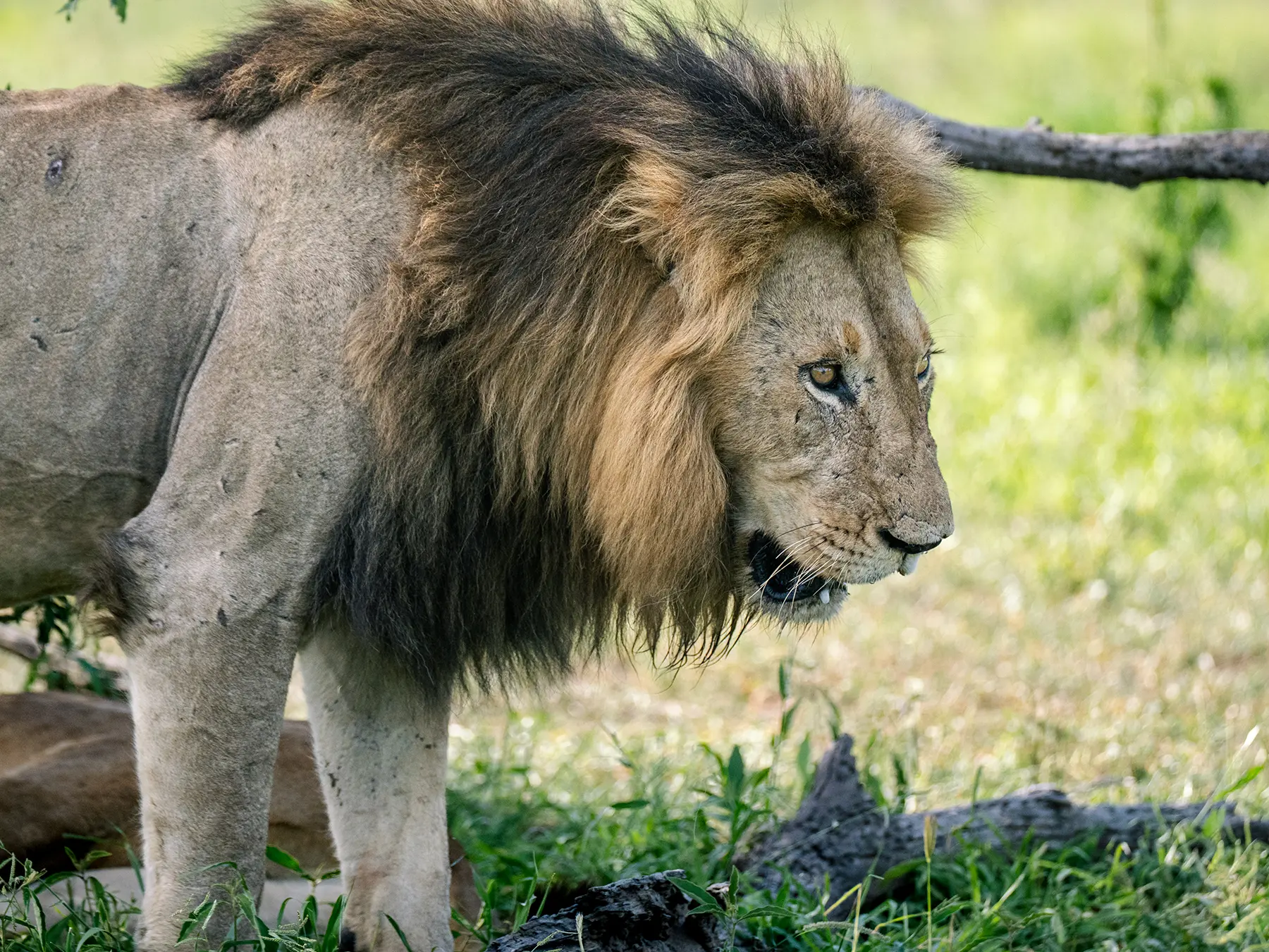
What Wildlife Can I See in the Serengeti?
The Serengeti has all of the Big Five and supports one of the highest concentrations of large predators anywhere in Africa, with over 4,000 lions, 1,000 leopards and 500 cheetahs calling the park home. The park is also a key stage for the Great Migration, with close to 2 million wildebeest moving through its grasslands at different times of the year.
- Big cats: Lion prides are a common sight across the plains, with density reaching 20 per 100 km2 in Central Serengeti. The Seronera region is particularly renowned for leopard sightings in the riverine woodland.
- Tree-climbing lions: The Serengeti is one of only a handful of places in the world where lions have been observed climbing and resting in trees, a behaviour thought to help them escape insects and survey prey.
- The Great Migration: Over 1.5 million wildebeest, accompanied by hundreds of thousands of zebras and gazelles, follow a circular route through the Serengeti year-round. The dramatic river crossings in the north between July and October are among the most spectacular wildlife events on the planet.
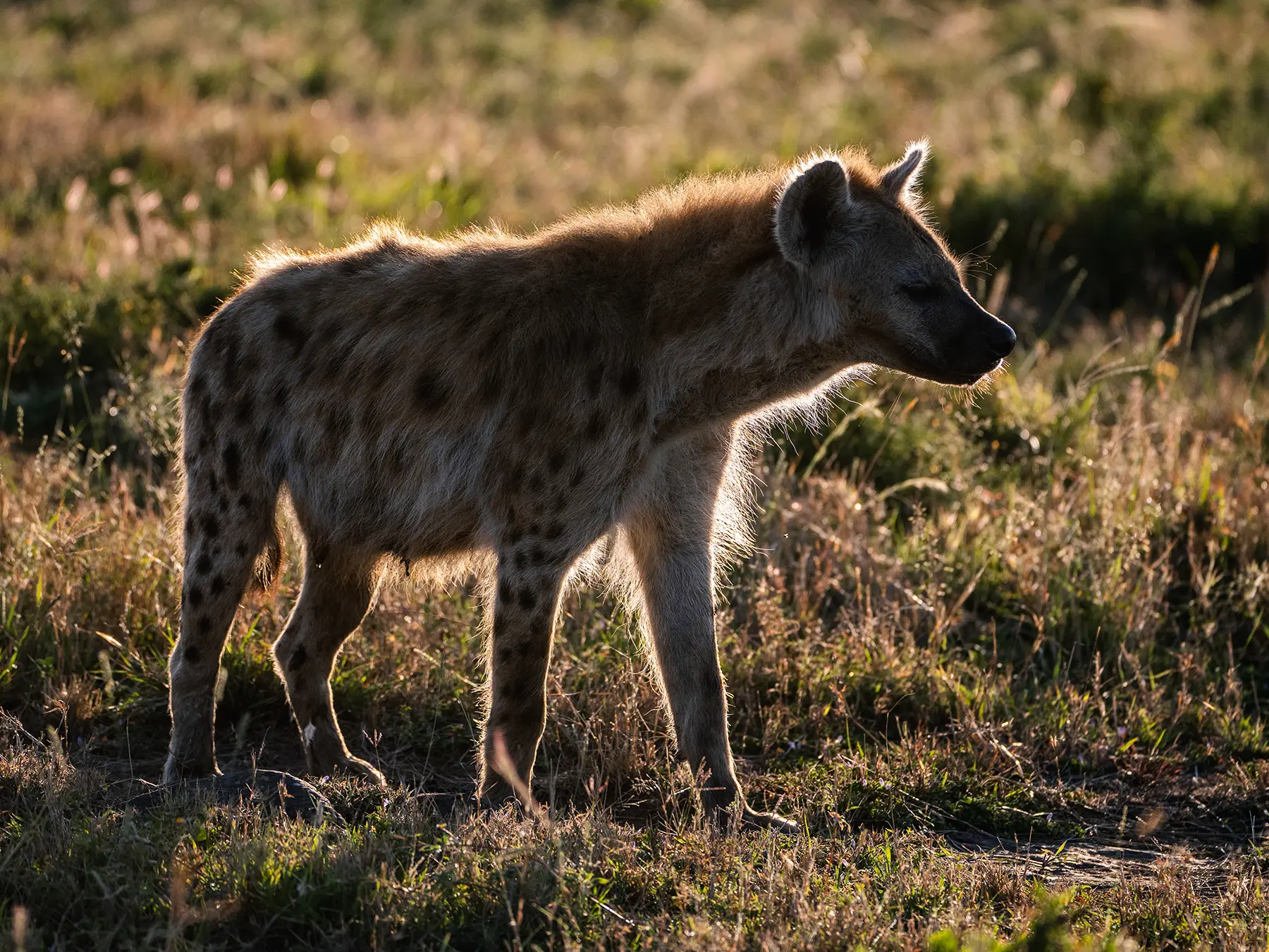
- Hyenas and other predators: Over 8,000 spotted hyenas inhabit the Serengeti, alongside smaller predators such as the African golden wolf, a subspecies found only in Kenya and northern Tanzania.
Itinerary
Your morning game drive in Serengeti’s Seronera region will start at dawn. Perfect for year-round wildlife viewing, this area is especially famous for its spectacular leopard and lion sightings. Later on, you’ll make your way to the waterholes and river valleys that form an essential component of the Serengeti ecosystem. Thanks to the varied habitats in the park, you should be able to sight a diverse range of wildlife, including huge herds of wildebeest and zebra as well as the reclusive leopard.
At lunchtime, you can either return to camp for a bite and some rest or stay out all day and enjoy a picnic lunch.
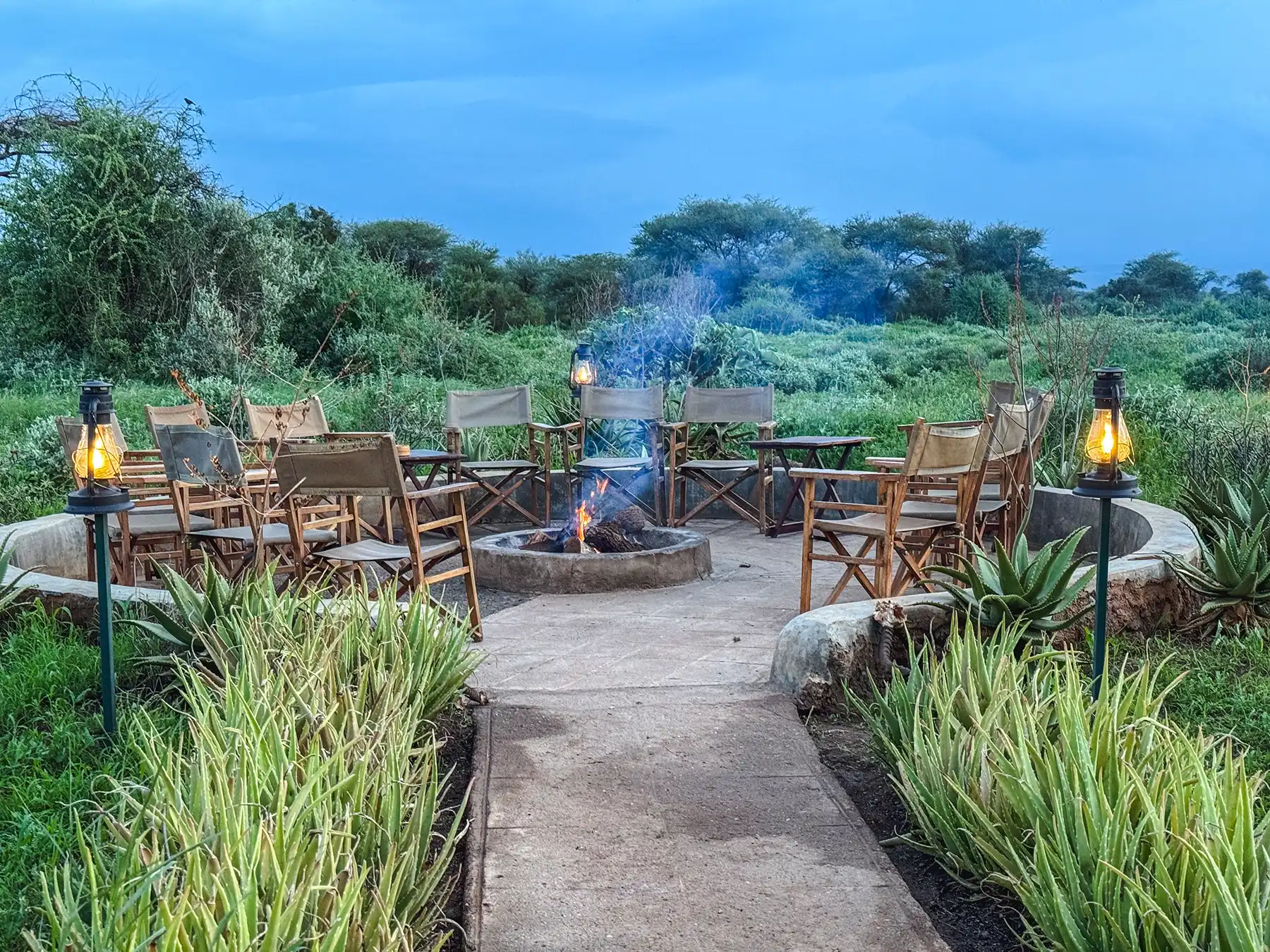
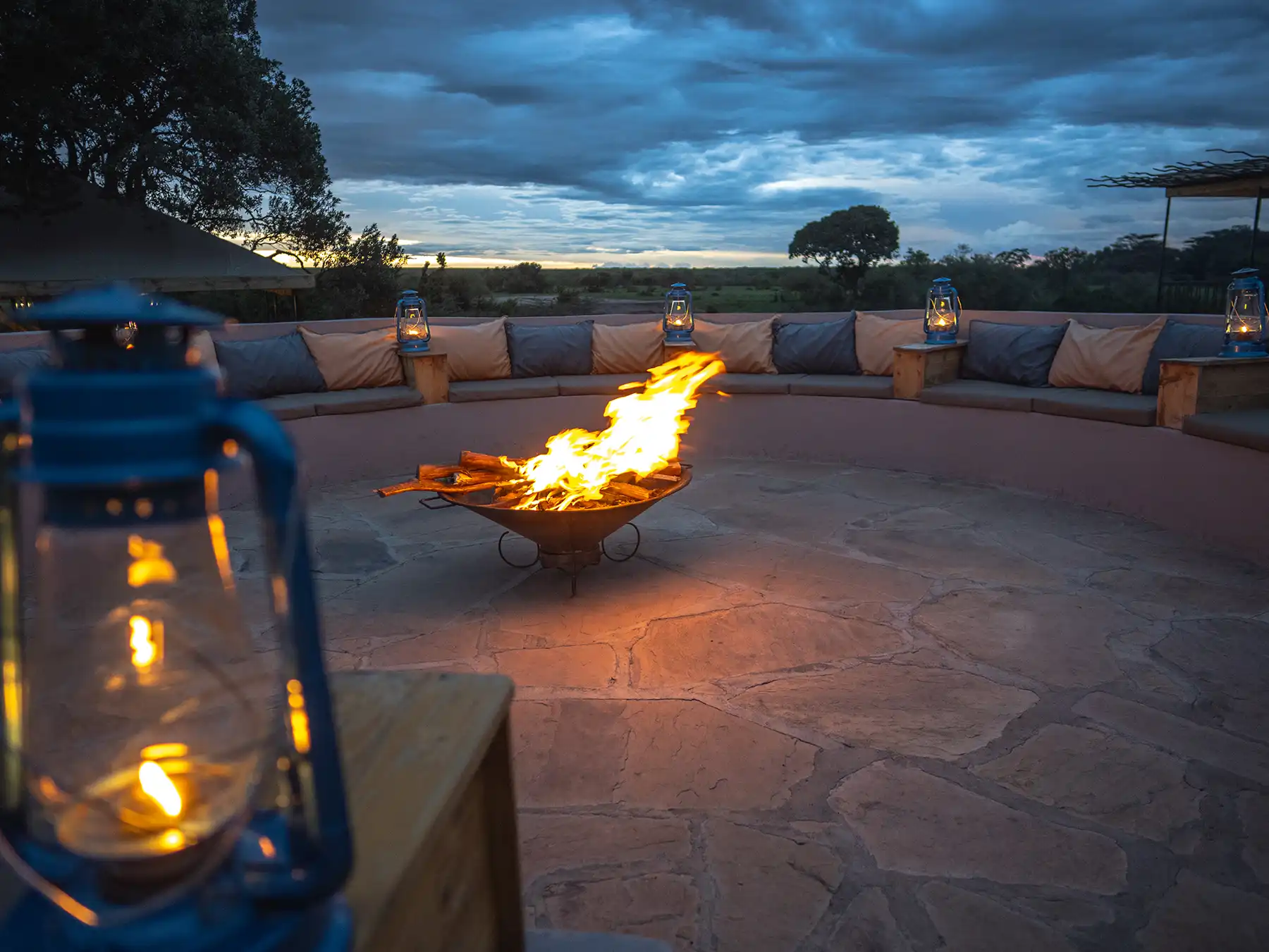
As dusk falls, it’s time to drive back to your lodge around 6:30pm. After dinner, I’d recommend sitting round the lodge campfire to take in the wonders of the night sky. With virtually no light pollution around, the stars are simply dazzling, and the sounds of the nocturnal animals around you add an atmospheric touch. As you gaze upwards, keep an ear out for the roar of lions in the distance or the cries of nearby hyenas.
Tips for Visiting Serengeti
The Serengeti is one of the leading safari destinations on Earth and one of my favourites. These quick tips should help you get the most out of your visit.
- The chances of seeing predators on the hunt are greatest at dawn and dusk, particularly for lions and cheetahs.
- Bring binoculars to help you pick out distant wildlife across the vast plains
- As much of the Serengeti is open grassland with little or no shade, be sure to wear sunscreen and a hat – and don’t forget to choose light-coloured clothing to deter tsetse flies
- Pack a lunch and plan on a full-day drive so you can cover more ground and avoid missing out while returning to the lodge at midday
My Experience of Serengeti
I’ve visited the Serengeti multiple times, and it never fails to live up to its reputation. The wildlife viewings here are out of this world, truly exceeding expectations.
I saw no fewer than three leopards in a single day when I was in central Serengeti (including a cub with its mother!), and also watched cheetahs feed on a freshly caught wildebeest. I couldn’t believe my luck!
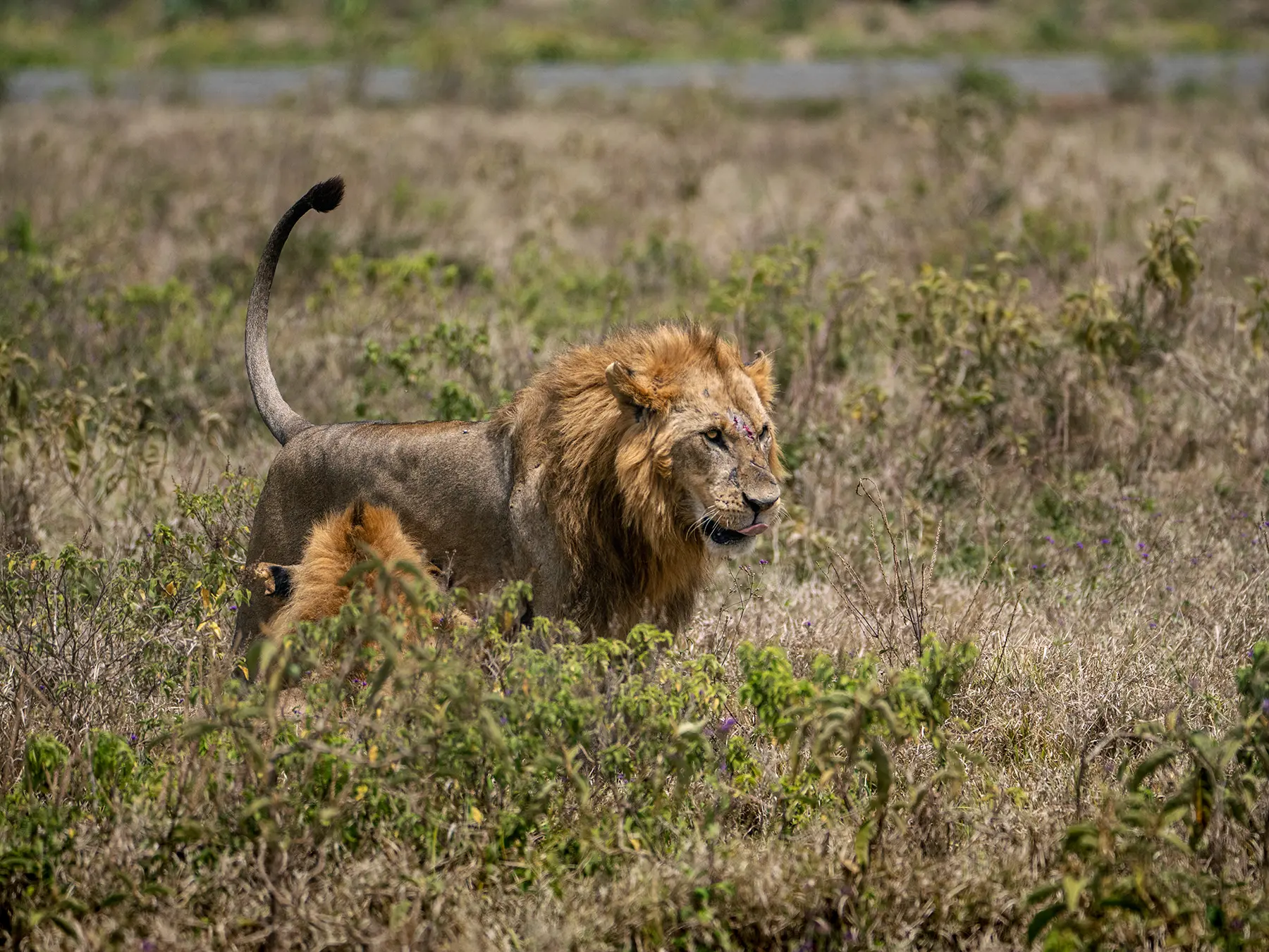
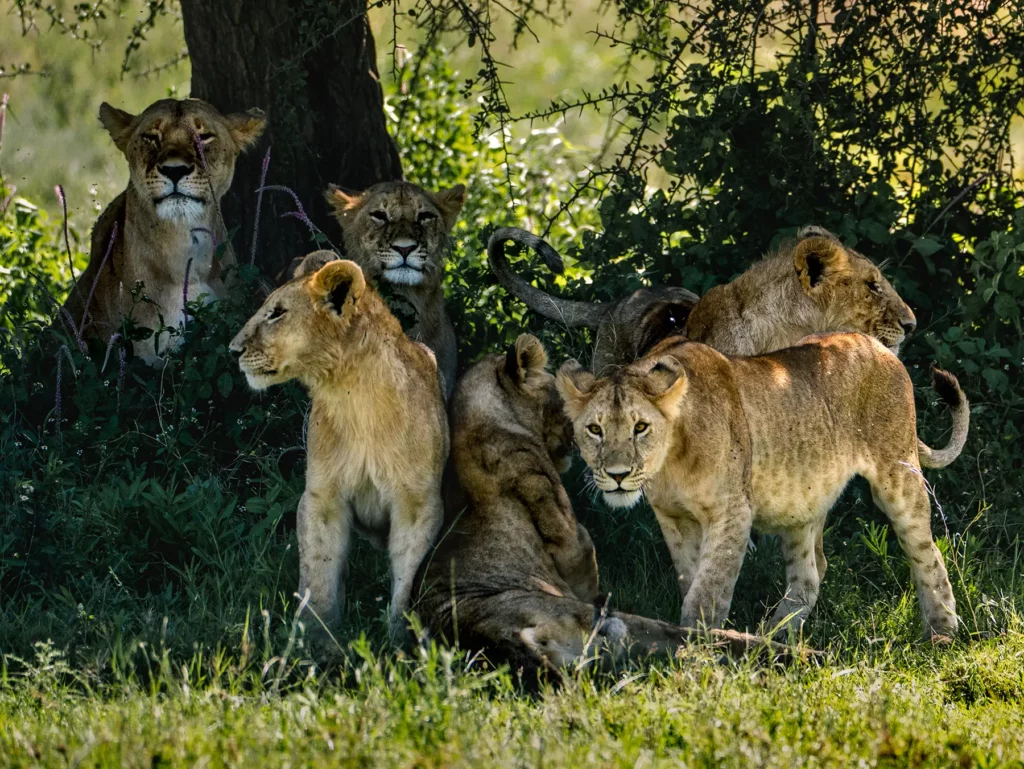
Lion lovers are also bound to love this place – I saw so many of them in the Serengeti! What’s more, every sighting was unique and amazing in its own way, from the rare tree-climbing lions to encountering a pride resting beside a stream and observing a pregnant lioness stalking some zebras.
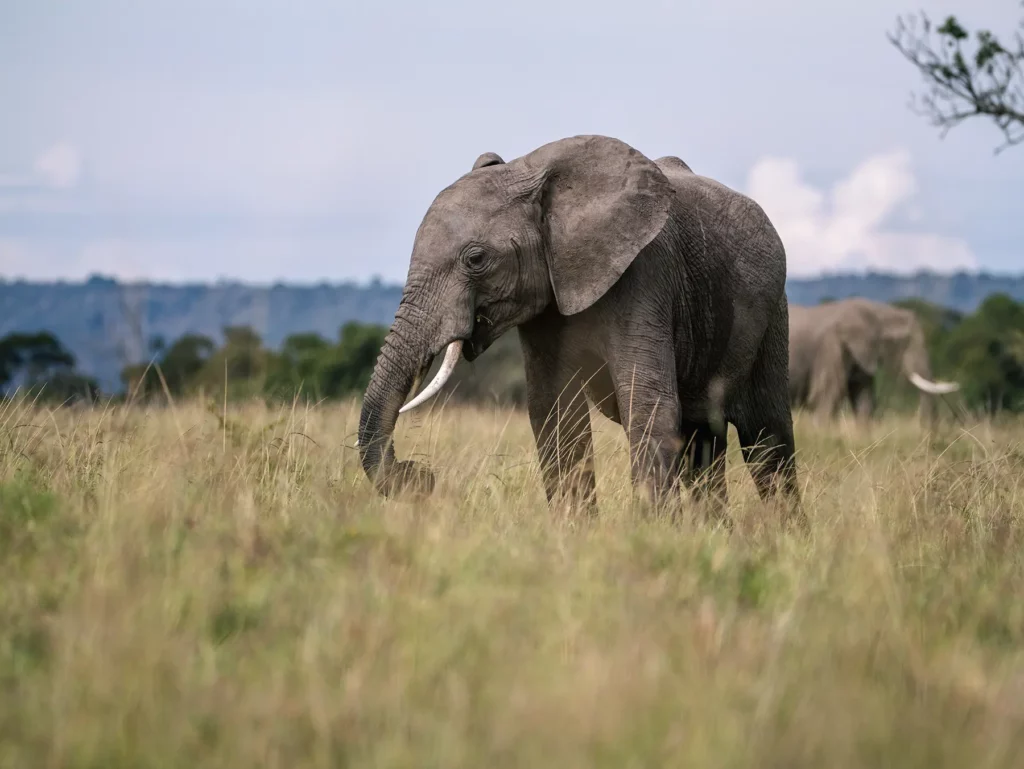
During my second trip, I witnessed the indescribable sight of hundreds of elephants marching through the savanna. Other animals I’ve seen here include huge numbers of giraffes and hyenas as well as topis, zebras, dik-diks, hippos in hippo pools, Thomson’s gazelles, impalas, baboons and so many more.
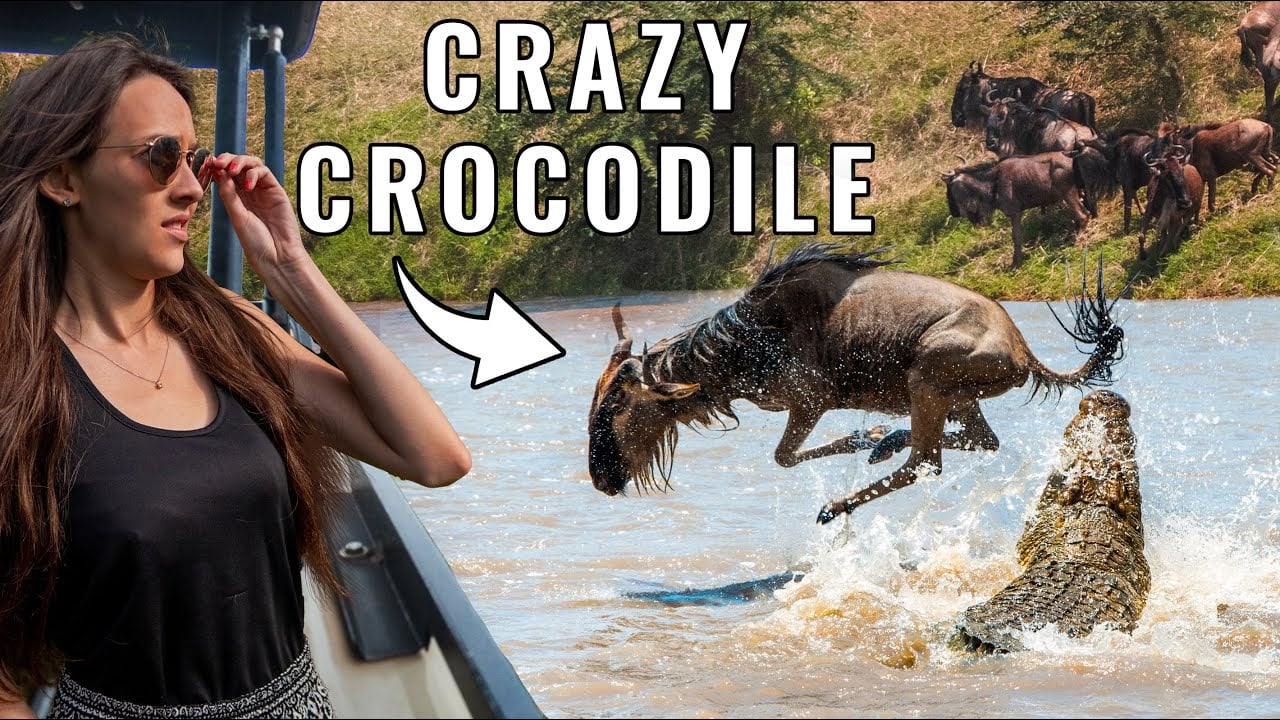
But perhaps the most emotional experience for me was watching the Great Migration river crossings in Northern Serengeti. This has been a lifelong dream for me and it is a truly exceptional and special thing to experience. I will cherish the memory of it forever. If you decide to visit during this season, I recommend spending at least a full day in the North to maximise your chances of seeing the crossing. The wildebeest sometimes trample around on the riverbanks for hours before getting up the courage to make the crossing!
Here’s a video of a Serengeti river crossing.
Where to Stay in Serengeti National Park
Tonight, you’ll be staying at the same lodge or tented camp as on day 4.
Day 6: Serengeti National Park to Ngorongoro Highlands
Drive Time (Excluding Game Drives): 3 hours
You’ll be spending most of the day today driving through the sprawling Serengeti grasslands as you slowly make your way to the Ngorongoro Highlands towards the end of the day. Like yesterday’s outing, this drive should be packed with exciting wildlife encounters and fabulous photo opportunities, so have your camera at the ready!
Your game drives today will bring you to the flatter southerly areas of the Serengeti. This change in habitat should enable you to spot a number of different species that you might not see elsewhere within the reserve. Keep your eyes peeled for wildlife and look for differences in the surrounding vegetation as well!
Itinerary
Another early start today will give you the best chance of catching big cats and other predators on their morning hunts. Prey animals will be out and about, too, so there’ll be plenty to watch for as you drive.
Wildebeest, zebra and gazelles abound in the Serengeti, and their presence naturally draws large numbers of predators such as cheetahs, lions and hyenas but also jackals and caracals.
There are also herds of buffalo, elephant and giraffes to spot. Your game drive today will finish around lunchtime as you’ll be leaving the Serengeti later today.
After your morning game drive, it’s back to the lodge to get packed up and grab a bite. Then in the afternoon, you’ll set your sights on the Ngorongoro Conservation Area.
The drive from Serengeti to Ngorongoro is an amazing experience, allowing you to watch the landscape change from endless expanses of grassland to the more varied terrain around Ngorongoro, with its mountains and lush forests.
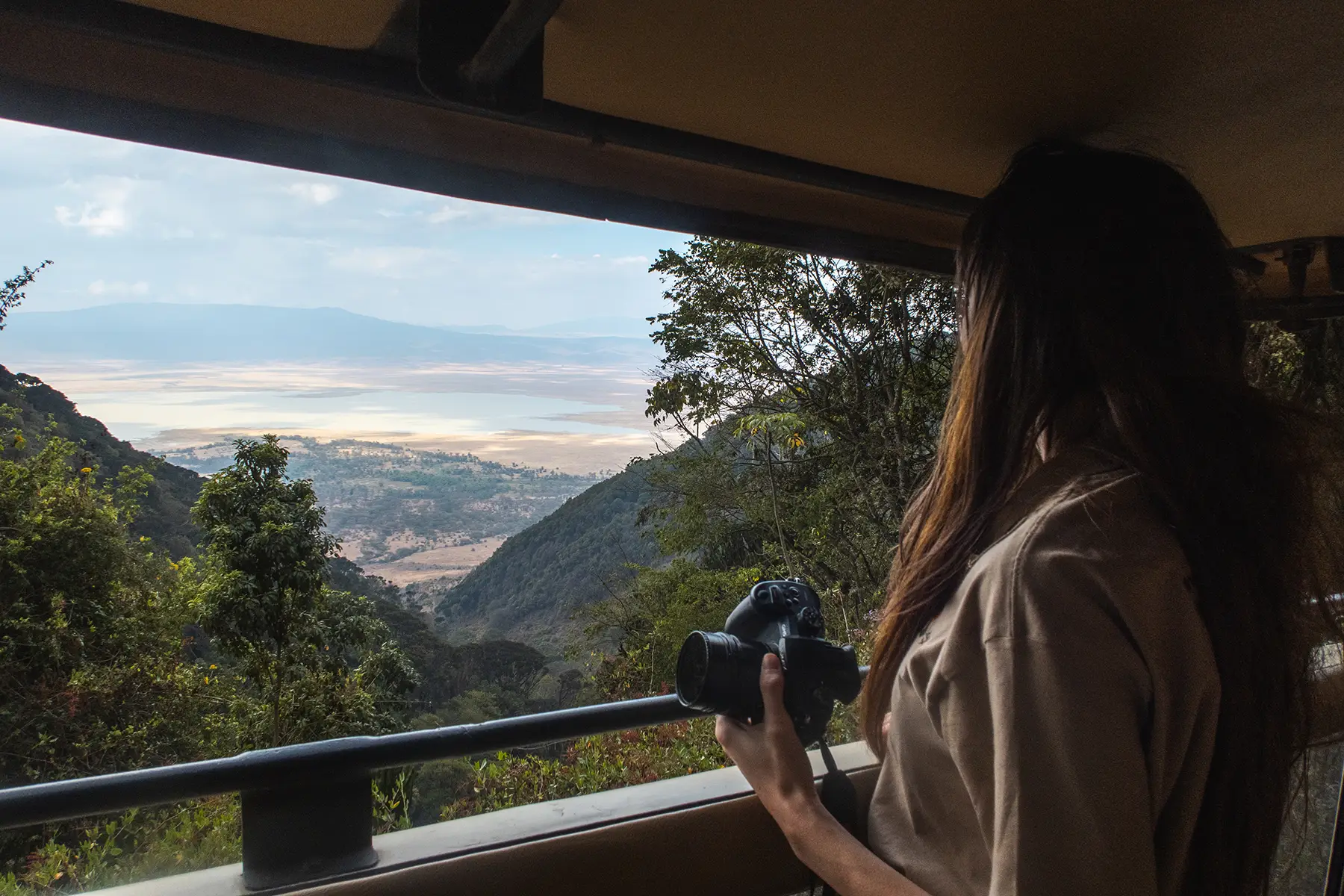
Entering the Ngorongoro Conservation Area, you may also spot some giraffes, which are absent in the crater itself. The road to the crater will take you past a number of Maasai villages, or bomas. These are distinguished by the thick, thorny fences that encircle them. You might even spot some Maasai herders tending their cattle in their distinctive red robes!
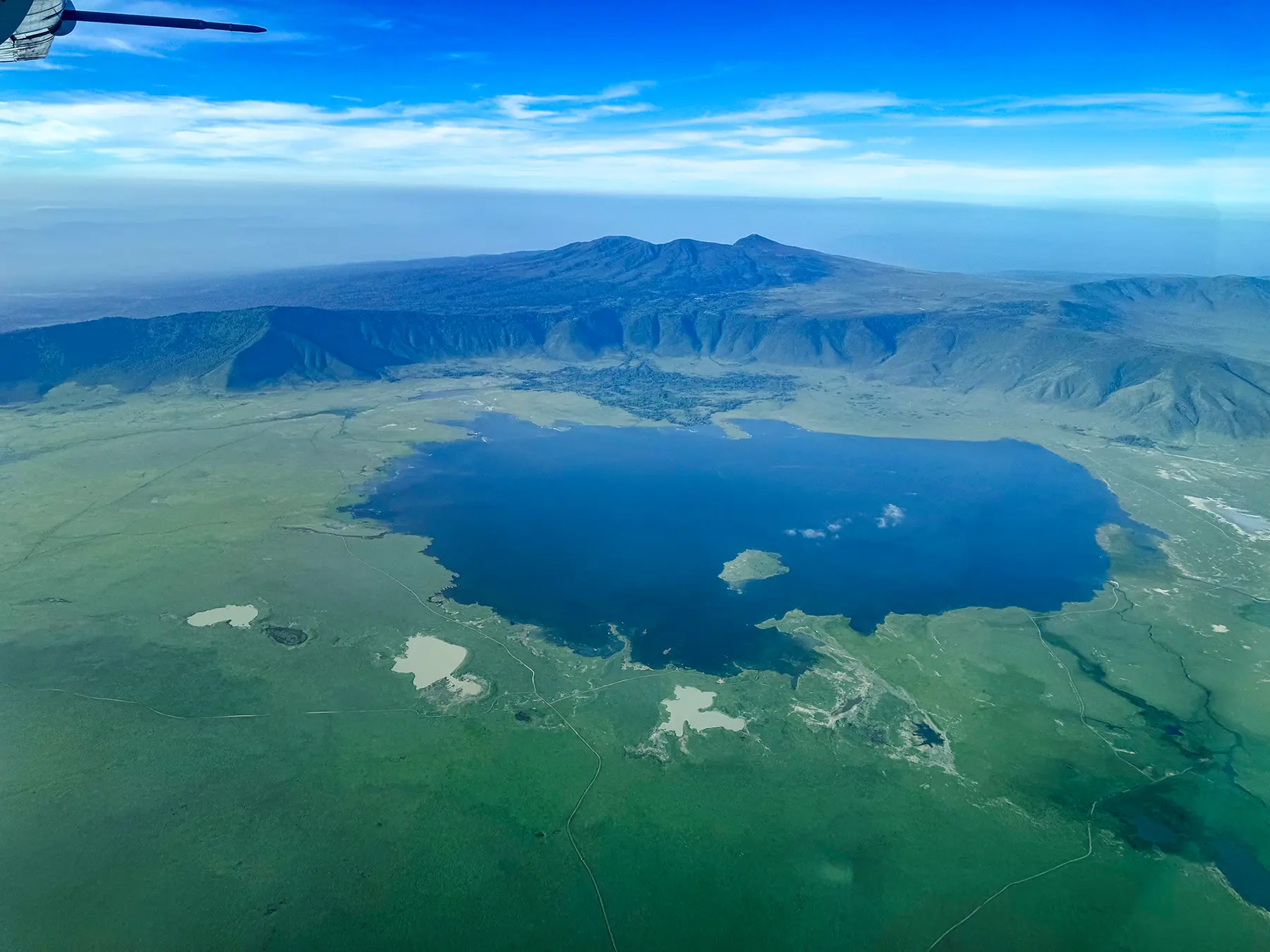
As you drive towards Ngorongoro, you’ll be heading towards the rim of the crater. This is where you’ll be staying tonight. From the elevated crater edge, you can enjoy breathtaking views down into the crater itself – a world-famous wildlife haven. If you’re lucky enough to time it right, the sunsets here are nothing short of incredible.
Where to Stay in Ngorongoro Conservation Area
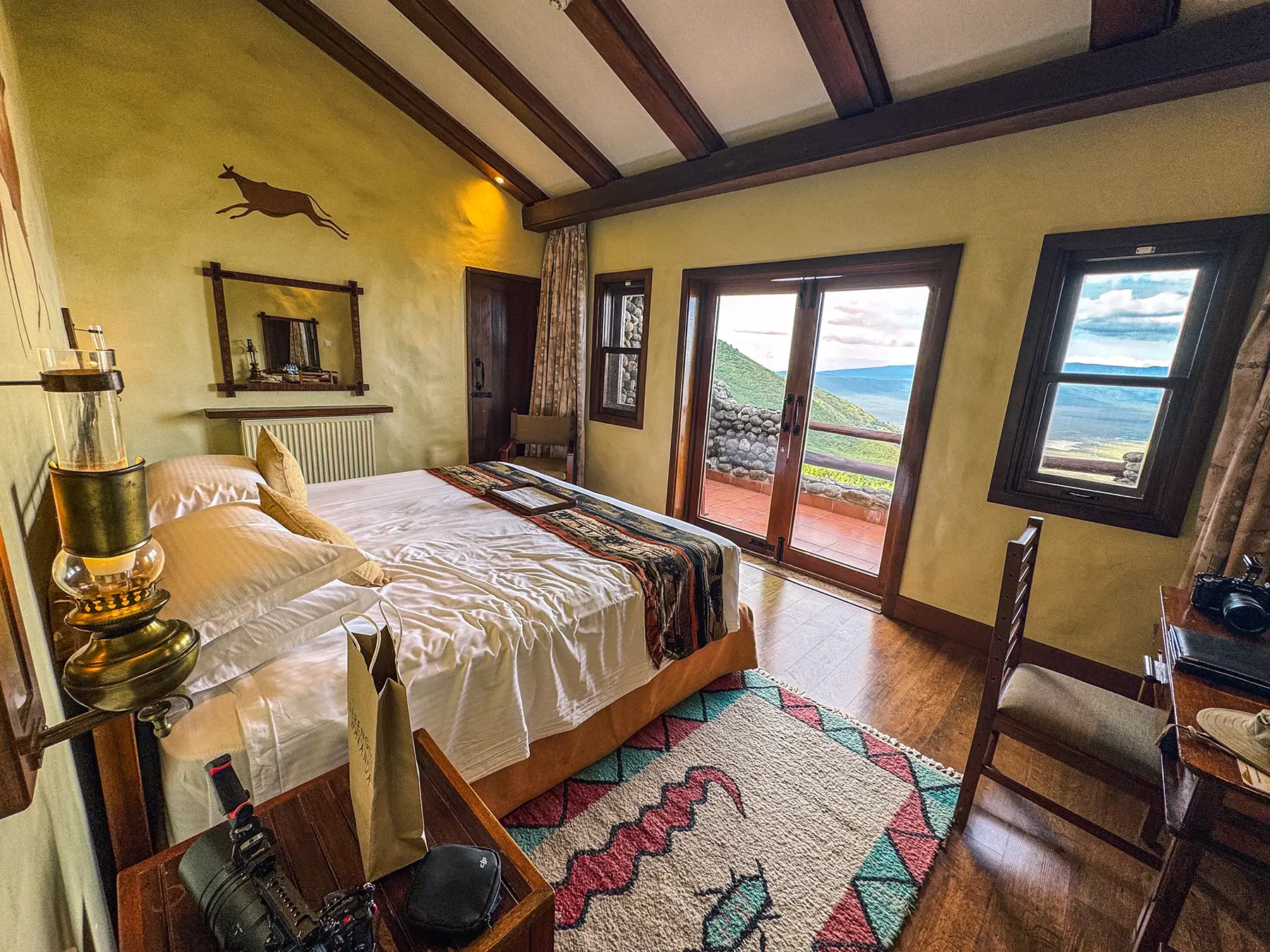
Tonight you’ll be staying around the Ngorongoro Conservation Area. If you have the budget for it, the crater rim is the ideal place to stay.
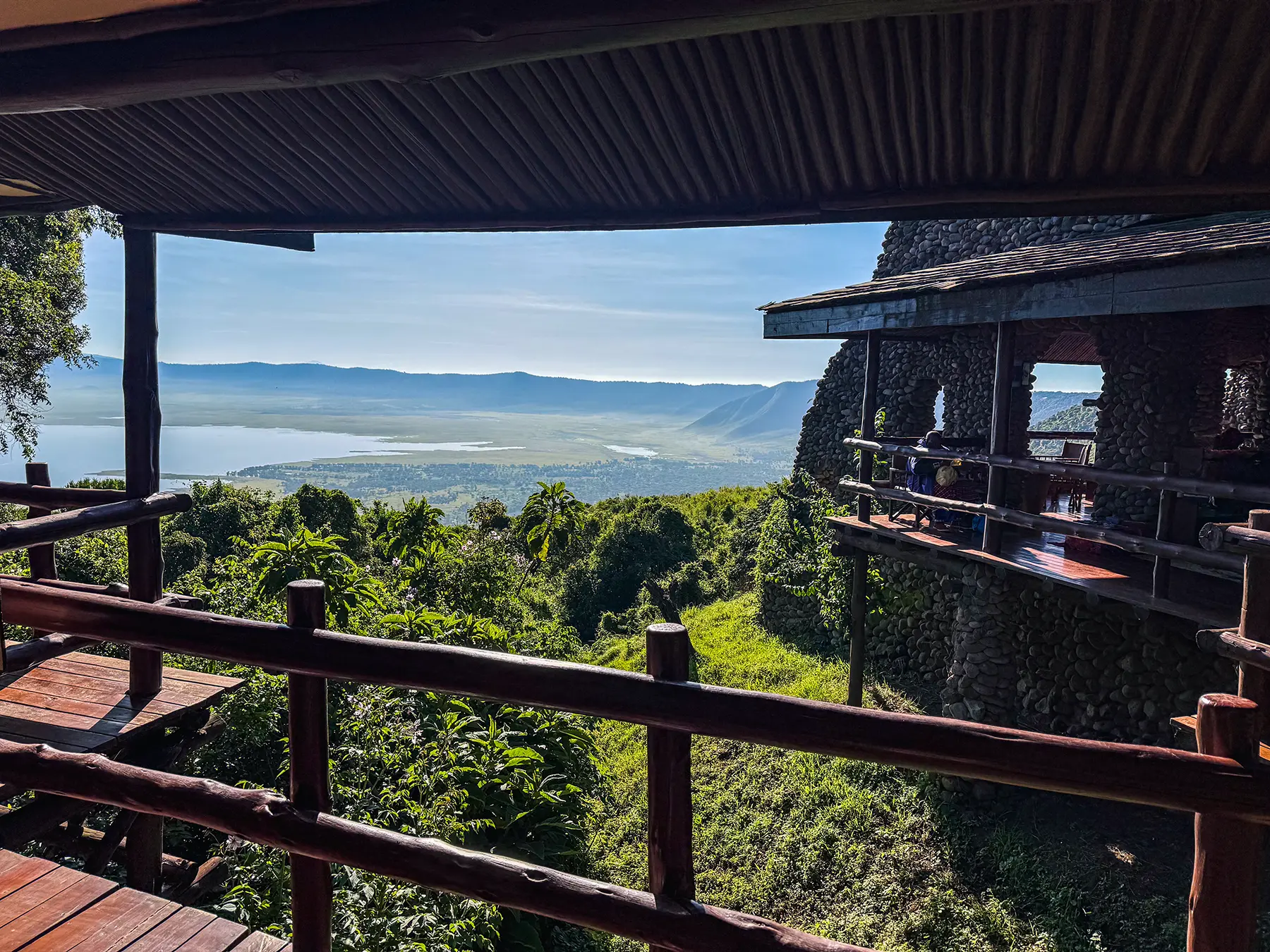
Lodges on the crater rim range from mid-range to luxury level and offer spectacular views from the very edge of the crater.
The best thing about staying on the rim is that you can enjoy early access to Ngorongoro Crater in the morning. This means you’ll be arriving on the crater floor before most other visitors, getting you there in time to witness a fabulous sunrise in relative quietude. This is also the best time to spot lions and rhinos.
If you’re seeking a less expensive option, however, the town of Karatu is a wonderful choice. Located just outside the Ngorongoro Conservation Area, the town has a range of more affordable accommodation.
Staying in Karatu still leaves you within easy reach of the crater, but also presents you with the opportunity to find out more about rural life in northern Tanzania. The town is well-known for its coffee plantations and local markets and is a great place to experience Tanzanian culture first-hand in addition to your safari adventures, adding a totally different but equally enjoyable element to your trip.
Day 7: Ngorongoro Crater Safari
Drive Time (Excluding Game Drives): 4 hours
You’ll start this last day of your trip with a safari in the unique Ngorongoro Crater before making the approximately four-hour drive back to Arusha, where you can catch your onward flight home or extend your trip.
Map of Ngorongoro Crater
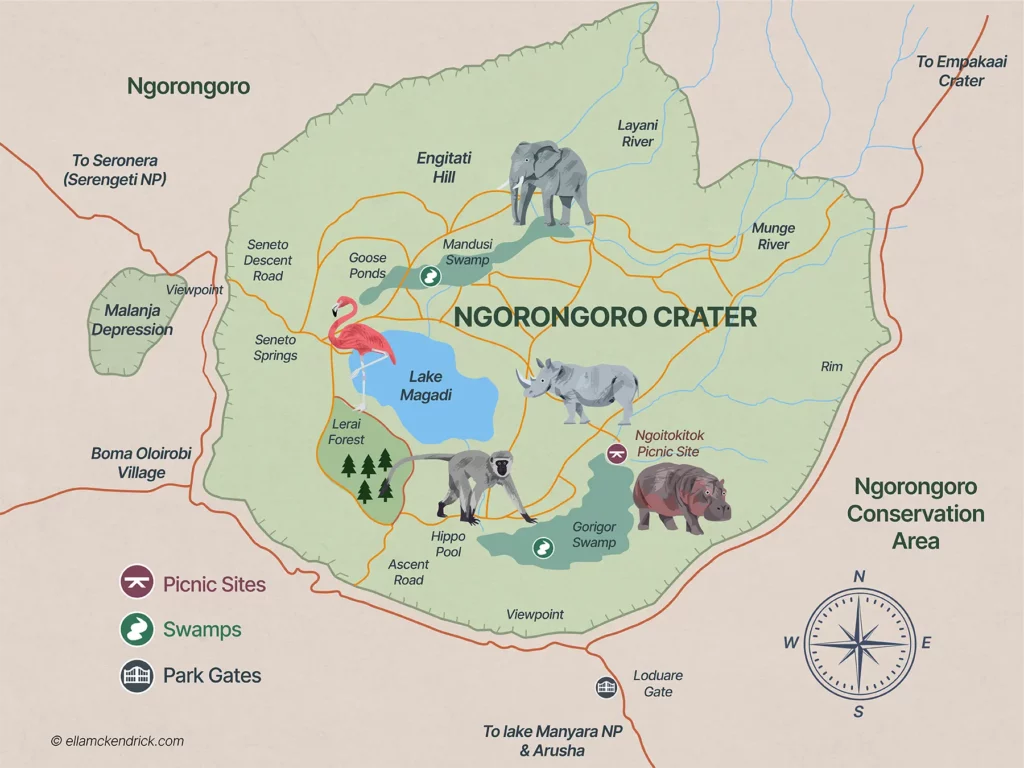
Itinerary
The park gates open at 6am, and I strongly recommend being there when they do to maximise lion and rhino sighting opportunities.
After a dramatic, meandering descent, you’ll emerge onto the crater floor, which feels almost prehistoric – I almost expected a dinosaur to emerge from the shadows! With its open grasslands, lakes, and woodlands, the crater is a haven for wildlife.
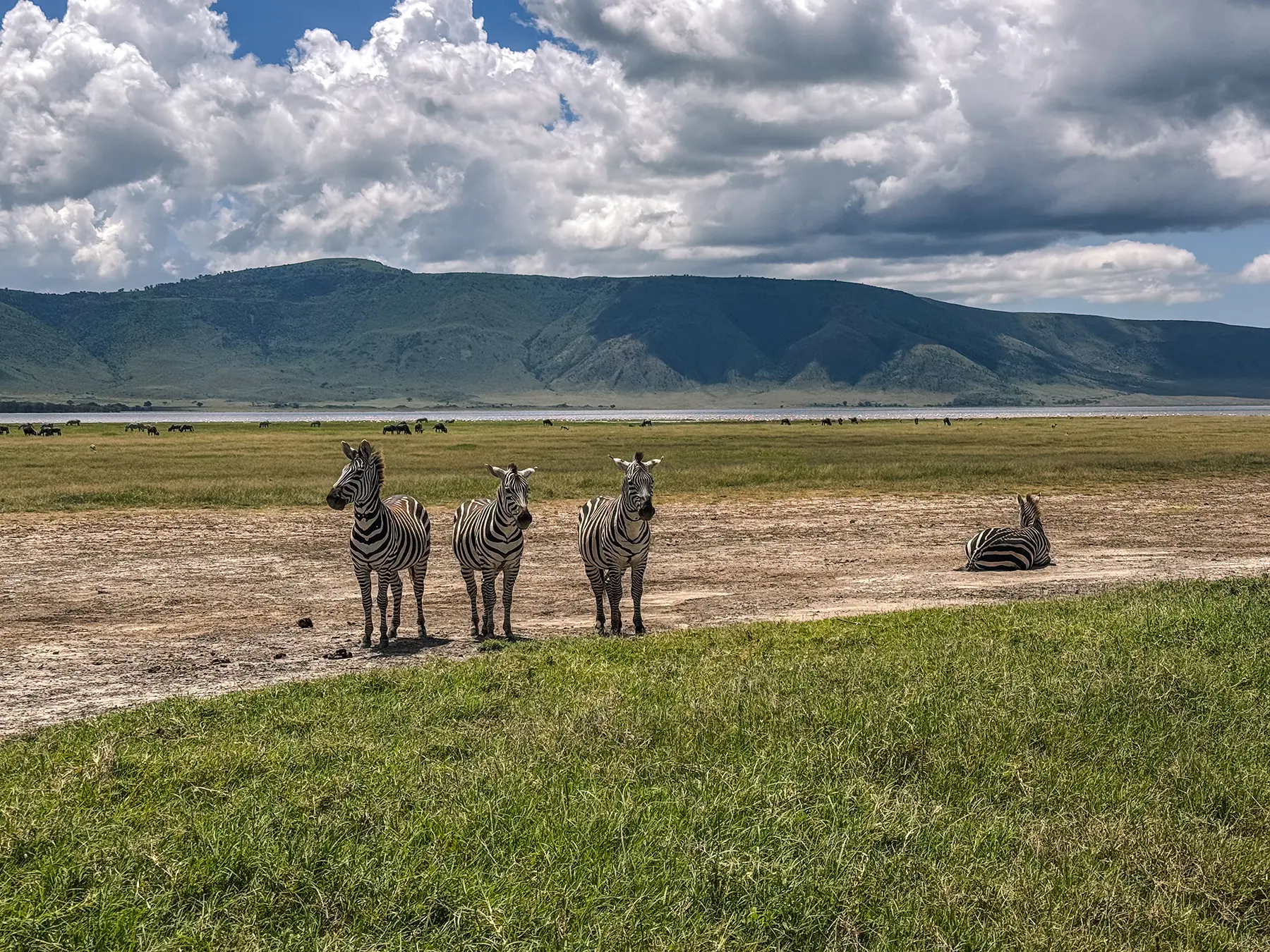
Keep an eye out for lions, which are especially abundant here, and you will also see plenty of wildebeest, zebras, Thomson’s gazelles and Grant’s gazelles grazing in the open grassland. There are also warthogs, and don’t forget to look out for flamingos in the water!
Stopping for a picnic lunch by a hippo pool is a real highlight. Here, you can relax and take in the fabulous surroundings, observing the hippos in their natural habitat as you eat. There’s something truly special about being so close to the wildlife as you enjoy your lunch!
After lunch it’s time to ascend the crater walls for the drive to Arusha. You can either spend the night there or get an evening flight home.
About the Ngorongoro Crater
Established in 1959, the Ngorongoro Conservation Area was designated a UNESCO World Heritage Site in 1979. The wider Conservation Area covers some 8,288 square kilometres, including Olduvai Gorge and the surrounding highlands, where Maasai pastoralists and wildlife live side by side.
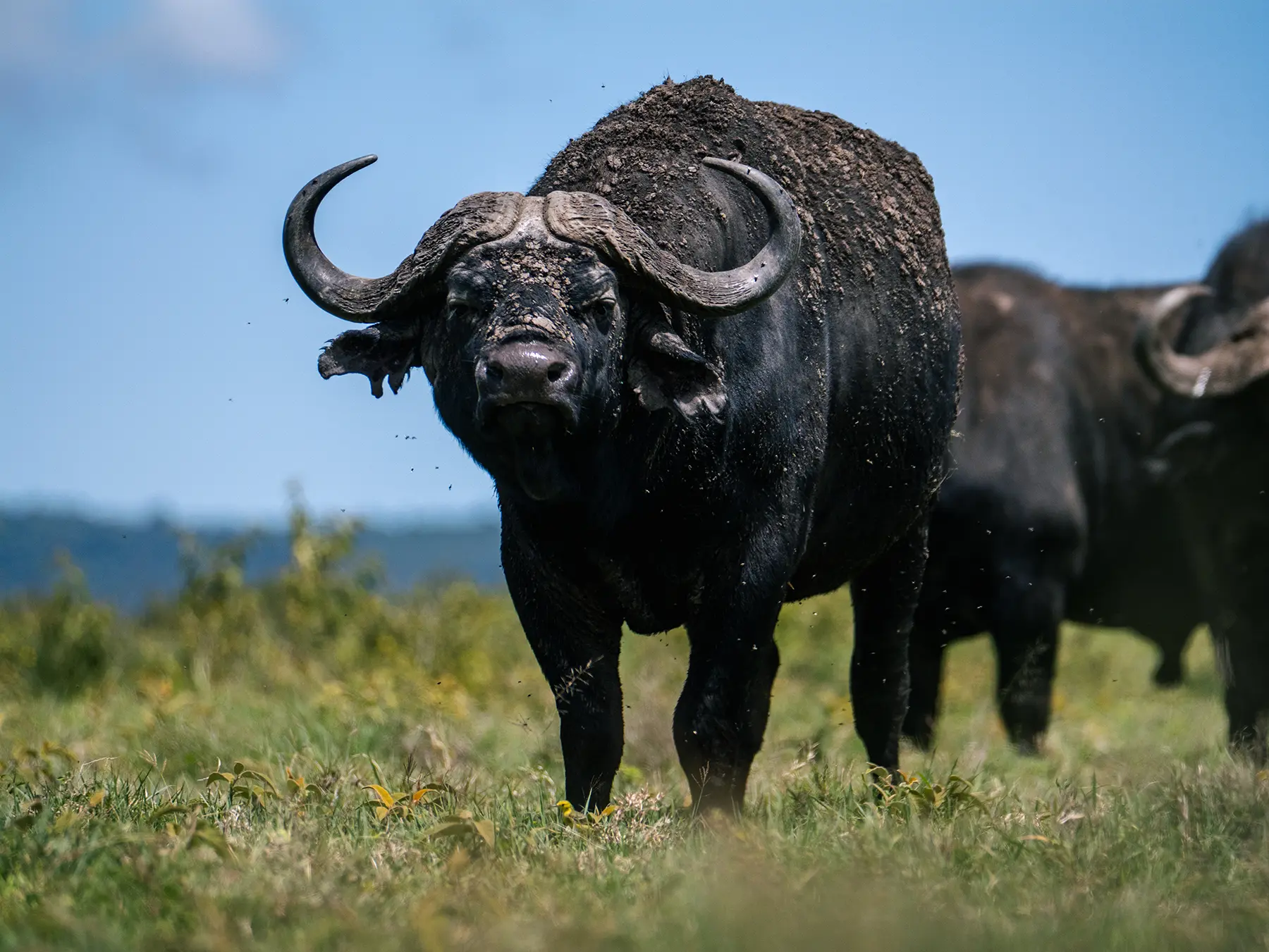
The Ngorongoro Crater floor covers around 264 km2, with walls that reach up to 610 metres high (NCAA). Up to 30,000 mammals live here year-round, including around 7,000 wildebeest, 4,000 zebras and 4,000 Cape buffalos (NCAA).
At 21 lions per 100 km2, the crater’s lion density surpasses even the Maasai Mara’s 16.5 (Royal Society). Interestingly, however, no giraffes are found inside the crater, though they are abundant elsewhere in the Conservation Area.
What Wildlife Can I See in the Ngorongoro Crater?
The Ngorongoro Crater houses all of the Big Five.
Lion sightings are the most reliable due to the super-high density of lions in the crater and I’ve seen them on every visit.
The crater actually has one of the highest lion densities on the continent. During my visit, we saw a pride of lions crossing the road in front of us, some of them passing right by our vehicle.
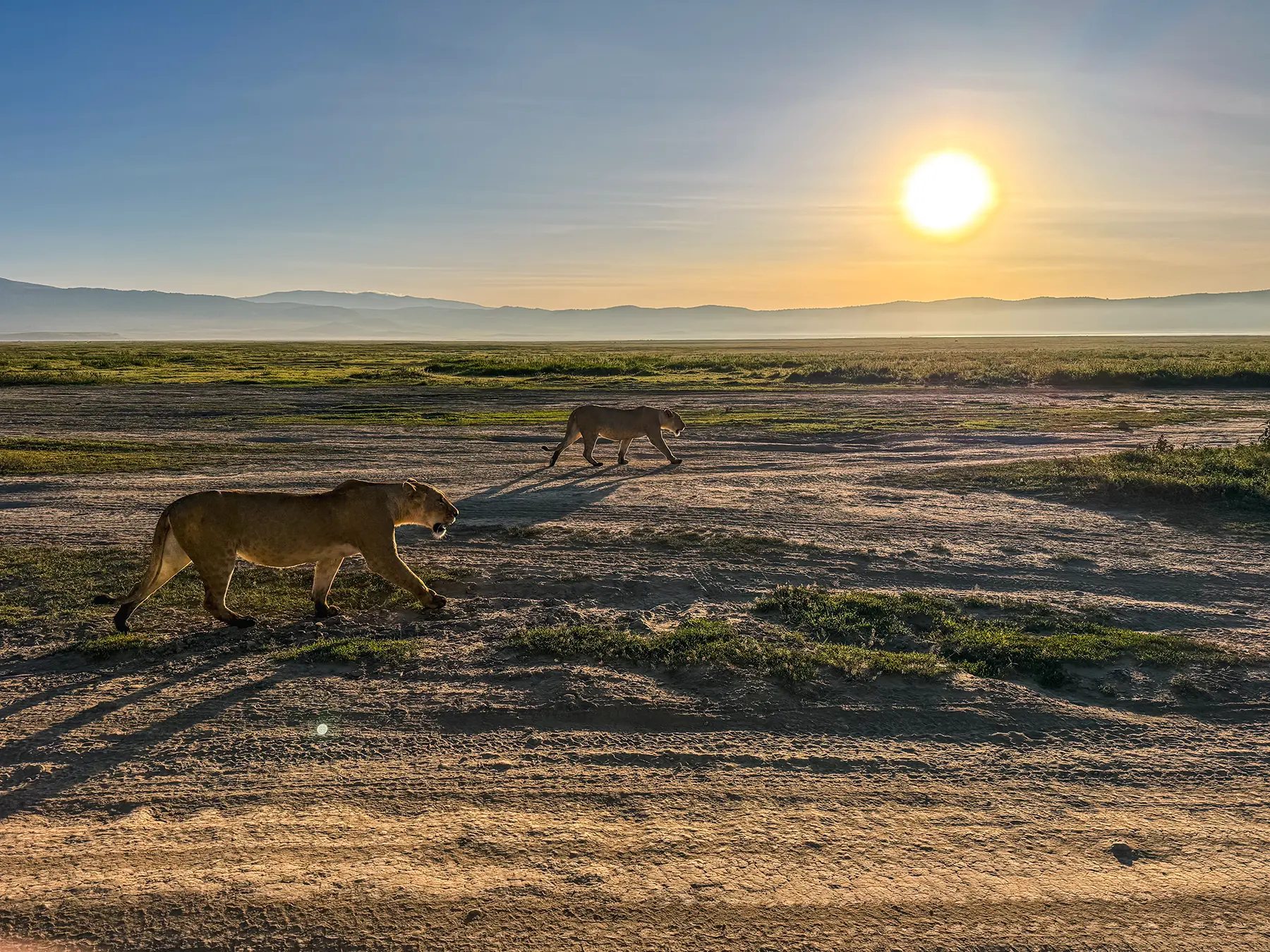
Cheetahs are the hardest to spot in my experience. I’ve yet to see a cheetah in the crater.
I’ve seen the other big five in there: rhinos, buffalo and elephants.
There are at least 30 rhinos in the crater and thanks to its small size, the crater is one of the best places in Africa to spot this critically endangered creature. I have found the best time to see them is in the wet seasons when they come out from the forests to browse on the denser vegetation which grows in the wet seasons.
Its towering walls minimise migration in and out of the crater, meaning that populations remain stable throughout the year. The enclosed nature of the crater also means that it has its own unique ecosystem.
Some 300 elephants call this place home, among them about 75 big tuskers, which are an awe-inspiring sight. In addition, you should see pods of hippos wallowing in the swamplands and freshwater pools, and there are numerous baboons and vervet monkeys around.
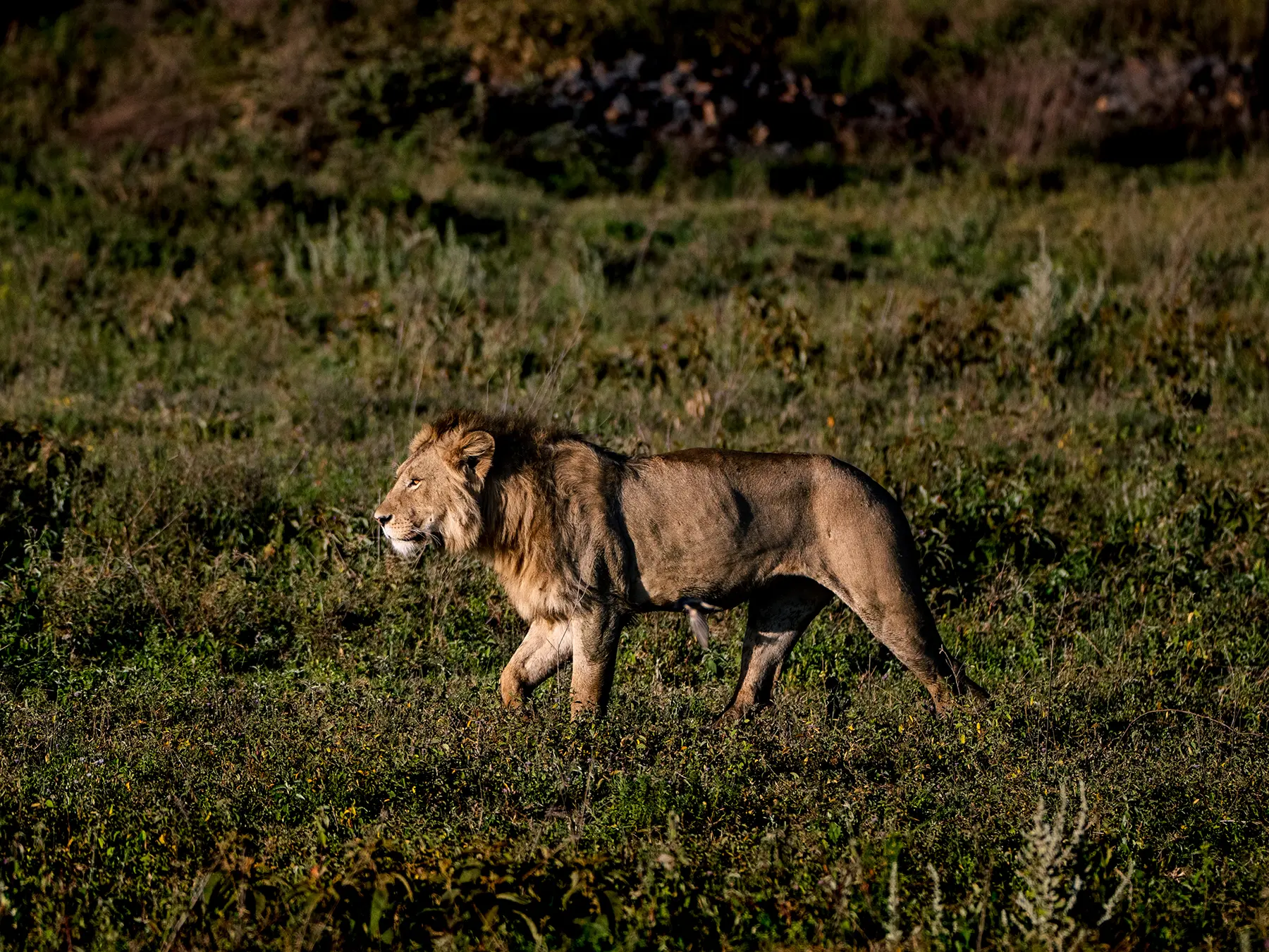
I had the privilege of seeing four black rhinos during my own visit to the Ngorongoro Crater – an experience that will remain with me always.
The alkaline Lake Magadi in the centre of the crater is home to a host of flamingos, whose striking pink plumage contrasts beautifully against the green of the crater floor. Crowned cranes, ostriches, secretary birds, augur buzzards and numerous raptor species are also among the 500+ bird species that call this place home.
Tips for Visiting Ngorongoro Crater
The Ngorongoro Crater is one of my all-time safari highlights. Here are some tips for your visit!
- Try to descend into the crater as early as possible (gates open at 6am) for optimal light and fewer vehicles.
- Dress in warm layers – the crater floor is surprisingly cold and windy!
- Beware of the fearless black kites at the picnic area – they’ll do their best to snatch food right out of your hands!
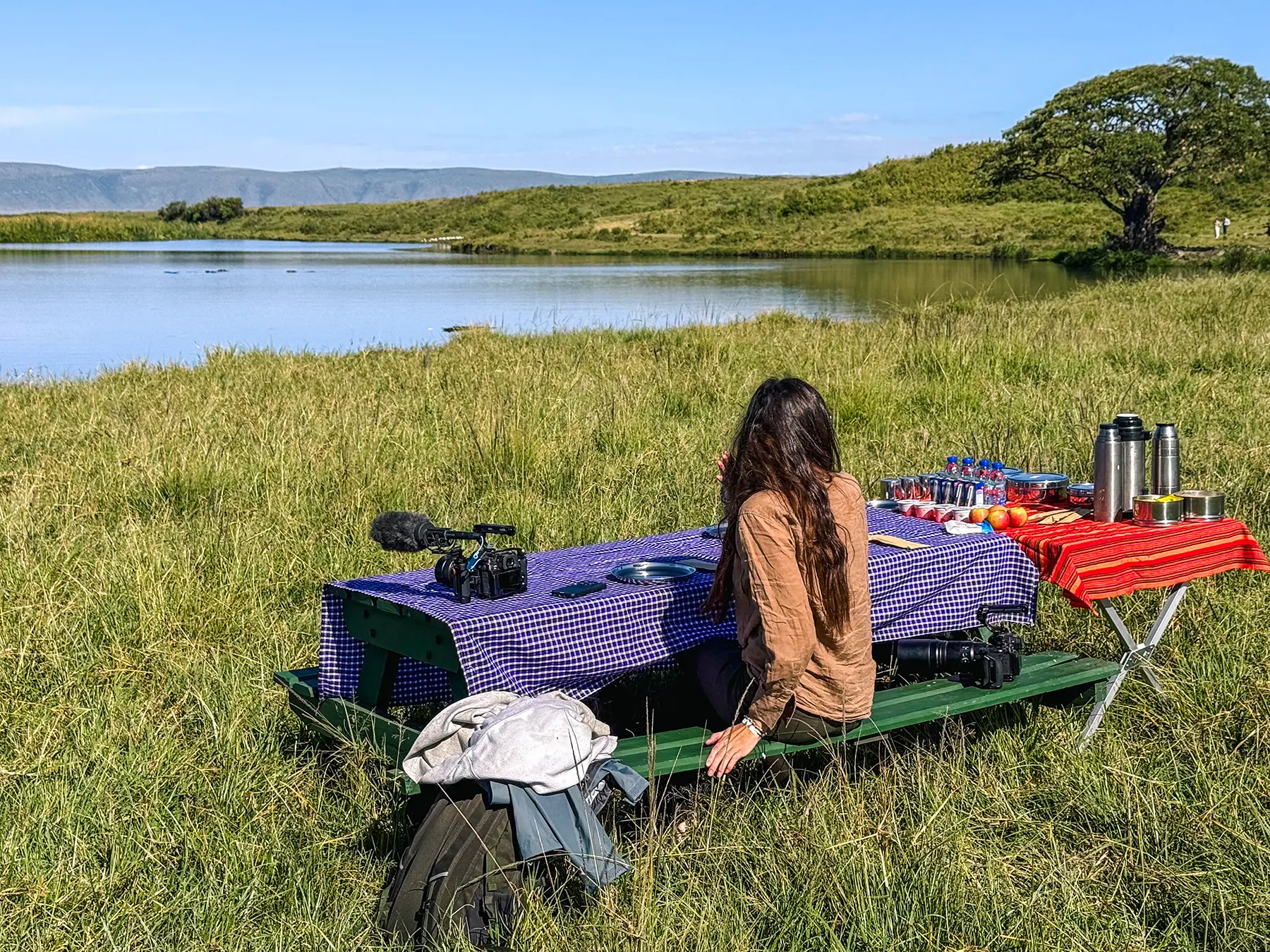
My Experience Visiting Ngorongoro Crater
Ngorongoro Crater is my second favourite spot in Tanzania after the Serengeti. The drive down to the crater floor was breathtaking, with the misty forested roads around the rim giving such a magical feeling. As the mist cleared, we saw some Maasai herders and zebras before descending to the vast savannah below. The sun was rising as we emerged onto the crater floor, and the shades of pink and orange over the crater rim were just divine.
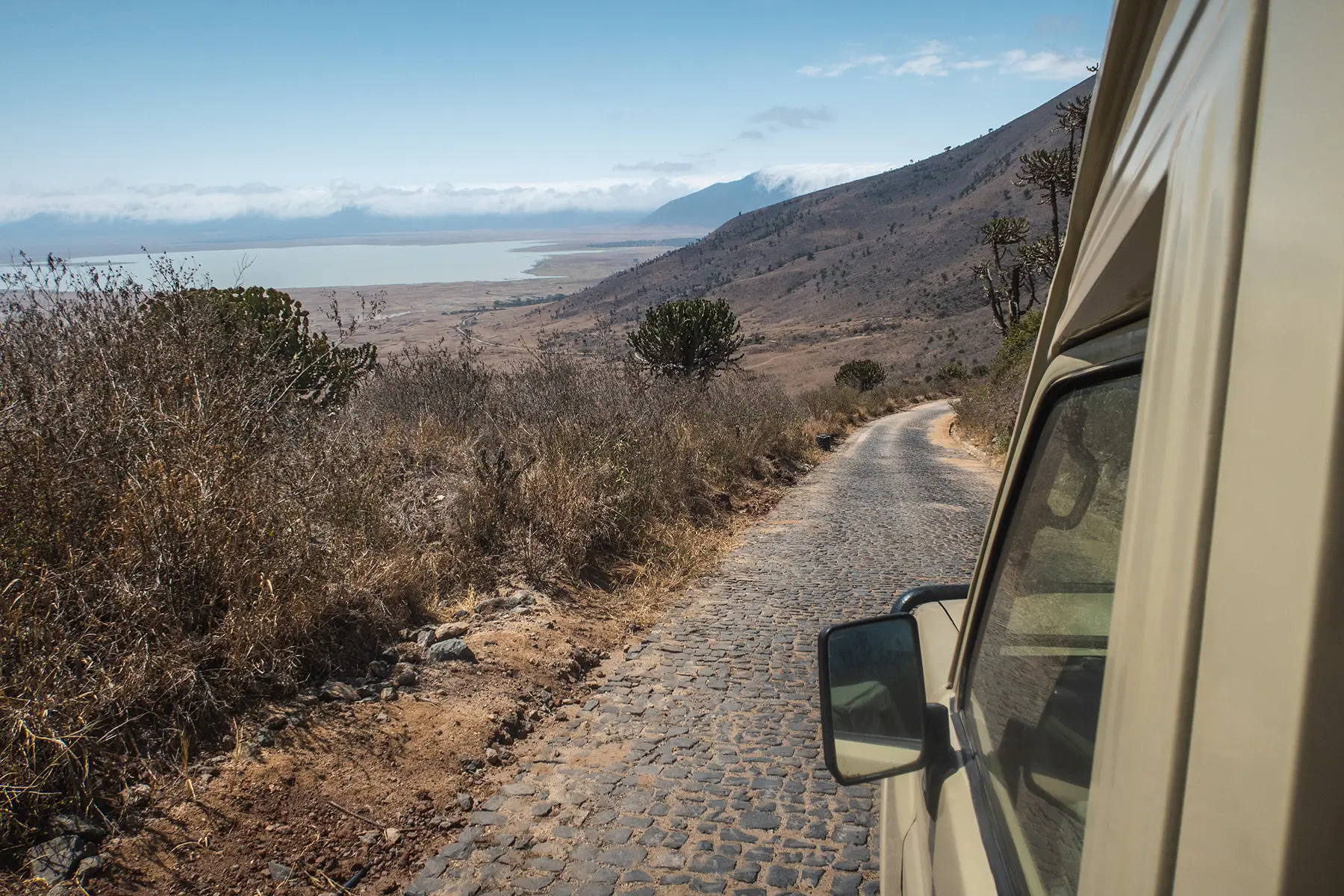
Our amazing guide had spotted a lion by the side of the road on the crater floor as we descended and when we went down for a closer look, we were rewarded with an unbelievable sighting – an entire pride of lions walking through the short grass on the crater floor, complete with several young cubs. We watched with bated breath as lionesses walked right by our vehicle, the playful little cubs tumbling along beside them.
The crater floor was simply packed with wildlife – buffalo, zebras, gazelles, lions, warthogs, hippos and, of course, the fabulous flamingos at Lake Magadi. Despite the sunshine, though, the breeze was very cold and I regretted not packing a beanie!
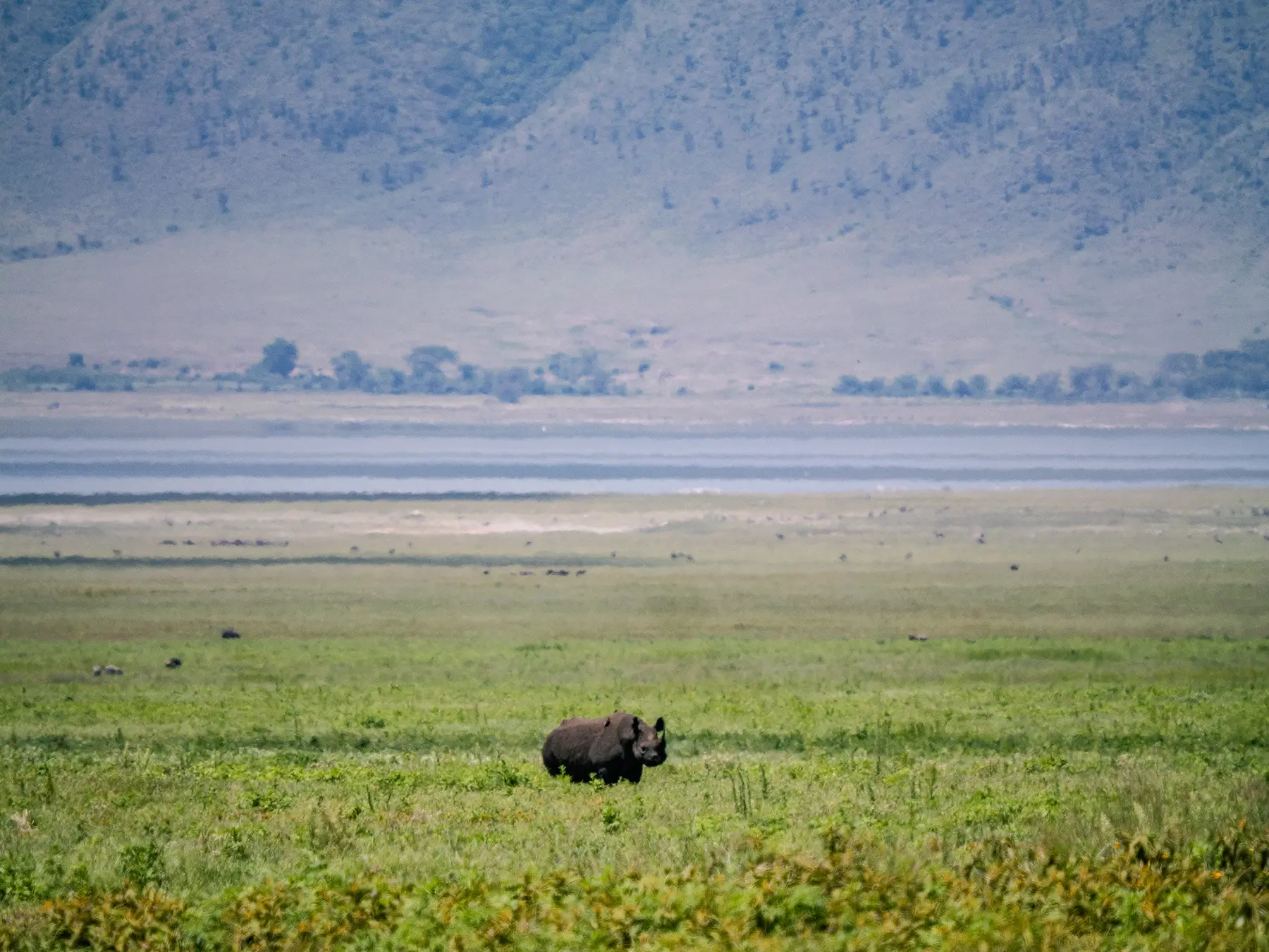
We spotted a black rhino in the distance not long after entering the crater, and were rewarded with a second sighting after our breakfast. Imagine our delight when this was followed by a third and fourth! Each time, the rhino was quite far off and we needed binoculars or a long-lens camera to see it properly, but seeing these animals living wild in the crater was such a moving experience.
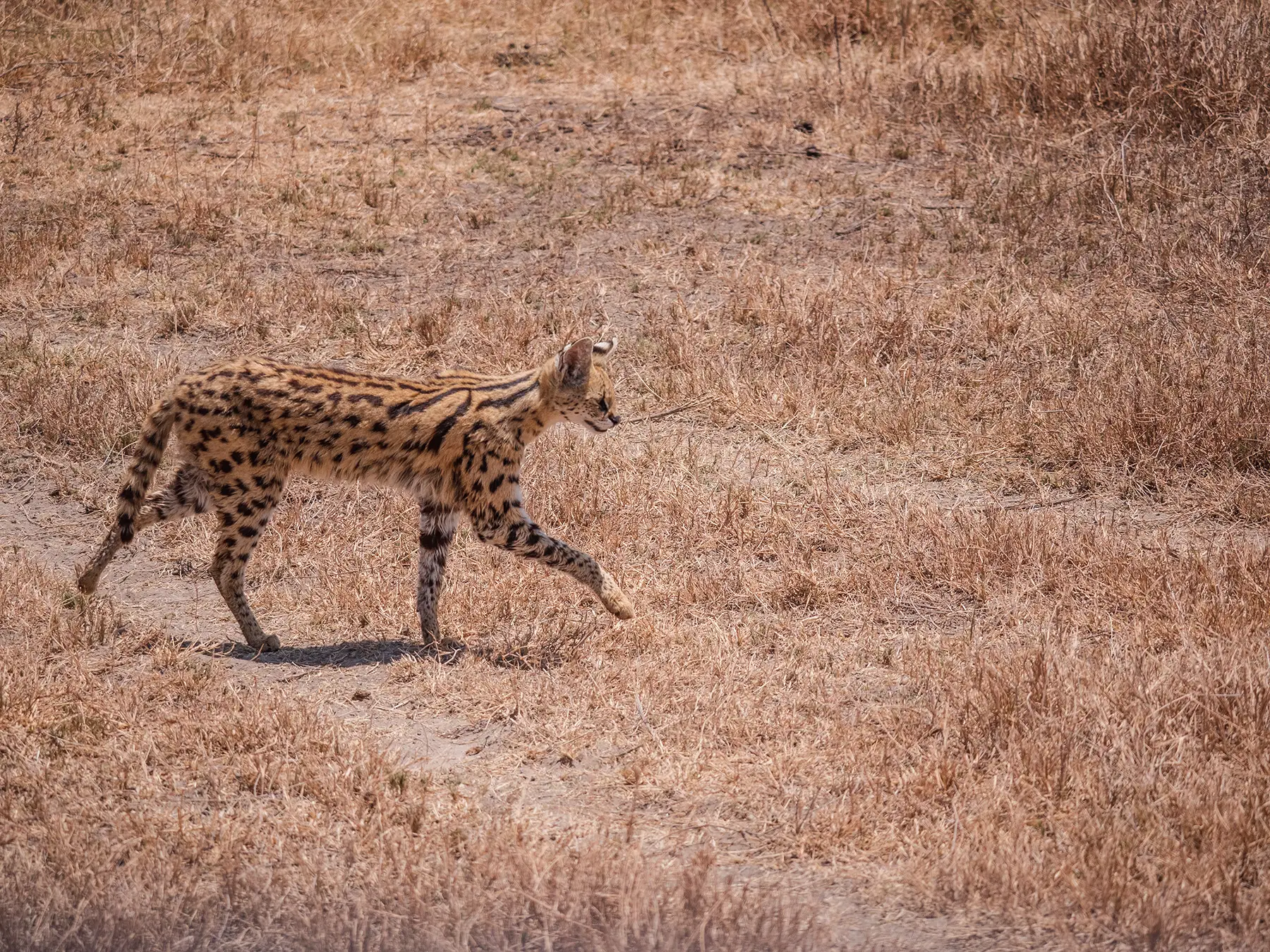
The highlight of our visit was when we glimpsed a serval family hunting in the grass. We also spotted an African golden wolf, some lionesses cooling off in the mud, and elephants feeding in Lerai Forest. We had lunch by the hippo pool and were visited by some cheeky birds, including a marabou stork sipping champagne and black kites trying to steal our sandwiches. What a fantastic day!
Here are two videos of our experiences visiting Ngorongoro Crater.
The first video was taken in the long dry season (September) and the second in the short dry season (February).
Where to Spend the Night
Arusha offers various accommodation options, from the luxurious Malia to the mid-range Arusha Coffee Lodge to the budget-friendly options. But if you’re catching a late evening international flight from Kilimanjaro International Airport, you may not need accommodation at all.
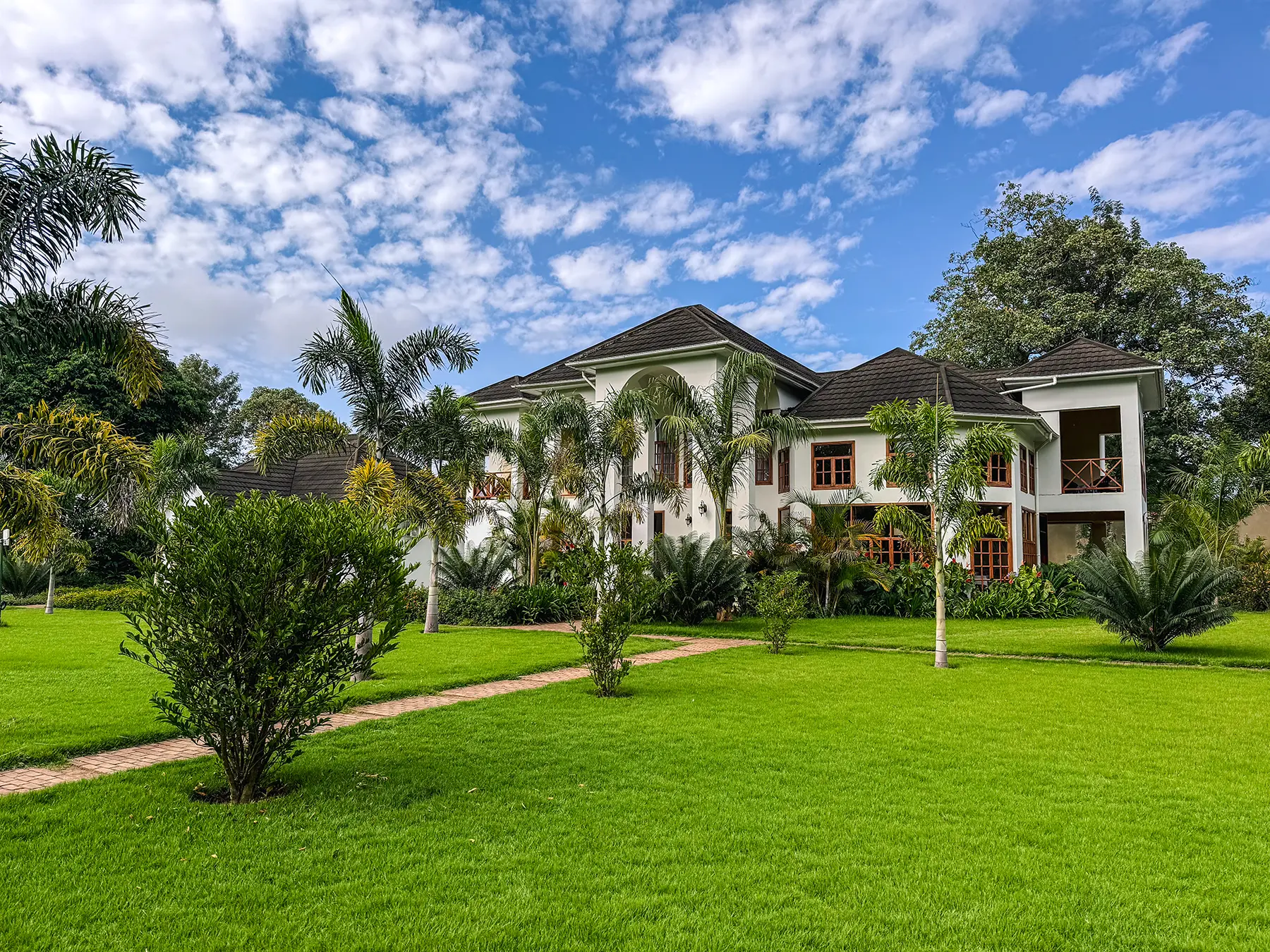
Recommended Booking Options For Your Kenya and Tanzania Safari Itinerary
Private Safari
Most popular & best experience – typical prices for this itinerary start from $350 per person per day.
Visit safarisbyella.com for free quotes from trustworthy local tour companies I use to book my own trips.
Kenya and Tanzania Safari FAQs
Click on any of the frequently asked questions below to show the answer.
Is it worth combining Kenya and Tanzania on one safari?
Yes! A combination trip of Kenya and Tanzania will enable you to see two of the most iconic destinations in East Africa in the same trip. You can look forward to outstanding predator sightings in the Maasai Mara as well as the Mara river crossings as part of the Great Migration, while the vast plains of the Serengeti are home to Africa’s largest lion population.
Lastly, a visit to the Ngorongoro Crater is a totally new experience as you explore the floor of a volcanic caldera that’s teeming with wildlife. Even the border crossing is an exciting element of the trip!
How does the Kenya-Tanzania border crossing work?
It takes between 30 minutes and 2 hours to cross the border between Kenya and Tanzania at Isibania. Be sure to have your passport, your Tanzanian visa (you can either get this when you arrive or organise it in advance as an e-visa) and your yellow fever vaccination certificate.
Crossing the border itself is a simple process, though there can be delays during busier periods such as weekends or public holidays. As you’ll be moving to a different vehicle at the border, it’s a good idea to have all your things packed and ready to move. This will save you time and ensure you don’t lose anything!
If you made your reservations through a local operator, they will help you with the border crossing process and offer helpful advice to ensure all goes seamlessly.
What is the best time to visit Kenya and Tanzania for safari?
Peak safari season is in the dry season, from July to October, when the Great Wildebeest Migration is in full swing in the Maasai Mara and you can witness the electrifying Mara River crossings.
Alternatively, you can plan your visit for the amazing wildebeest calving season from January to February, when thousands of baby wildebeest are born every day in southern Serengeti. Predators are also particularly active at this time, attracted by the young wildebeest.
You can really visit both countries any time of year, though it’s important to be aware that some roads in the Serengeti can become impassable during the long rains in April/May, and the weather can also impact visibility at this time.
How much does a 7-day Kenya and Tanzania safari cost?
Price for a 7-day combined safari start at around $300 per person per day for a budget safari. If you opt for mid-range, with comfortable lodges, you can expect to pay around $400-600 per person per day. Meanwhile, a trip that takes in the luxury lodges and more exclusive conservancies can cost from $800 per person per day.
Prices generally include accommodation, meals, game drives and park fees as well as the border crossing fee.
Can you see the Big Five on this itinerary?
Absolutely! The Big Five (lion, leopard, elephant, buffalo, and rhino) can be found at all three destinations on this itinerary. Lion, leopard, elephant, and buffalo viewing is excellent in the Maasai Mara and Serengeti all year round.
Rhinos are rare in the Serengeti, but you have a good chance of spotting one on a crater game drive – the Ngorongoro Crater is Tanzania’s top destination for black rhino sightings, with a stable population of 30 resident rhinos.
Do you need vaccinations for a Kenya and Tanzania safari?
You need to present proof of Yellow Fever vaccination when crossing from Kenya to Tanzania due to the risk of Yellow Fever in Kenya. While this is the only officially required vaccine, there are a number of other recommended ones.
A list of recommended vaccines for Tanzania and recommended vaccines for Kenya is available online.
Do you need separate visas for Kenya and Tanzania?
Yes – a visa is required to enter each country. For Kenya, you’ll need to apply online for an Electronic Travel Authorisation (eTA) at a cost of $30. Entry into Tanzania is conditional on having a tourist visa, which costs $50 ($100 for US citizens) and can also be obtained online. There is an East Africa Tourist Visa that is valid for Kenya, Uganda and Rwanda but this does not cover Tanzania.
How much should you tip your safari guide in Kenya and Tanzania?
The standard tip for a driver guide in Kenya and Tanzania is $20 per day for a party of two (around $10 per person). You would usually tip your guide in US dollars at the end of your safari. I’d say $5 per adult per night is about right for your accommodation in Tanzania and Kenya. If you’re lucky enough to visit a Maasai community, please be aware that tipping is not expected or normal; buying souvenirs is a more suitable way to show your appreciation.
Final Thoughts – Is a Kenya and Tanzania Safari Worth It?
A 7-day Kenya and Tanzania safari is going to give you an incredible experience and packs a lot into one week!
Covering the Maasai Mara, Serengeti and Ngorongoro Crater, this itinerary will enable you to see three of Africa’s premier wildlife destinations in a single week, plus there’s the chance of Big Five sightings in every park. What’s more, you’ll be able to view the Great Migration ecosystem from both sides of the border.
That said, 7 days doesn’t give you a whole lot of time to explore both countries. Ideally, if you can spare more time, I’d recommend either a 10-day itinerary or a 2-week itinerary for a more in-depth discovery of Kenya and Tanzania with additional time to relax.
Read More Kenya Guides
For an overview of planning your safari, you can read my Ultimate Kenya Safari Guide.
Kenya Itineraries
Recomended itineraries and how to book them.
7-10-Day Kenya Safari Itinerary
3 Day Kenya Safari Itinerary & Costs
2-Week Kenya Safari Itinerary & Costs
3-Week Kenya Safari Itinerary & Costs
Kenya & Tanzania Itineraries
Multi-country itineraries and how to book them.
10-Day Kenya and Tanzania Safari Itinerary
2-Week Kenya & Tanzania Safari Itinerary
Costs & Planning
How to get the most bang for your buck and the best time of year to visit depending on what you want to do and see.
Kenya Safari Costs – Everything you Need to Know
The Great Wildebeest Migration Guide
National Parks & Reserves
Complete guides to the best and most famous safari reserves, including the wildlife you’ll see, entrance costs and best time to visit.
Coming soon.
Other Popular Safari Destinations
How to Book Your Safari
Save time and ensure an incredible safari experience by getting quotes from my recommended local safari companies.
Join the rapidly growing tribe of over 1,000 travellers who’ve booked their dream safari using my insider tips and recommendations.